


Pulpotomy for treatment of complicated crown fractures in permanent teeth: A systematic review
- PMID: 35076954
- PMCID: PMC9304243
- DOI: 10.1111/iej.13690
Pulpotomy for treatment of complicated crown fractures in permanent teeth: A systematic review
Abstract
Background: Consensus on the treatment of choice for complicated crown fractures of teeth is limited. Recent guidance recommends vital-pulp-therapy; however, the preferred type is not specified. Higher success rates for pulpotomy compared to pulp-capping have been documented, which suggests pulpotomy may be a preferable option for complicated crown-fractures.
Objectives: The purpose of this systematic review was to determine the success rate of pulpotomy (partial and complete) on teeth that suffered complicated crown fractures.
Participants: patients who have suffered a complicated crown fracture to an anterior permanent tooth.
Intervention: pulpotomy (partial or complete). Comparator: pulp-capping or root canal treatment.
Outcome: combined clinical and radiographic success at or after 12 months.
Methods: A systematic literature using key search terms was conducted using PubMed, Web of Science and Cochrane-Central-Register-of-Controlled-Trials (CENTRAL) as well as a grey literature search from inception to May 2021 and without language restricted to English. Strict inclusion criteria were applied. A standardized tool with defined criteria to assess the risk of bias in each study was used. For non-randomized comparative trials, the Robins-I tool was used while the Newcastle-Ottawa scale was used for non-comparative non-randomized studies.
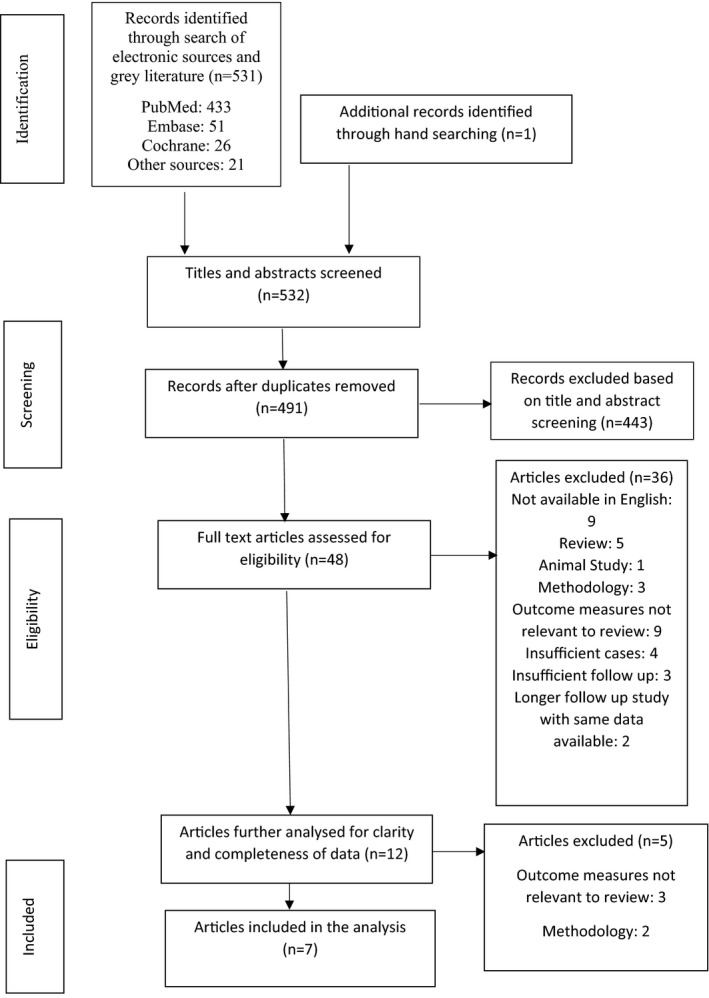
Results: Seven retrospective clinical studies were included. The studies reported high success rates for pulpotomy with overall success ranges for partial or complete pulpotomy ranging from 75% to 96%. One study compared the success rates of pulpotomy to an alternative treatment option pulp capping (90.9% vs. 67%, respectively). Due to the lack of homogeneity in the included studies, a meta-analysis was not possible.
Discussion: This review highlights the limited evidence based for the current guidance on treatment of complicated crown fractures. The findings of the review indicate high success rates for pulpotomy; however, there is a moderate risk of bias and small sample sizes in the included studies with the result that the overall results should be interpreted with caution.
Conclusion: Within the limitations of this review, the benefits and high success rates reported for partial pulpotomy suggest this procedure, rather than pulp-capping, should be considered as the treatment of choice for both immature and mature teeth that have suffered complicated crown-fractures.
Keywords: complicated crown fractures; dental trauma; follow-up; pulp exposure; pulpotomy; vital pulp therapy.
© 2022 The Authors. International Endodontic Journal published by John Wiley & Sons Ltd on behalf of British Endodontic Society.
Conflict of interest statement
The authors deny any conflict of interest related to this study.
Figures
References
-
- Abuelniel, G.M. , Duggal, M.S. & Kabel, N. (2020) A comparison of MTA and Biodentine as medicaments for pulpotomy in traumatized anterior immature permanent teeth: a randomized clinical trial. Dental Traumatology, 36, 400–410. - PubMed
-
- Alghaithy, R.A. & Qualtrough, A.J. (2017) Pulp sensibility and vitality tests for diagnosing pulpal health in permanent teeth: a critical review. International Endodontic Journal, 50, 135–142. - PubMed
-
- Al‐Nuaimi, N. , Ciapryna, S. , Chia, M. , Patel, S. & Mannocci, F. (2020) A prospective study on the effect of coronal tooth structure loss on the 4‐year clinical survival of root canal retreated teeth and retrospective validation of the Dental Practicality Index. International Endodontic Journal, 53, 1040–1049. - PubMed
-
- Alqaderi, H.E. , Al‐Mutawa, S.A. & Qudeimat, M.A. (2014) MTA pulpotomy as an alternative to root canal treatment in children's permanent teeth in a dental public health setting. Journal of Dentistry, 42, 1390–1395. - PubMed
Publication types
MeSH terms
LinkOut - more resources
Full Text Sources
