


Reduction and liquid-solid partitioning of SARS-CoV-2 and adenovirus throughout the different stages of a pilot-scale wastewater treatment plant
- PMID: 35077942
- PMCID: PMC8759026
- DOI: 10.1016/j.watres.2022.118069
Reduction and liquid-solid partitioning of SARS-CoV-2 and adenovirus throughout the different stages of a pilot-scale wastewater treatment plant
Abstract
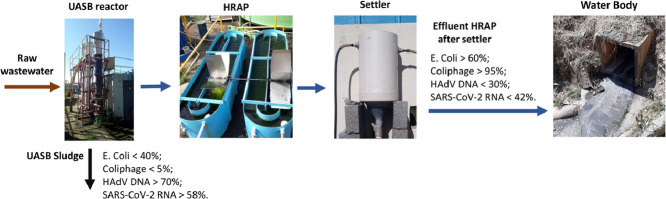
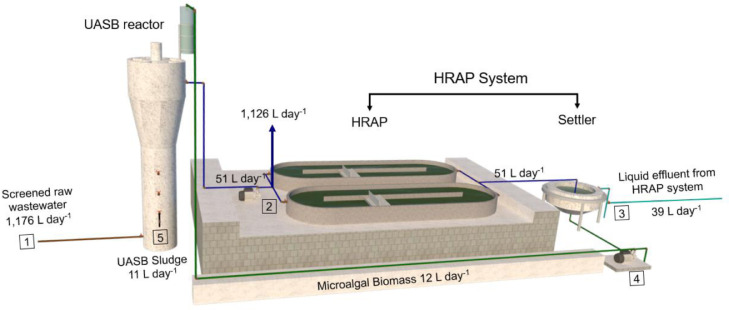
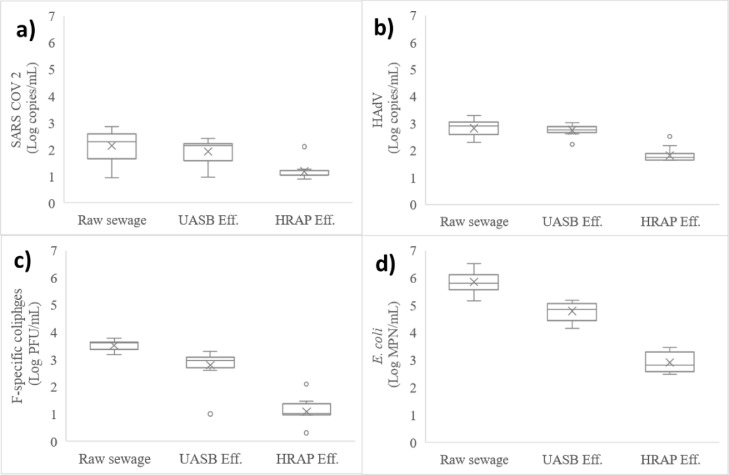
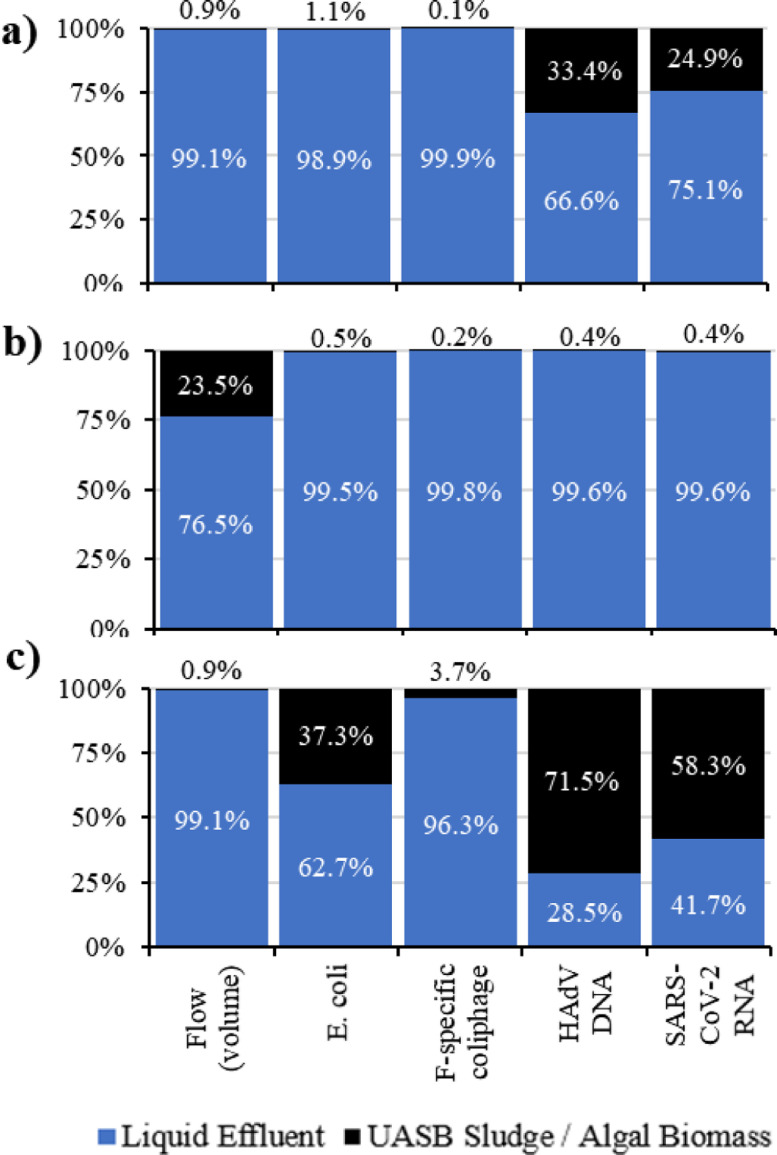
Investigating waterborne viruses is of great importance to minimizing risks to public health. Viruses tend to adsorb to sludge particles from wastewater processes by electrostatic and hydrophobic interactions between virus, aquatic matrix, and particle surface. Sludge is often re-used in agriculture; therefore, its evaluation is also of great interest to public health. In the present study, a pilot scale system treating real domestic wastewater from a large city in Brazil was used to evaluate the removal, the overall reduction, and liquid-solid partitioning of human adenovirus (HAdV), the novel coronavirus (SARS-CoV-2) and fecal indicators (F-specific coliphages and E. coli). The system consists of a high-rate algal pond (HRAP) post-treating the effluent of an upflow anaerobic sludge blanket (UASB) reactor. Samples were collected from the influent and effluent of each unit, as well as from the sludge of the UASB and from the microalgae biomass in the HRAP. Pathogens and indicators were quantified by quantitative polymerase chain reaction (qPCR) (for HAdV), qPCR with reverse transcription (RTqPCR) (for SARS-CoV-2), the double agar plaque assay (for coliphages), and the most probable number (MPN) method (for E. coli). The removal and overall reduction of HAdV and SARS-CoV-2 was greater than 1-log10. Almost 60% of remaining SARS-CoV-2 RNA and more than 70% of remaining HAdV DNA left the system in the sludge, demonstrating that both viruses may have affinity for solids. Coliphages showed a much lower affinity to solids, with only 3.7% leaving the system in the sludge. The system performed well in terms of the removal of organic matter and ammoniacal nitrogen, however tertiary treatment would be necessary to provide further pathogen reduction, if the effluent is to be reused in agriculture. To our knowledge, this is the first study that evaluated the reduction and partitioning of SARS-CoV-2 and HAdV through the complete cycle of a wastewater treatment system consisting of a UASB reactor followed by HRAPs.
Keywords: Adenovirus; High-rate algal ponds; SARS-CoV-2; Sewage; Sludge; UASB; Virus removal.
Copyright © 2022. Published by Elsevier Ltd.
Conflict of interest statement
The authors declare that they have no known competing financial interests or personal relationships that could have appeared to influence the work reported in this paper.
Figures
References
-
- Ahmed W., Angel N., Edson J., Bibby K., Bivins A., O'Brien J.W., Choi P.M., Kitajima M., Simpson S.L., Li J., Tscharke B., Verhagen R., Smith W.J.M., Zaugg J., Dierens L., Hugenholtz P., Thomas K.v., Mueller J.F. First confirmed detection of SARS-CoV-2 in untreated wastewater in Australia: a proof of concept for the wastewater surveillance of COVID-19 in the community. Sci. Total Environ. 2020;728 doi: 10.1016/j.scitotenv.2020.138764. - DOI - PMC - PubMed
-
- Ahmed W., Bertsch P., Bivins A., Bibby K., Farkas K., Gathercole A., Haramoto E., Gyawali P., Korajkic A., McMinn B.R., Mueller J., Simpson S., Smith W.J.M., Symonds E.M., Thomas K.v., Verhagen R., Kitajima M. Comparison of virus concentration methods for the RT-qPCR-based recovery of murine hepatitis virus, a surrogate for SARS-CoV-2 from untreated wastewater. Sci. Total Environ. 2020;739 doi: 10.1016/j.scitotenv.2020.139960. - DOI - PMC - PubMed
-
- Allard A. In: Global Water Pathogen Project. Rose J.B., Jiménez-Cisneros B., editors. UNE, Michigan State University; E. Lansing, MI: 2017. Adenoviruses.http://www.waterpathogens.org/book/adenoviruses (J.S Meschke, and R. G. (eds) P. 3V.(Ed.) (Ed.)
-
- APHA SMWW 9224 Detection of coliphages. 2017 doi: 10.2105/SMWW.2882.195. https://doi.org/ - DOI
MeSH terms
Substances
LinkOut - more resources
Full Text Sources
Medical
Miscellaneous
