. 2022 Apr;6(2):156-165.
doi: 10.1016/j.mayocpiqo.2022.01.003. Epub 2022 Jan 21.

Stroke Features, Risk Factors, and Pathophysiology in SARS-CoV-2-Infected Patients

Affiliations

Stroke Features, Risk Factors, and Pathophysiology in SARS-CoV-2-Infected Patients

Amir A Mbonde et al. Mayo Clin Proc Innov Qual Outcomes. 2022 Apr.

Abstract

Objective: To provide a comprehensive description of stroke characteristics, risk factors, laboratory parameters, and treatment in a series of severe acute respiratory syndrome coronavirus 2 (SARS-CoV-2)-infected patients admitted to Mayo Clinic hospitals in Rochester, Minnesota; Jacksonville, Florida; and Phoenix, Arizona, as well as the Mayo Clinic Health System.

Patients and methods: We retrospectively identified hospitalized patients in whom stroke and SARS-CoV-2 infection were diagnosed within the same 3-month interval between September 8, 2019, and December 31, 2020. and extracted data on all available variables of interest. We further incorporated our findings into the existing body of basic science research to present a schematic model illustrating the proposed pathogenesis of ischemic stroke in SARS-CoV-2-infected patients.

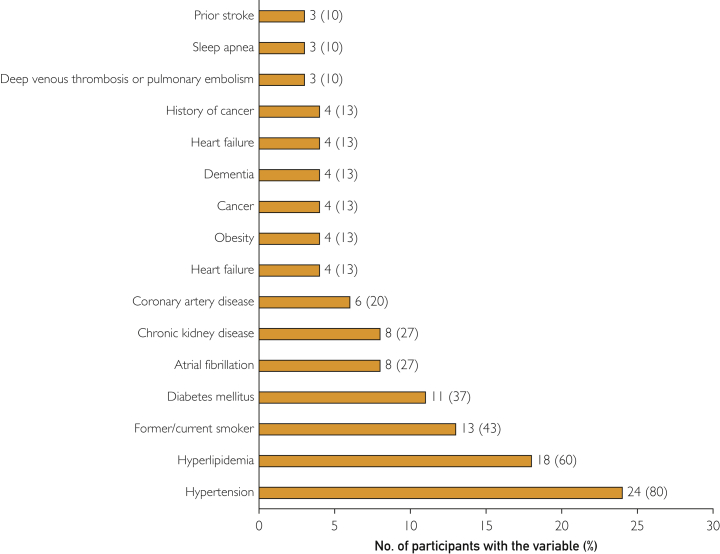
Results: We identified 30 cases during the study period, yielding a 0.5% stroke rate across 6381 SARS-CoV-2-infected hospitalized patients. Strokes were ischemic in 26 of 30 individuals and hemorrhagic in 4 of 30. Traditional risk factors were common including hypertension (24 of 30), hyperlipidemia (18 of 30), smoking history (13 of 30), diabetes (11 of 30), and atrial fibrillation (8 of 30). The most common ischemic stroke mechanisms were cardioembolism (9 of 26) and cryptogenic (9 of 26). Intravenous alteplase and mechanical thrombectomy were administered to 2 of 26 and 1 of 26, respectively. The median (interquartile range) serum C-reactive protein, interleukin-6, D-dimer, fibrinogen, and ferritin levels were 66 (21-210) mg/L, 116 (8-400) pg/mL, 1267 (556-4510) ng/mL, 711 (263-772) mg/dL, and 407 (170-757) mcg/L, respectively, which were elevated in individuals with available results.

Conclusion: The high prevalence of vascular risk factors and concurrent elevation of proinflammatory and procoagulation biomarkers suggest that there is an interplay between both factors in the pathogenesis of stroke in SARS-CoV-2-infected patients.

Keywords: COVID-19, coronavirus disease 2019; EC, endothelial cell; EMR, electronic medical record; IQR, interquartile range; RAAS, renin-angiotensin-aldosterone system; SARS-CoV-2, severe acute respiratory syndrome coronavirus 2.


Figures

Figure 1
Figure 1
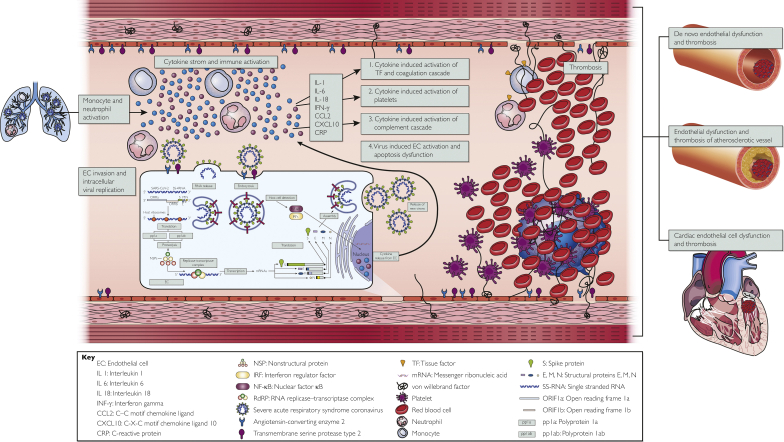
Schematic model illustrating the proposed pathogenesis of ischemic stroke in severe acute respiratory syndrome coronavirus 2–infected patients. Severe acute respiratory syndrome coronavirus 2 (SARS-CoV-2) binds to cells that express angiotensin-converting enzyme 2 and transmembrane protease serine 2 receptors such as alveolar epithelial cells and vascular endothelial cells. The infected host cells then release an initial set of cytokines and chemokines such as tumor necrosis factor, C-reactive protein, interleukin-1, and interleukin-6, which leads to the recruitment of macrophages and monocytes. These produce even more proinflammatory cytokines and eventually a cytokine storm. The resultant cytokine storm then leads to activation of tissue factor located on neutrophils, direct platelet activation, and endothelial cell damage. Endothelial cell damage leads to the release of more inflammatory cytokines, release of von Willebrand factor, and decreased production of nitrous oxide. These processes can lead to endotheliopathy and thrombosis in those with or without preexisting vascular risk factors. pp1a = polyprotein 1a; E, M, N = structural proteins E, M, N; mRNA = messenger ribonucleic acid; ORIFIa = open reading frame 1a; ORIFIb = open reading frame; pp1ab = polyprotein 1ab; S = spike protein; SS-RNA = single stranded RNA; TF = tissue factor.
Figure 2
Figure 2
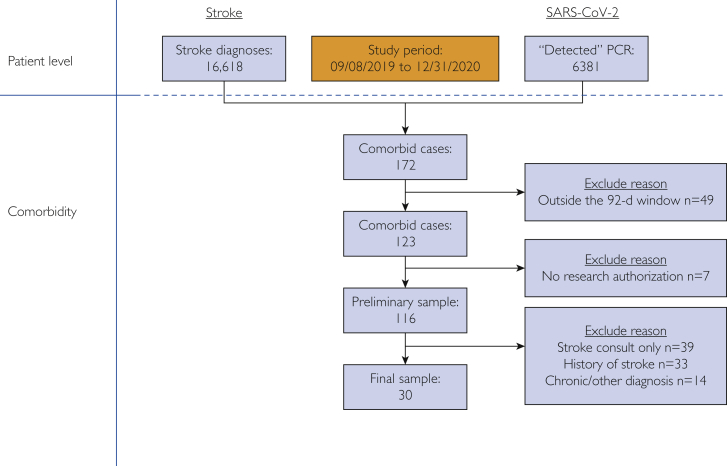
Flow diagram showing all included and excluded participants. SARS-CoV-2 = severe acute respiratory syndrome coronavirus 2.
Figure 3
Figure 3
Prevalence of vascular risk factors.
Supplementary figure 1

References

    1. Zhu N., Zhang D., Wang W., et al. for the China Novel Coronavirus Investigating and Research Team. A novel coronavirus from patients with pneumonia in China, 2019. N Engl J Med. 2020;382(8):727–733. - PMC - PubMed
    1. Washington N.L., Gangavarapu K., Zeller M., et al. Emergence and rapid transmission of SARS-CoV-2 B.1.1.7 in the United States. Cell. 2021;184(10):2587–2594.e2587. - PMC - PubMed
    1. Wang D., Hu B., Hu C., et al. Clinical characteristics of 138 hospitalized patients with 2019 novel coronavirus-infected pneumonia in Wuhan, China. JAMA. 2020;323(11):1061–1069. Published correction appears in JAMA. 2021;325(11):1113. - PMC - PubMed
    1. Paterson R.W., Brown R.L., Benjamin L., et al. The emerging spectrum of COVID-19 neurology: clinical, radiological and laboratory findings. Brain. 2020;143(10):3104–3120. - PMC - PubMed
    1. Varatharaj A., Thomas N., Ellul M.A., et al. CoroNerve Study Group Neurological and neuropsychiatric complications of COVID-19 in 153 patients: a UK-wide surveillance study. Lancet Psychiatry. 2020;7(10):875–882. Published correction appears in Lancet Psychiatry. 2020;7(10):e64. - PMC - PubMed