. 2022 Jun 15;225(12):2155-2162.
doi: 10.1093/infdis/jiac017.

Persistent Autoimmune Activation and Proinflammatory State in Post-Coronavirus Disease 2019 Syndrome

Affiliations

Persistent Autoimmune Activation and Proinflammatory State in Post-Coronavirus Disease 2019 Syndrome

Yeny Acosta-Ampudia et al. J Infect Dis. .

Abstract

Background: The immunopathological pathways enabling post-coronavirus disease 2019 (COVID-19) syndrome (PCS) development are not entirely known. We underwent a longitudinal analysis of patients with COVID-19 who developed PCS aiming to evaluate the autoimmune and immunological status associated with this condition.

Methods: Thirty-three patients were included for longitudinal clinical and autoantibody analyses, 12 of whom were assessed for cytokines and lymphocyte populations. Patients were followed for 7-11 months after acute COVID-19. Autoimmune profile and immunological statuses were evaluated mainly by enzyme-linked-immunosorbent assays and flow cytometry.

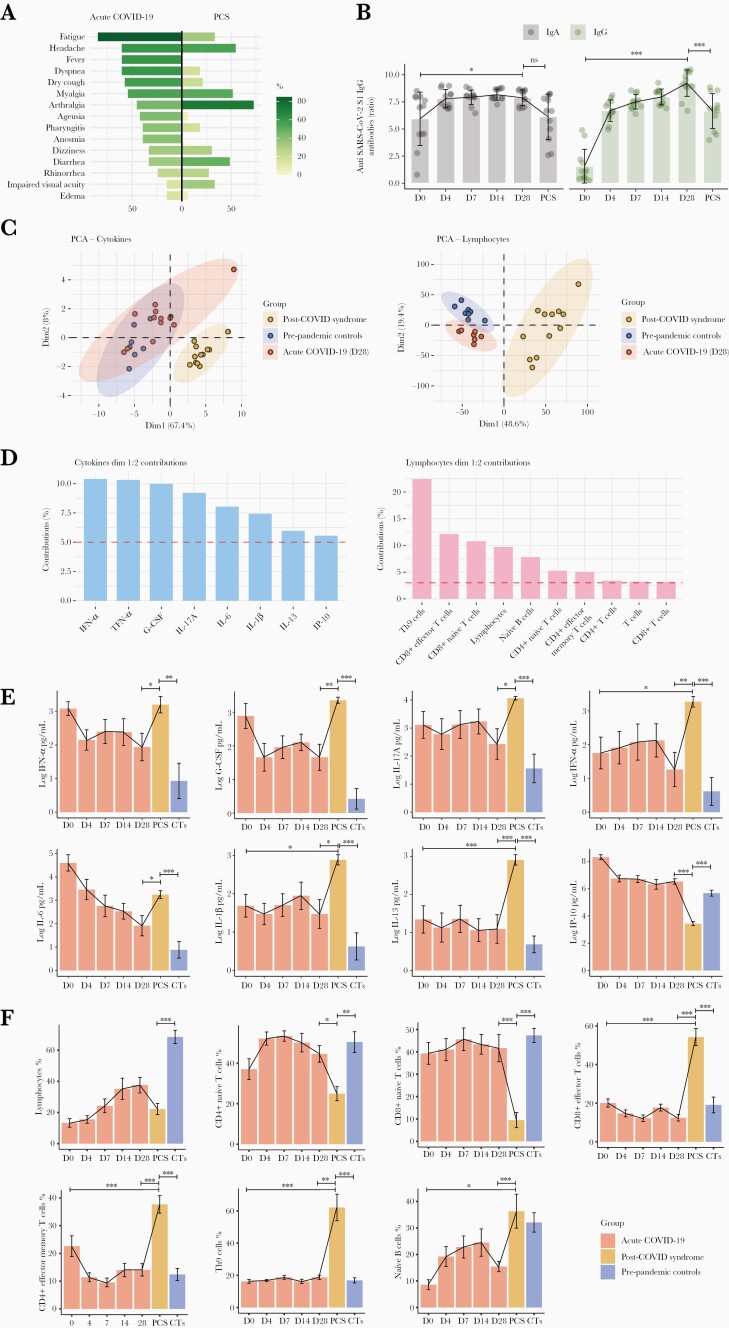
Results: Latent autoimmunity and overt autoimmunity persisted over time. A proinflammatory state was observed in patients with PCS characterized by up-regulated interferon-α, tumor necrosis factor-α, granulocyte colony-stimulating factor (G-CSF), interleukin (IL)-17A, IL-6, IL-1β, and IL-13, whereas interferon-γ-induced protein 10 (IP-10) was decreased. In addition, PCS was characterized by increased levels of Th9, CD8+ effector T cells, naive B cells, and CD4+ effector memory T cells. Total levels of immunoglobulin G S1-severe acute respiratory syndrome coronavirus 2 (SARS-CoV-2) antibodies remained elevated over time.

Conclusions: The clinical manifestations of PCS are associated with the persistence of a proinflammatory and effector phenotype induced by SARS-CoV-2 infection. This long-term persistent immune activation may contribute to the development of latent and overt autoimmunity. Results suggest the need to evaluate the role of immunomodulation in the treatment of PCS.

Keywords: COVID-19; autoimmunity; long COVID; naive B cells; post-COVID syndrome.


Figures

Figure 1.
Figure 1.
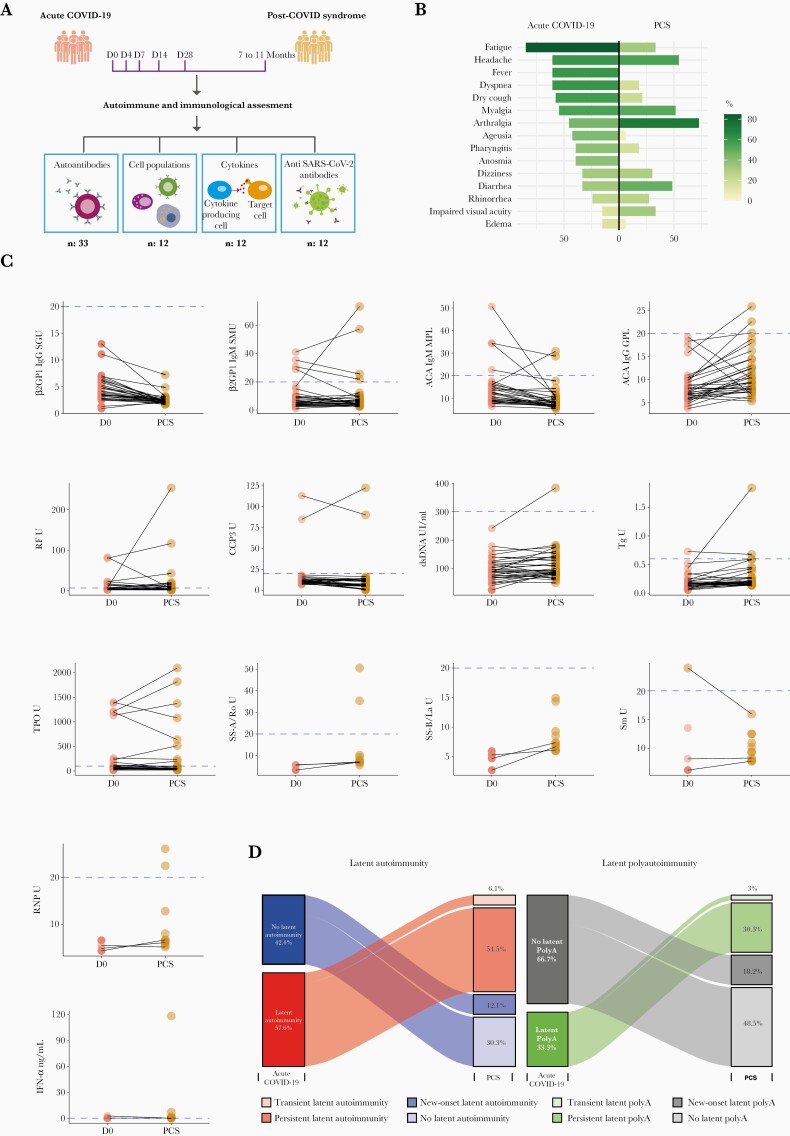
Autoimmune assessment of post-coronavirus disease 2019 (COVID-19) syndrome (PCS). (A) Study design. Patients assessed for autoantibodies were followed 7–11 months postinfection (n: 33). Patients evaluated for cytokines, lymphocytes, immunoglobulin (Ig)G, and IgA S1-severe acute respiratory syndrome coronavirus 2 (SARS-CoV-2) antibodies were followed 7–9 months postinfection (n: 12). (B) Mirrored bar plot for symptoms on acute COVID-19 and PCS (n: 33). (C) Paired dot plot for concentration of autoantibodies. Dashed blue line represents cutoff values for positivity of each autoantibody (by their respective enzyme-linked-immunosorbent assay thresholds). (D) Alluvial diagrams for latent autoimmunity and overt autoimmunity. ACAs, Anti-cardiolipin antibodies; β2GPI, β2 glycoprotein-1; CCP3, Cyclic citrullinated peptide third-generation; dsDNA, Double-stranded DNA; IFN-α, Interferon-α; PolyA, Polyautoimmunity; RF, Rheumatoid factor; RNP, Ribonucleoprotein; Sm, Smith; Tg, Thyroglobulin.
Figure 2.
Figure 2.
Immunological assessment of post-coronavirus disease 2019 (COVID-19) syndrome (PCS). (A) Mirrored bar plot for symptoms of acute COVID-19 and post-COVID syndrome (n: 12). (B) Dynamics of the severe acute respiratory syndrome coronavirus 2 (SARS-CoV-2) antibody response and the change in anti-SARS-CoV-2 immunoglobulin (Ig)A and IgG ratios (OD sample/OD calibrator) were plotted against days of follow-up. None of these patients were vaccinated during the follow-up. (C) Principal component analysis (PCA) of 20 cytokines and 30 cell subsets that were analyzed in prepandemic controls (n: 8), acute COVID-19 (n: 12), and PCS (n: 12). (D) Contribution of cytokines and lymphocytes on dimensions 1 and 2 from principal component analyses. Thresholds for cytokines 5% (1/20 cytokines = 5%), and lymphocytes (1/30 populations = 3.3%). (E) Longitudinal bar plots for selected cytokines in prepandemic controls (n: 8), acute COVID-19 (n: 12), and PCS (n: 12). Longitudinal analyses were done by generalized linear models with post hoc comparisons adjusted by Bonferroni correction. Comparisons between prepandemic controls and PCS were analyzed by means of linear regression with post hoc comparison. (F) Longitudinal bar plots for selected lymphocyte populations in prepandemic controls (n: 8), acute COVID-19 (n: 12), and PCS (n: 12). Longitudinal analyses were done by generalized linear models with post hoc comparisons adjusted by Bonferroni correction. Comparisons between prepandemic controls and PCS were analyzed by means of linear regression with post hoc comparison. ∗∗∗, P < .0001; ∗∗, P < .0010; ∗P < .0500. CTs, Prepandemic controls; D, Days; G-CSF, Granulocyte colony-stimulating factor; IFN, Interferon; IL, Interleukin; IP-10, Interferon-γ-induced protein 10; ns, Not significant; TNF-α, Tumor necrosis factor-alpha.

Comment in

References

    1. Dhama K, Khan S, Tiwari R, et al. Coronavirus disease 2019–COVID-19. Clin Microbiol Rev 2020; 33:e00028–20. - PMC - PubMed
    1. Anaya J-M, Rojas M, Salinas ML, et al. Post-COVID syndrome. A case series and comprehensive review. Autoimmun Rev 2021; 20:102947. - PMC - PubMed
    1. Jacobs JJL. Persistent SARS-2 infections contribute to long COVID-19. Med Hypotheses 2021; 149:110538. - PMC - PubMed
    1. Mongioì LM, Barbagallo F, Condorelli RA, et al. Possible long-term endocrine-metabolic complications in COVID-19: lesson from the SARS model. Endocrine 2020; 68:467–70. - PMC - PubMed
    1. Fogarty H, Townsend L, Morrin H, et al. Persistent endotheliopathy in the pathogenesis of long COVID syndrome. J Thromb Haemost 2021; 19:2546–53. - PMC - PubMed

Publication types