Multicenter Study
. 2022 Jan;9(1):e001783.
doi: 10.1136/openhrt-2021-001783.

Uncovering the treatable burden of severe aortic stenosis in the UK

Affiliations
Multicenter Study

Uncovering the treatable burden of severe aortic stenosis in the UK

Geoffrey A Strange et al. Open Heart. 2022 Jan.

Abstract

Objective: To estimate the population prevalence and treatable burden of severe aortic stenosis (AS) in the UK.

Methods: We adapted a contemporary model of the population profile of symptomatic and asymptomatic severe AS in Europe and North America to estimate the number of people aged ≥55 years in the UK who might benefit from surgical aortic valve replacement (SAVR) or transcatheter aortic valve implantation (TAVI).

Results: With a point prevalence of 1.48%, we estimate that 291 448 men and women aged ≥55 years in the UK had severe AS in 2019. Of these, 68.3% (199 059, 95% CI 1 77 201 to 221 355 people) would have been symptomatic and, therefore, more readily treated according to their surgical risk profile; the remaining 31.7% of cases (92 389, 95% CI 70 093 to 144 247) being asymptomatic. Based on historical patterns of intervention, 58.4% (116 251, 95% CI 106 895 to 1 25 606) of the 199 059 symptomatic cases would qualify for SAVR, with 7208 (95% CI 7091 to 7234) being assessed as being in a high, preoperative surgical risk category. Among the remaining 41.6% (82 809, 95% CI 73 453 to 92 164) of cases potentially unsuitable for SAVR, an estimated 61.7% (51 093, 95% CI 34 780 to 67 655) might be suitable for TAVI. We estimate that 172 859 out of 291 448 prevalent cases of severe AS (59.3%) will subsequently die within 5 years without proactive management.

Conclusions: These data suggest a high burden of severe AS in the UK requiring surgical or transcatheter intervention that challenges the ongoing capacity of the National Health Service to meet the needs of those affected.

Keywords: aortic valve stenosis; cardiac surgical procedures; transcatheter aortic valve replacement.


Conflict of interest statement

Competing interests: GS: Research grants: Actelion, Bayer, Edwards, GSK, Jensen, Novartis. Consultancies: Edwards, Echo IQ, NEDA Ltd. SS: Research grants: Actelion, Bayer, Edwards, GSK, Jensen, Novartis. NC: Research grants: Boston Scientific, HeartFlow, Beckmann Coulter. Speaker Fees/Consultancy: HeartFlow, Abbott, Edwards. Travel Sponsorship: HeartFlow, Boston Scientific, Biosensors, Medtronic, Edwards. PB: Honoraria: Edwards Lifesciences and Atricure Ltd. DP: Research grants: Actelion, Bayer, Edwards, GSK, Jensen, Novartis. HHG: Consultancies: Wilmington Healthcare, Edwards Lifesciences, Heart Valve Voice.

Figures
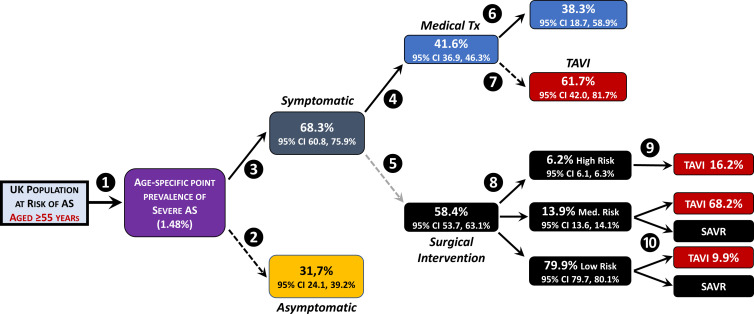
Figure 1
Figure 1
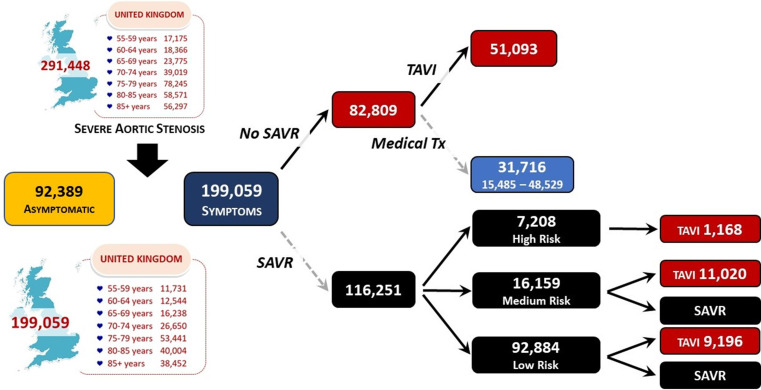
Summary model used to derive treatable burden of disease for severe aortic stenosis (AS) in the UK. To generate our estimates, we first identified the number of individuals aged ≥55 years within the UK population (ie, those most at risk of developing severe AS) and then applied age-specific prevalence rates to this population to determine the total number of cases with severe AS (regardless of their symptomatic or surgical risk status) ❶. These cases were then divided into those most likely to be asymptomatic ❷ or symptomatic ❸. Based on the assumption that symptomatic cases would most likely be detected and, according to current guidelines, be most likely to be considered for treatment, this ‘symptomatic severe AS’ group was then divided into those who might be initially considered for medical ❹ versus surgical management ❺. The former was divided into those who would continue to receive conservative medical management ❻ versus those who might benefit from the increasingly accessible option of transcatheter aortic valve implantation (TAVI) ❼. The initially identified surgical cases were then divided according to their surgical risk profile ❽ with further stratification of this subgroup according to what proportion of high-risk surgical/surgical aortic valve replacement (SAVR) cases might benefit from TAVI ❾ and, similarly, what proportion of low-to-medium risk individuals being considered for SAVR might undergo TAVI instead ❿. For each estimate point from 2 to 10, the equivalent proportion (and 95% CI) applied in the original flowchart was applied.
Figure 2
Figure 2
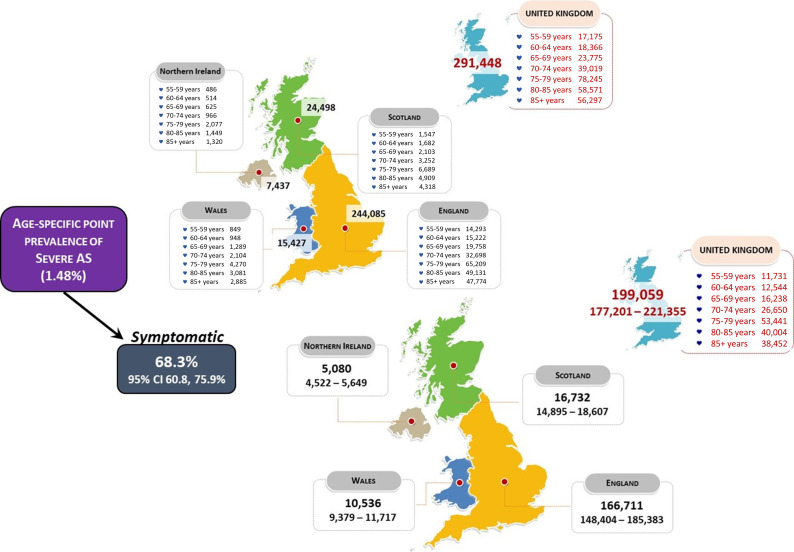
Estimated point prevalence of severe (symptomatic) aortic stenosis (AS) in the UK (2019). This figure shows the estimated prevalence of severe AS across the UK in those aged ≥55 years when applying age-specific prevalence rates (top panel—overall prevalence of 1.48% as per purple box) in addition to those with symptoms (symptomatic rate with 95% CI shown in dark blue box—bottom panel). All numbers are subject to rounding from the Office of National Statistics data
Figure 3
Figure 3
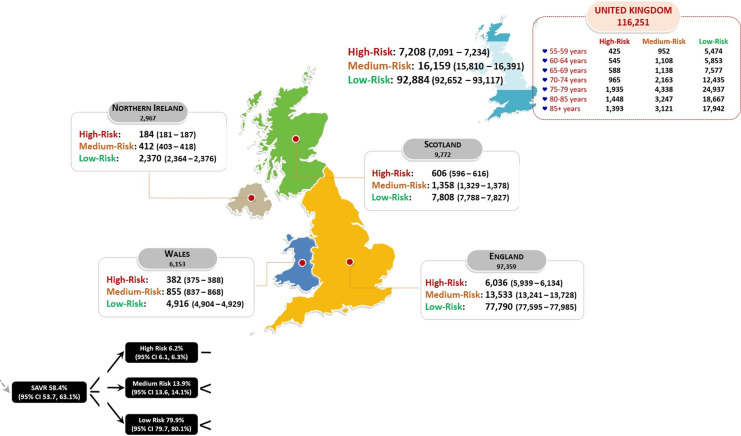
Estimated cases of severe, symptomatic aortic stenosis (AS) in the UK considered for surgical aortic valve replacement (SAVR) (2019). This figure shows the estimated number (with 95% CI) of prevalent cases of symptomatic, severe AS aged ≥55 years who would be considered for SAVR according to their STS-PROM risk category (rates provided in black boxes).
Figure 4
Figure 4
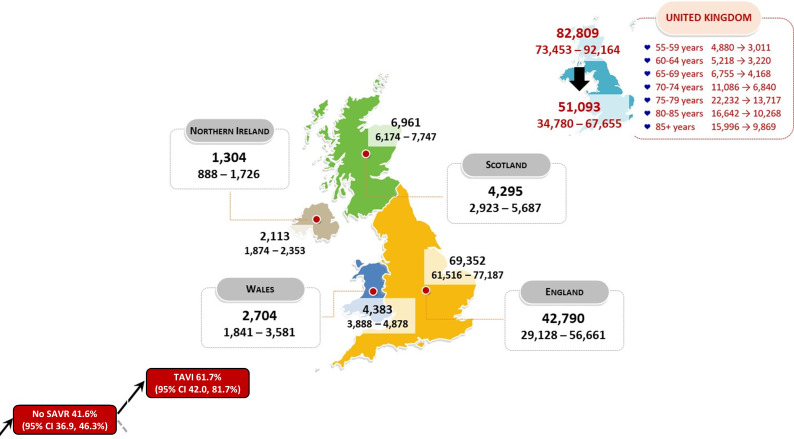
Estimated cases of severe, symptomatic aortic stenosis (AS) in the UK considered for transcatheter aortic valve implantation (TAVI) (2019). This figure shows the estimated number (with 95% CI) of prevalent cases aged ≥55 years who would be considered too high risk for surgical aortic valve replacement (SAVR) but instead be potential candidates for TAVI (sequential estimate rates for both provided in the red boxes).
Figure 5
Figure 5
Summary of the estimated (prevalent) burden and management of severe aortic stenosis (AS) in the UK (2019). SAVR, surgical aortic valve replacement; TAVI, transcatheter aortic valve implantation.

References

    1. Nkomo VT, Gardin JM, Skelton TN, et al. Burden of valvular heart diseases: a population-based study. Lancet 2006;368:1005–11. 10.1016/S0140-6736(06)69208-8 - DOI - PubMed
    1. Beyersdorf F, Praz F, Milojevic M. 2021 ESC/EACTS guidelines for the management of valvular heart disease. Eur Heart J 2021;00:1–72. - PubMed
    1. d'Arcy JL, Coffey S, Loudon MA, et al. Large-scale community echocardiographic screening reveals a major burden of undiagnosed valvular heart disease in older people: the OxVALVE population cohort study. Eur Heart J 2016;37:3515–22. 10.1093/eurheartj/ehw229 - DOI - PMC - PubMed
    1. Nchimi A, Dibato JE, Davin L, et al. Predicting disease progression and mortality in aortic stenosis: a systematic review of imaging biomarkers and meta-analysis. Front. Cardiovasc. Med. 2018;5:112. 10.3389/fcvm.2018.00112 - DOI - PMC - PubMed
    1. Stewart S, Chan Y-K, Playford D, et al. Incident aortic stenosis in 49 449 men and 42 229 women investigated with routine echocardiography. Heart 2021;8:heartjnl-2021-319697. 10.1136/heartjnl-2021-319697 - DOI - PubMed

Publication types