


Differential Effects of One Meal per Day in the Evening on Metabolic Health and Physical Performance in Lean Individuals
- PMID: 35087416
- PMCID: PMC8787212
- DOI: 10.3389/fphys.2021.771944
Differential Effects of One Meal per Day in the Evening on Metabolic Health and Physical Performance in Lean Individuals
Abstract
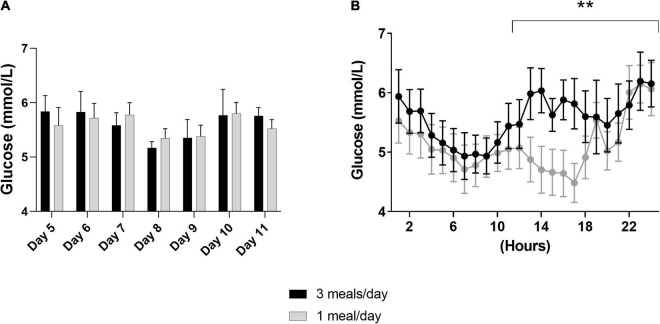
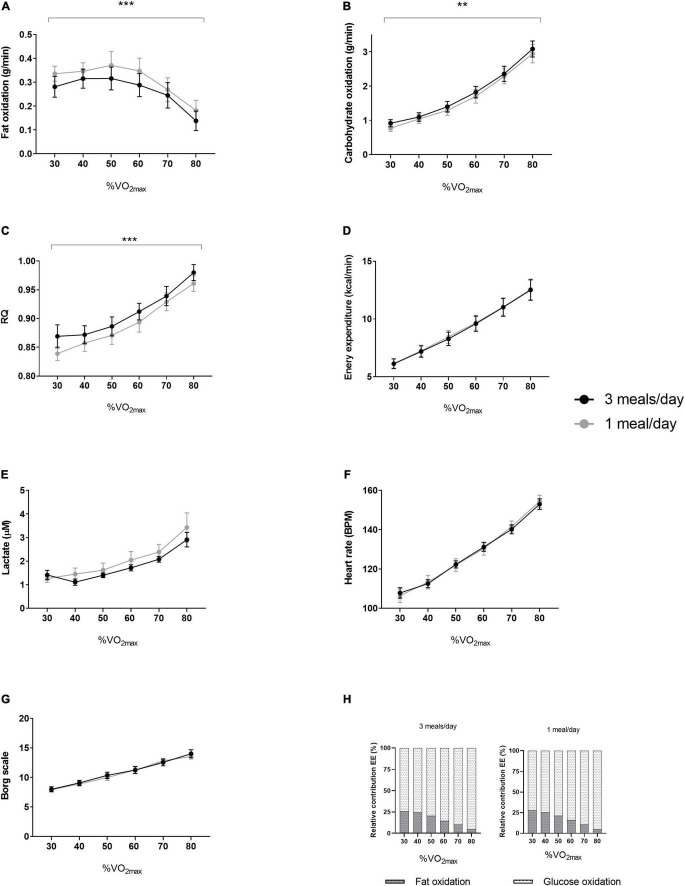
Background: Generally, food intake occurs in a three-meal per 24 h fashion with in-between meal snacking. As such, most humans spend more than ∼ 12-16 h per day in the postprandial state. It may be reasoned from an evolutionary point of view, that the human body is physiologically habituated to less frequent meals. Metabolic flexibility (i.e., reciprocal changes in carbohydrate and fatty acid oxidation) is a characteristic of metabolic health and is reduced by semi-continuous feeding. The effects of time-restricted feeding (TRF) on metabolic parameters and physical performance in humans are equivocal. Methods: To investigate the effect of TRF on metabolism and physical performance in free-living healthy lean individuals, we compared the effects of eucaloric feeding provided by a single meal (22/2) vs. three meals per day in a randomized crossover study. We included 13 participants of which 11 (5 males/6 females) completed the study: age 31.0 ± 1.7 years, BMI 24.0 ± 0.6 kg/m2 and fat mass (%) 24.0 ± 0.6 (mean ± SEM). Participants consumed all the calories needed for a stable weight in either three meals (breakfast, lunch and dinner) or one meal per day between 17:00 and 19:00 for 11 days per study period. Results: Eucaloric meal reduction to a single meal per day lowered total body mass (3 meals/day -0.5 ± 0.3 vs. 1 meal/day -1.4 ± 0.3 kg, p = 0.03), fat mass (3 meals/day -0.1 ± 0.2 vs. 1 meal/day -0.7 ± 0.2, p = 0.049) and increased exercise fatty acid oxidation (p < 0.001) without impairment of aerobic capacity or strength (p > 0.05). Furthermore, we found lower plasma glucose concentrations during the second half of the day during the one meal per day intervention (p < 0.05). Conclusion: A single meal per day in the evening lowers body weight and adapts metabolic flexibility during exercise via increased fat oxidation whereas physical performance was not affected.
Keywords: bile acids; energy expentidure; glucose; human; physical performance; postprandial metabolism; time restricted eating; time restricted feeding.
Copyright © 2022 Meessen, Andresen, van Barneveld, van Riel, Johansen, Kolnes, Kemper, Olde Damink, Schaap, Romijn, Jensen and Soeters.
Conflict of interest statement
The authors declare that the research was conducted in the absence of any commercial or financial relationships that could be construed as a potential conflict of interest.
Figures
References
-
- Beregning av kaloribehov—NHI.no (2021). Available online at: https://nhi.no/skjema-og-kalkulatorer/kalkulatorer/diverse/beregning-av-... (accessed June 11, 2020).
-
- Borg G. A. (1982). Psychophysical bases of perceived exertion. Med. Sci. Sports Exerc. 14 377–381. - PubMed
-
- Bouguerra L., Ben Abderrahman A., Chtourou H., Zouhal H., Tabka Z., Prioux J. (2017). The effect of time-of-day of training during Ramadan on physiological parameters in highly trained endurance athletes. Biol. Rhythm Res. 48 541–555. 10.1080/09291016.2016.1276271 - DOI
LinkOut - more resources
Full Text Sources
Research Materials
