


Social Media Platforms Listening Study on Atopic Dermatitis: Quantitative and Qualitative Findings
- PMID: 35089160
- PMCID: PMC8838596
- DOI: 10.2196/31140
Social Media Platforms Listening Study on Atopic Dermatitis: Quantitative and Qualitative Findings
Abstract
Background: Atopic dermatitis (AD) is a chronic, pruritic, inflammatory disease that occurs most frequently in children but also affects many adults. Social media have become key tools for finding and disseminating medical information.
Objective: The aims of this study were to identify the main themes of discussion, the difficulties encountered by patients with respect to AD, the impact of the pathology on quality of life (QoL; physical, psychological, social, or financial), and to study the perception of patients regarding their treatment.
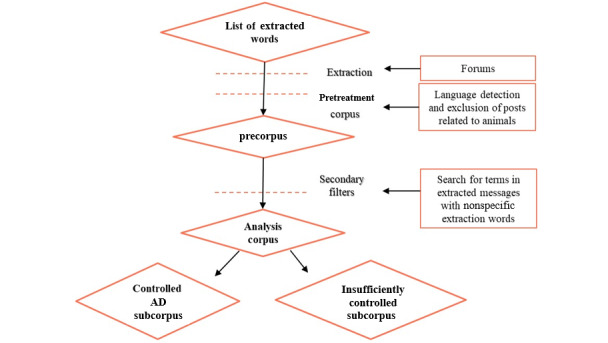
Methods: A retrospective study was carried out by collecting social media posts in French language written by internet users mentioning their experience with AD, their QoL, and their treatments. Messages related to AD discomfort posted between July 1, 2010, and October 23, 2020, were extracted from French-speaking publicly available online forums. Automatic and manual extractions were implemented to create a general corpus and 2 subcorpuses depending on the level of control of the disease.
Results: A total of 33,115 messages associated with AD were included in the analysis corpus after extraction and cleaning. These messages were posted by 15,857 separate web users, most of them being women younger than 40 years. Tips to manage AD and everyday hygiene/treatments were among the most discussed topics for controlled AD subcorpus, while baby-related topics and therapeutic failure were among the most discussed topics for insufficiently controlled AD subcorpus. QoL was discussed in both subcorpuses with a higher proportion in the controlled AD subcorpus. Treatments and their perception were also discussed by web users.
Conclusions: More than just emotional or peer support, patients with AD turn to online forums to discuss their health. Our findings show the need for an intersection between social media and health care and the importance of developing new approaches such as the Atopic Dermatitis Control Tool, which is a patient-related disease severity assessment tool focused on patients with AD.
Keywords: Atopic Dermatitis Control Tool; atopic dermatitis; dermatology; health care; health-related quality of life; online health; online health information; real world; skin disease; social media; social media use.
©Paméla Voillot, Brigitte Riche, Michel Portafax, Pierre Foulquié, Anaïs Gedik, Sébastien Barbarot, Laurent Misery, Stéphane Héas, Adel Mebarki, Nathalie Texier, Stéphane Schück. Originally published in the Journal of Medical Internet Research (https://www.jmir.org), 28.01.2022.
Conflict of interest statement
Conflicts of Interest: BR and MP have disclosed that they are employees of Sanofi Genzyme, and may hold shares or stock options in the company. PV, PF, AG, AM, NT, and SS have disclosed that they are employees of Kap Code, a CRO, having a contract with Sanofi Genzyme to carry out this study. SB works with Almirall, Sanofi-Genzyme, Abbvie, Novartis, Janssen, Leo-Pharma, Pfizer, Eli Lilly, UCB Pharma, and Chiesi.
Figures



References
-
- Eichenfield LF, Tom WL, Berger TG, Krol A, Paller AS, Schwarzenberger K, Bergman JN, Chamlin SL, Cohen DE, Cooper KD, Cordoro KM, Davis DM, Feldman SR, Hanifin JM, Margolis DJ, Silverman RA, Simpson EL, Williams HC, Elmets CA, Block J, Harrod CG, Smith Begolka W, Sidbury R. Guidelines of care for the management of atopic dermatitis: section 2. Management and treatment of atopic dermatitis with topical therapies. J Am Acad Dermatol. 2014 Jul;71(1):116–32. doi: 10.1016/j.jaad.2014.03.023. http://europepmc.org/abstract/MED/24813302 S0190-9622(14)01257-2 - DOI - PMC - PubMed
-
- Berke R, Singh A, Guralnick M. Atopic dermatitis: an overview. Am Fam Physician. 2012 Jul 01;86(1):35–42. https://www.aafp.org/link_out?pmid=22962911 d10377 - PubMed
-
- Drucker AM, Wang AR, Li W, Sevetson E, Block JK, Qureshi AA. The Burden of Atopic Dermatitis: Summary of a Report for the National Eczema Association. J Invest Dermatol. 2017 Jan;137(1):26–30. doi: 10.1016/j.jid.2016.07.012. https://linkinghub.elsevier.com/retrieve/pii/S0022-202X(16)32120-0 S0022-202X(16)32120-0 - DOI - PubMed
Publication types
MeSH terms
LinkOut - more resources
Full Text Sources
