Lymphatic Pain in Breast Cancer Survivors
- PMID: 35089817
- PMCID: PMC9603252
- DOI: 10.1089/lrb.2021.0017
Lymphatic Pain in Breast Cancer Survivors
Abstract
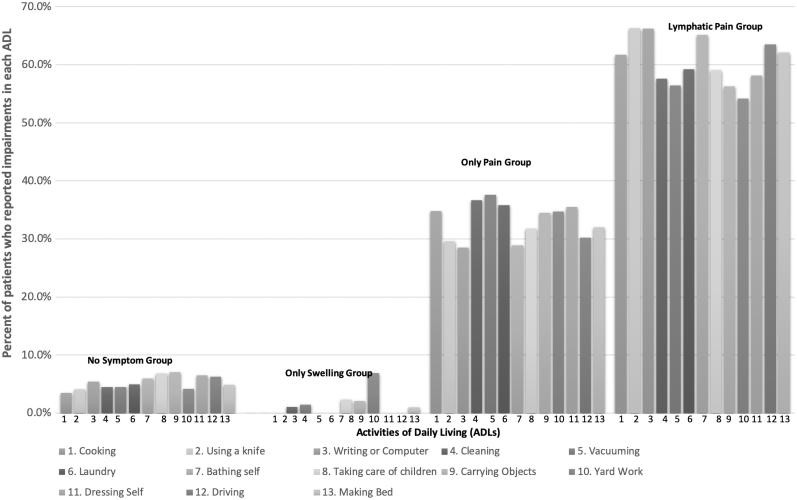
Background: Breast cancer survivors who report chronic pain in the affected ipsilateral upper limb or body are nearly twice as likely to develop lymphedema. Little is known about lymphatic pain, defined as co-occurring pain and swelling in the affected ipsilateral upper limb or body. The study aimed to examine the predictors and effects of lymphatic pain on breast cancer survivors' activities of daily living (ADLs). Materials and Methods: A sample of 568 patients was recruited in a metropolitan cancer center in the United States. Demographic and clinical data were collected. Body mass index (BMI) and limb volume were measured using infra-red perometer. Lymphatic pain and ADLs were measured by the Lymphedema and Breast Cancer Symptom Experience Index. Parametric and nonparametric tests and generalized linear models were used to analyze data. Results: Lymphatic pain affected 33% of survivors. Significant predictors of lymphatic pain included younger age, higher BMI, financial hardship, and a diagnosis of lymphedema. Patients with a diagnosis of lymphedema had 9.68 odds (confidence interval [CI]: 5.78-16.63; p < 0.001) and those with financial hardship had 4.64 odds (CI: 1.99-11.32; p = 0.001) of experiencing lymphatic pain. Patients with lymphatic pain had more impairments in ADLs (p < 0.001) compared to patients with only pain, only swelling, and no symptoms. Significantly more patients with lymphatic pain had a limb volume difference of >5% and >10% compared to patients with only pain and no symptom. Conclusion: This study is the first to report that in a large sample of patients, 33.1% experienced lymphatic pain and that lymphatic pain was associated with significant impairments in ADLs. Findings suggest that lymphatic pain may be due to abnormal accumulation of lymph fluid. Research is needed to ascertain the physiological mechanisms that underlie lymphatic pain and determine whether strategies to prevent and treat lymphedema can decrease lymphatic pain.
Keywords: activities of daily living; breast cancer; limb volume; lymph fluid; lymph fluid accumulation; lymphatic pain; lymphedema; pain.
Conflict of interest statement
No competing financial interests exist.
Figures
References
-
- Breast Cancer Facts & Figures 2019–2020. Atlanta: American Cancer Society https://www.cancer.org/content/dam/cancer-org/research/cancer-facts-and-... Accessed June 18, 2020.