


Effects of non-aversive versus tail-lift handling on breeding productivity in a C57BL/6J mouse colony
- PMID: 35089969
- PMCID: PMC8797240
- DOI: 10.1371/journal.pone.0263192
Effects of non-aversive versus tail-lift handling on breeding productivity in a C57BL/6J mouse colony
Abstract
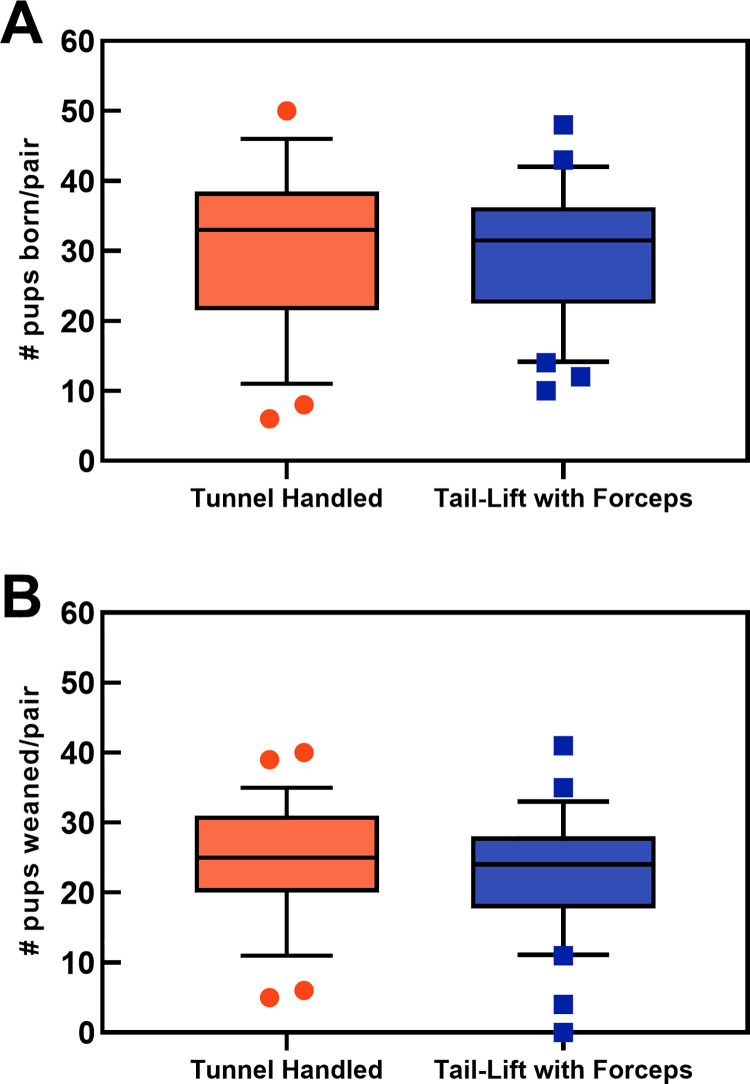
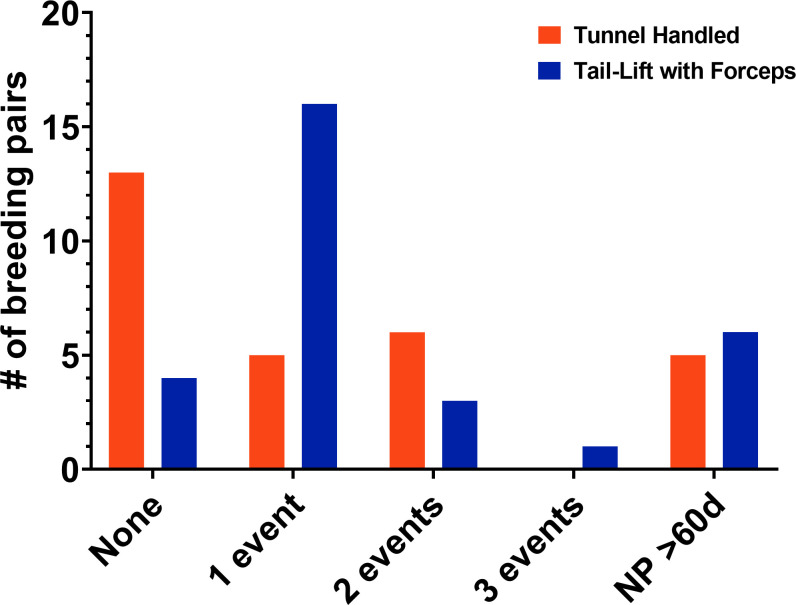
Non-aversive handling is a well-documented refinement measure for improving rodent welfare. Because maternal stress is related to reduced productivity, we hypothesized that welfare benefits associated with non-aversive handling would translate to higher production and fewer litters lost in a laboratory mouse breeding colony. We performed a randomized controlled trial to examine the effects of a standard method of handling (tail-lift with forceps) versus non-aversive handling with transfer tunnels ('tunnel-handled') on breeding performance in 59 C57BL/6J mouse pairs. Intervention assignments could not be concealed from technicians, but were concealed from assessors and data analyst. An operationally significant effect of tunnel-handling (large enough differences to warrant programmatic change) was defined before study initiation as a 5% increase in productivity, or one extra pup over the reproductive lifetime of each pair. Pairs were randomly allocated to handling intervention and cage rack location, and monitored over an entire 6-month breeding cycle. For each group, we measured number of pups born and weaned, and number of entire litters lost prior to weaning. Differences between transfer methods were estimated by two-level hierarchical mixed models adjusted for parental effects and parity. Compared to tail-lift mice, tunnel-handled mice averaged one extra pup per pair born (+1.0; 95% CI 0.9, 1.1; P = 0.41) and weaned (+1.1, 95% CI 0.9, 1.2; P = 0.33). More tunnel-handled pairs successfully weaned all litters produced (13/29 pairs, 45% vs 4/30 pairs, 13%; P = 0.015), averaged fewer litter losses prior to weaning (11/29 pairs [38%] vs 26/30 pairs [87%]; P <0.001), and had a 20% lower risk of recurrent litter loss. The increase in numbers of pups produced and weaned with tunnel handling met threshold requirement for operational significance. These data and projected cost savings persuaded management to incorporate tunnel handling as standard of care across the institution. These data also suggest that overlooked husbandry practices such as cage transfer may be major confounders in studies of mouse models.
Conflict of interest statement
The authors have declared that no competing interests exist.
Figures
References
-
- Doerning C.M., Thurston S.E., Villano J.S., Kaska C.L., Vozheiko T.D., Soleimanpour S.A., et al.. Assessment of Mouse Handling Techniques During Cage Changing. Journal of the American Association for Laboratory Animal Science. 2019;58(6):767–73. doi: 10.30802/AALAS-JAALAS-19-000015 - DOI - PMC - PubMed
MeSH terms
LinkOut - more resources
Full Text Sources
Miscellaneous
