. 2022 Feb 1;119(5):e2120134119.
doi: 10.1073/pnas.2120134119.

Valence opponency in peripheral olfactory processing

Affiliations

Valence opponency in peripheral olfactory processing

Shiuan-Tze Wu et al. Proc Natl Acad Sci U S A. .

Abstract

A hallmark of complex sensory systems is the organization of neurons into functionally meaningful maps, which allow for comparison and contrast of parallel inputs via lateral inhibition. However, it is unclear whether such a map exists in olfaction. Here, we address this question by determining the organizing principle underlying the stereotyped pairing of olfactory receptor neurons (ORNs) in Drosophila sensory hairs, wherein compartmentalized neurons inhibit each other via ephaptic coupling. Systematic behavioral assays reveal that most paired ORNs antagonistically regulate the same type of behavior. Such valence opponency is relevant in critical behavioral contexts including place preference, egg laying, and courtship. Odor-mixture experiments show that ephaptic inhibition provides a peripheral means for evaluating and shaping countervailing cues relayed to higher brain centers. Furthermore, computational modeling suggests that this organization likely contributes to processing ratio information in odor mixtures. This olfactory valence map may have evolved to swiftly process ethologically meaningful odor blends without involving costly synaptic computation.

Keywords: countervailing cues; olfactory receptor neurons (ORNs); olfactory sensilla; sensory map; valence opponency.


Conflict of interest statement

The authors declare no competing interest.

Figures

Fig. 1.
Fig. 1.
Valence opponency in place preference. (A) (Top) Optogenetic place preference assay. Inset: Single-sensillum recording; ab1C responded to a 500-ms pulse of 635-nm light. (Bottom) Collective distribution probability along the arena; the illuminated side was adjusted to be on the right (n = 10). (B) Average place preference over time when ab1C was optogenetically activated. Shaded area, SEM. (CH) Violin plots showing preference indices to the illuminated side when CsChrimson was expressed in the indicated ORN types. Sample traces of single-sensillum recordings were shown to demonstrate optogenetic activation of target ORNs. Circle: average PI from three trials of each experiment; horizontal line: median preference. Negative controls were age-matched siblings without retinal feeding (gray). Results are from sated flies. n = 10 for each condition, **P < 0.01, ***P < 0.001, Wilcoxon rank-sum test.
Fig. 2.
Fig. 2.
Valence opponency in oviposition and courtship. (A) Optogenetic oviposition preference assay. (BD) Violin plots showing oviposition preference indices (OI) to the illuminated side when CsChrimson was expressed in the indicated ORN types. Sample traces of single-sensillum recordings were shown to demonstrate optogenetic activation of target ORNs. Circle: OI for each trial; horizontal line: median preference. Negative controls were age-matched siblings without retinal feeding (gray). n = 20 trials, *P < 0.05, **P < 0.01, ***P < 0.001, unpaired Student’s t test. (E) (Top) at4 ORNs and their spikes. (Bottom Left) Courtship competition assay. (Bottom Right) Single-sensillum recording of at4A responses to heat generated by an IR laser. (FH) Normalized cumulative copulation rates of males whose at4A (F), at4B (G), or at4C (H) was thermogenetically activated, when competing with the respective parental controls (black and gray). Cumulative copulation rates were normalized to the total copulation rate of all tested males in the same experiments. (Right) Each circle denotes the end copulation rate of a given experiment with lines connecting data from the same experiments (n = 4 to 6 experiments, total 68 to 94 matches). (IK) As in EH, except that TrpA1 was expressed in ac4A (J) or its small-spike Ir76a+ neighbor (K) (n = 5 experiments; total 83 to 85 matches). P values are indicated; one-sample z-test.
Fig. 3.
Fig. 3.
Ephaptic lateral inhibition processes countervailing olfactory cues. (A) Single-sensillum recording. Representative trace (Top) and raster plot (Bottom) are shown for at4A spikes without (Left) or with its ligand, palmitoleic acid (PA, 10−1 vol/vol dilution), presented in the background (Right). The colored bars indicate odorant stimulations. MP: methyl palmitate (10−2). Parallel experiments, mean ± SEM (n = 12, from 3 to 4 male flies). (B) As with (A), except that recordings were performed with the at1 ligand, cis-vaccenyl acetate (cVA, 10−1), as the transient odorant. Parallel experiments, mean ± SEM (n = 8, from 3 to 4 male flies). (C) Peri-stimulus time histograms of at4A spikes from data shown in (AB). Line width indicates SEM. (D) Quantification of at4A activity. Each data point represents the basal spike frequency of at4A before methyl palmitate (MP) or cis-vaccenyl acetate (cVA) was presented, as shown in (A and B). (E) Single-pair courtship assays. Cumulative and final copulation rates. Females were perfumed with solvent (acetone) or methyl palmitate (∼87 ng/fly). Lines connect results from parallel experiments. (F) As with (E), except that females were perfumed with cVA (∼38 ng/fly). Numbers of copulated males are indicated in parentheses. (G) Inhibition indices from results in (E and F). (HJ) As with (EG), except that synaptic transmission was blocked in at4C (H, Or88a::Shits1) or in at1 (I, Or67d::Shits1). (KM) As with (EG), except that females were perfumed with palmitoleic acid alone (∼0.1 ng/fly) or with a binary mixture of palmitoleic acid and methyl palmitate (K) or palmitoleic acid and cVA (L). (NP) As with (KM), except that synaptic transmission was blocked in at4C (N, Or88a::Shits1) or in at1 (O, Or67d::Shits1). *P < 0.05, **P < 0.01, Wilcoxon rank-sum test. n = 5 to 6, 125 to 150 matches for individual conditions.
Fig. 4.
Fig. 4.
Countervailing cues detected by nonneighboring ORNs. (A) Single-pair courtship assays with a 7-d-old male and a 3-d-old female perfumed with either solvent (acetone) or 9-tricosene (∼7 ng/fly). Cumulative copulation rates of wild-type males; the final copulation rates are shown on the Right. Lines connect results from parallel experiments. The total numbers of copulated males are indicated in the parentheses. (B) As with A, except that Or7a mutant males were tested. (C and D) As with A, except that females were perfumed with 9-tricosene alone (∼7 ng/fly) or with a binary mixture of 9-tricosene and methyl palmitate (C) or 9-tricosene and cVA (D). (E) Inhibition indices from results in (C and D). (FH) As with CE, except that synaptic transmission was blocked in at4C (F, Or88a::Shits1) or in at1 (G, Or67d::Shits1). **P < 0.01, Wilcoxon rank-sum test. n = 4 to 6, 100 to 150 matches for individual conditions.
Fig. 5.
Fig. 5.
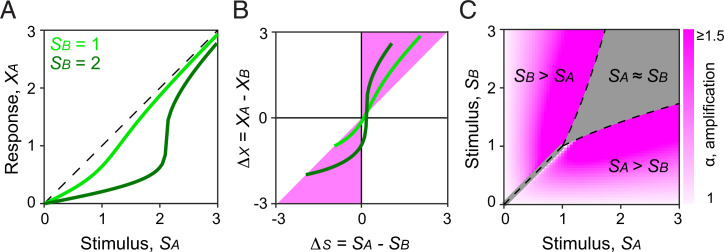
Theoretical modeling of valance enhancement by ephaptic inhibition. (A) Steady-state response of ORNA (XA) as a function of odor stimulus SA. Without ephaptic inhibition, XA is defined to be equal to SA (dashed line, in arbitrary units). When the neighboring ORNB is also activated by SB, XA (green lines) is inhibited ephaptically in a manner that depends on the strength of both SA and SB. (B) Response difference between paired neurons (ΔX) as a function of stimulus difference (ΔS). Ephaptic inhibition amplifies the valence signal if ΔX and ΔS have the same sign, and if |ΔX| > |ΔS|. The simulated responses fall almost entirely within the amplified region (pink-shaded area, see Methods for modeling details). (C) The degree of valence amplification (α) as a function of SA and SB. Ephaptic inhibition amplifies valence in a manner that depends on the ratio of SA and SB. Gray-shaded region: SASB, where the response polarity is likely ambiguous and is thus excluded in the analysis (see SI Appendix, Fig. S12 and Methods for modeling details).

References

    1. van Hateren J. H., A theory of maximizing sensory information. Biol. Cybern. 68, 23–29 (1992). - PubMed
    1. Soucy E. R., Albeanu D. F., Fantana A. L., Murthy V. N., Meister M., Precision and diversity in an odor map on the olfactory bulb. Nat. Neurosci. 12, 210–220 (2009). - PubMed
    1. Hallem E. A., Carlson J. R., Coding of odors by a receptor repertoire. Cell 125, 143–160 (2006). - PubMed
    1. Hallem E. A., Ho M. G., Carlson J. R., The molecular basis of odor coding in the Drosophila antenna. Cell 117, 965–979 (2004). - PubMed
    1. Fishilevich E., Vosshall L. B., Genetic and functional subdivision of the Drosophila antennal lobe. Curr. Biol. 15, 1548–1553 (2005). - PubMed

Publication types

Substances