


The local and global mental health effects of the Covid-19 pandemic
- PMID: 35092869
- PMCID: PMC8750697
- DOI: 10.1016/j.ehb.2021.101095
The local and global mental health effects of the Covid-19 pandemic
Abstract
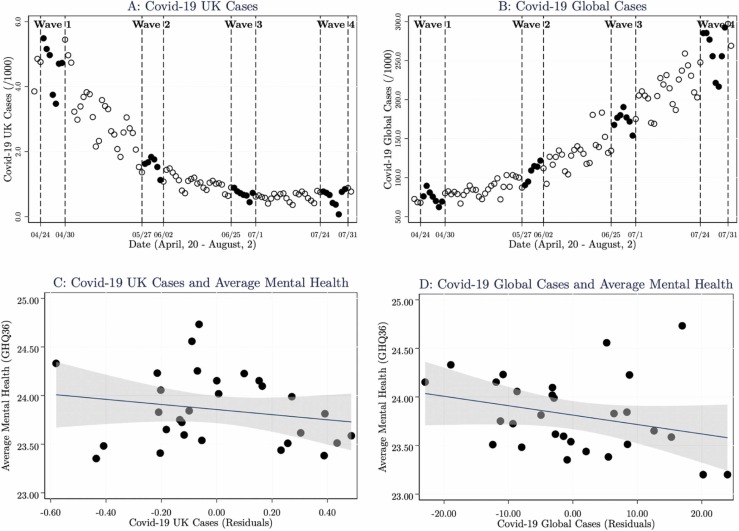
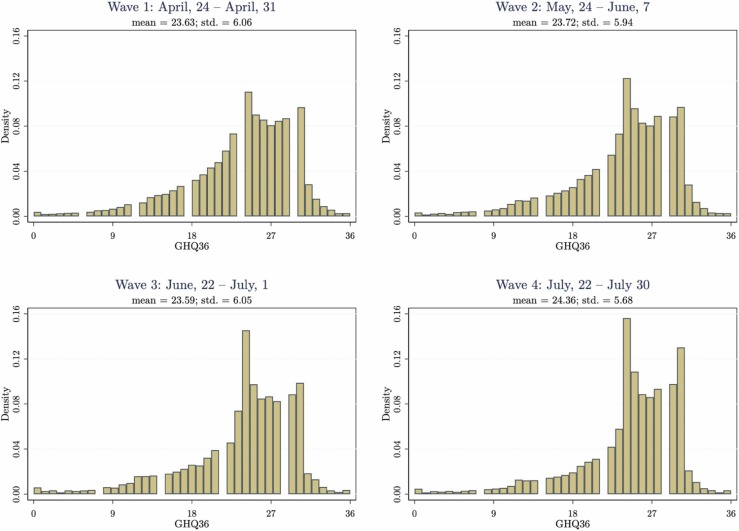
This paper investigates the mental health effects of the local and global level Covid-19 pandemic among the UK population. To identify the effect, we use a high-quality dataset and an original strategy where we match the previous day's confirmed pandemic cases to a four-month panel of individual mental health information observed during the interview next day. The approach suggested in this paper aims to identify the average mental health effect on the overall population for the first and second waves of the pandemic. Using a linear fixed-effects model specification, we report robust findings that the average mental health in the UK is substantially reduced by the local and global pandemic. The total reduction in the average mental health of the UK population during our sampling period (April - June, 2020) is about 1.5% for the local and 2.4% for the global cases, which sum up to a 3.9% reduction. Extrapolating the total reduction in average mental health during the first wave of the pandemic (February - September, 2020) sums up to 2.8% while the effect is as large as 9.6% for the first and second waves together, which covers roughly a year since the start. An extensive robustness check suggests that the findings are stable with respect to alternative pandemic datasets, measures, estimators, functional forms, and time functions. The characteristics of the most vulnerable individuals (e.g., elderly, chronic illness, and job security concerns) and their household conditions (e.g., living alone and no private space) are explored. The paper discusses on the implications of the results.
Keywords: Covid-19; Mental Health; Pandemic; Vulnerable Individuals.
Copyright © 2022 The Authors. Published by Elsevier B.V. All rights reserved.
Figures

References
-
- Akay A., Bargain O., Zimmermann K.F. Relative concerns of rural-to-urban migrants in China. J. Econ. Behav. Organ. 2012;81:421–441.
-
- Akay A., Bargain B.O., Elsayed A. Global terror and well-being. Eur. Econ. Rev. 2020;123
-
- Aneshensel C.S., Plelan J.C., Bierman A. Handbook of the Sociology of Mental Health. Springer; Dordrecht Heidelberg New York London: 2013. Religion and mental health. - DOI
-
- Banks J., Xu X. The mental health effects of the first two months of lockdown and social distancing during the Covid-19 pandemic in the UK. Covid Econ. 2020;28:91–118.
MeSH terms
LinkOut - more resources
Full Text Sources
Medical
Miscellaneous
