. 2022 Jan 12:12:806915.
doi: 10.3389/fpls.2021.806915. eCollection 2021.

Domestication Impacts the Wheat-Associated Microbiota and the Rhizosphere Colonization by Seed- and Soil-Originated Microbiomes, Across Different Fields

Affiliations

Domestication Impacts the Wheat-Associated Microbiota and the Rhizosphere Colonization by Seed- and Soil-Originated Microbiomes, Across Different Fields

Yulduzkhon Abdullaeva et al. Front Plant Sci. .

Abstract

The seed-transmitted microorganisms and the microbiome of the soil in which the plant grows are major drivers of the rhizosphere microbiome, a crucial component of the plant holobiont. The seed-borne microbiome can be even coevolved with the host plant as a result of adaptation and vertical transmission over generations. The reduced genome diversity and crossing events during domestication might have influenced plant traits that are important for root colonization by seed-borne microbes and also rhizosphere recruitment of microbes from the bulk soil. However, the impact of the breeding on seed-transmitted microbiome composition and the plant ability of microbiome selection from the soil remain unknown. Here, we analyzed both endorhiza and rhizosphere microbiome of two couples of genetically related wild and cultivated wheat species (Aegilops tauschii/Triticum aestivum and T. dicoccoides/T. durum) grown in three locations, using 16S rRNA gene and ITS2 metabarcoding, to assess the relative contribution of seed-borne and soil-derived microbes to the assemblage of the rhizosphere microbiome. We found that more bacterial and fungal ASVs are transmitted from seed to the endosphere of all species compared with the rhizosphere, and these transmitted ASVs were species-specific regardless of location. Only in one location, more microbial seed transmission occurred also in the rhizosphere of A. tauschii compared with other species. Concerning soil-derived microbiome, the most distinct microbial genera occurred in the rhizosphere of A. tauschii compared with other species in all locations. The rhizosphere of genetically connected wheat species was enriched with similar taxa, differently between locations. Our results demonstrate that host plant criteria for soil bank's and seed-originated microbiome recruitment depend on both plants' genotype and availability of microorganisms in a particular environment. This study also provides indications of coevolution between the host plant and its associated microbiome resulting from the vertical transmission of seed-originated taxa.

Keywords: bulk soil; coevolution; crop domestication; rhizosphere; seed microbiome.


Conflict of interest statement

The authors declare that the research was conducted in the absence of any commercial or financial relationships that could be construed as a potential conflict of interest.

Figures

FIGURE 1
FIGURE 1
Similarity and variation among microbial communities within compartments. Unconstrained ordination based on Euclidian distance matrices of bacterial (A) and fungal (B) communities across rhizosphere, root, bulk soil, and seedbed samples collected from wheat species (A. tauschii, T. aestivum. T. dicoccoides, and T. durum) in three locations (GG, Groß-Gerau; WG, Weilburger Grenze; RH, Rauischholzhausen) and seeds obtained from the gene bank labeled as Seed. Euclidian distance calculated from the data transformed to the centered log-ratio. The colors of the dots denote the compartments of the samples: rhizosphere (forest green), root (light green), bulk soil (brown), seed (yellow), and seedbed (gray). The box plots represent the range of distances from the centroid based on Euclidian distance matrices of bacterial (C) and fungal (D) compositions. The black lines in the box plots correspond to median values, and the dots indicate outliers.
FIGURE 2
FIGURE 2
Bacterial beta-diversity in different compartments and locations. Unconstrained ordination based on Euclidian distance matrices of bacterial communities across the root, rhizosphere, and bulk soil samples collected from wild and domesticated wheat species (A. tauschii, T. aestivum, T. dicoccoides, and T. durum) in three locations (GG, Groß-Gerau; WG, Weilburger Grenze; RH, Rauischholzhausen). Euclidian distances calculated from the data were transformed to the centered log-ratio.
FIGURE 3
FIGURE 3
Fungal beta-diversity in different compartments and locations. Unconstrained ordination based on Euclidian distance matrices of bacterial communities across the root, rhizosphere, and bulk soil samples collected from wild and domesticated wheat species (A. tauschii, T. aestivum, T. dicoccoides, and T. durum) in three locations (GG, Groß-Gerau; WG, Weilburger Grenze; RH, Rauischholzhausen). Euclidian distances calculated from the data were transformed to the centered log-ratio.
FIGURE 4
FIGURE 4
The relative proportion of seed-transmitted bacterial (A) and fungal (B) endorhiza and rhizosphere microbiome within each of the three locations (GG, WG and RH). Small letters show the significant differences (ANOVA, p < 0.05) between the relative proportion of seed-transmitted rhizosphere microbiome of wheat species. The capital letters show the significant difference between the relative proportion of seed-transmitted endorhiza microbiome of wheat species. (C) Differences between locations with respective p-values (*p < 0.05; **p < 0.01; ***p < 0.001).
FIGURE 5
FIGURE 5
Bacterial genera that were found differently enriched in the rhizosphere of two genetically connected wheat species (wild A. tauschii vs. modern T. aestivum; wild T. dicoccoides vs. modern T. durum) were grown in three research fields (GG, Groß-Gerau; WG, Weilburger Grenze; RH, Rauischholzhausen) as compared to corresponding bulk soil. The differently abundant genera are considered as significant when absolute ALDEx affect size is bigger than 1. The dark gray color of bars (n = 3) indicates genera found in wild relative and light gray indicates modern wheat species. The orange color shows the genera found in genetically connected wheat species.
FIGURE 6
FIGURE 6
Fungal genera that were found differently enriched in the rhizosphere of two genetically connected wheat species (wild A. tauschii vs. modern T. aestivum; wild T. dicoccoides vs. modern T. durum) were grown in three research fields (GG, Groß-Gerau; WG, Weilburger Grenze; RH, Rauischholzhausen) as compared to corresponding bulk soil. The differently abundant genera are considered as significant when absolute ALDEx affect size is bigger than 1. The dark gray color of bars (n = 3) indicates genera found in wild relative and light gray indicates modern wheat species. The orange color shows the genera found in genetically connected wheat species.
FIGURE 7
FIGURE 7
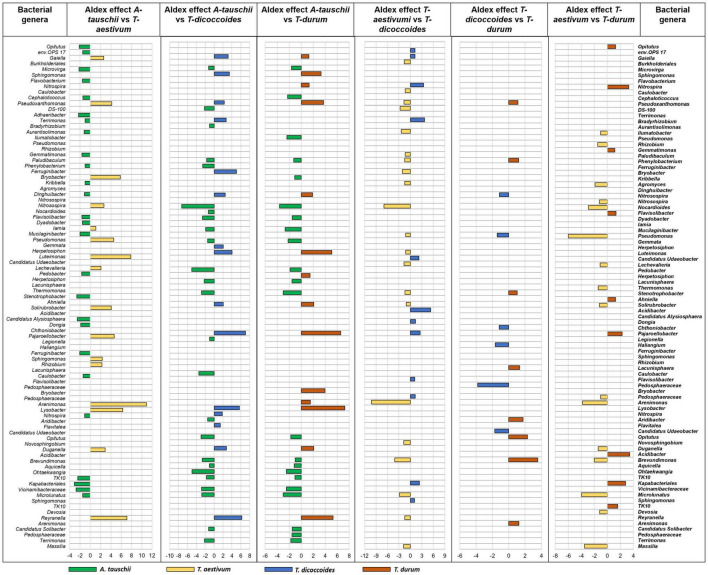
The rhizosphere bacterial microbiome assembly variation between wheat species (A. tauschii, T. aestivum, T. dicoccoides, and T. durum) grown in the same site (WG). The graph was created based on differential abundance analysis of core microbiome bacterial genera of rhizosphere soil. The significantly prevalent genera were identified by looking at ALDEx effect size table generated by ALDEx2. The differently abundant genera are considered as significant when absolute ALDEx affect size is bigger than 1 or lower than –1. More bars show higher differences and fewer bars explain more similarity between two wheat species.
FIGURE 8
FIGURE 8
The rhizosphere fungal microbiome assembly variation between wheat species (A. tauschii, T. aestivum, T. dicoccoides, and T. durum) grown in the same site (WG). The graph was created on differential abundance analysis of core microbiome bacterial genera of rhizosphere soil. The significantly prevalent genera were identified by looking at ALDEx effect size table generated by ALDEx2. The differently abundant genera are considered as significant when absolute ALDEx affect size is bigger than 1 or lower than –1.

References

    1. Abdullaeva Y., Ambika Manirajan B., Honermeier B., Schnell S., Cardinale M. (2021). Domestication affects the composition, diversity, and co-occurrence of the cereal seed microbiota. J. Adv. Res. 31 75–86. 10.1016/j.jare.2020.12.008 - DOI - PMC - PubMed
    1. Aitchison J. (1986). The Statistical Analysis of Compositional Data. London: Chapman and Hall.
    1. Aitchison J., Greenacre M. (2002). Biplots of compositional data. J. R. Stat. Soc. Ser. C Appl. Stat. 51 375–392.
    1. Alibrandi P., Schnell S., Perotto S., Cardinale M. (2020). Diversity and structure of the endophytic bacterial communities associated with three terrestrial orchid species as revealed by 16S rRNA gene metabarcoding. Front. Microbiol. 11:604964. 10.3389/fmicb.2020.604964 - DOI - PMC - PubMed
    1. Ambika Manirajan B., Maisinger C., Ratering S., Rusch V., Schwiertz A., Cardinale M., et al. (2018). Diversity, specificity, co-occurrence and hub taxa of the bacterial–fungal pollen microbiome. FEMS Microbiol. Ecol. 94:fiy112. 10.1093/femsec/fiy112 - DOI - PubMed

LinkOut - more resources