. 2022 Mar 1;79(3):228-243.
doi: 10.1001/jamaneurol.2021.5216.

Prevalence Estimates of Amyloid Abnormality Across the Alzheimer Disease Clinical Spectrum

Willemijn J Jansen  1   2 Olin Janssen  1 Betty M Tijms  3 Stephanie J B Vos  1 Rik Ossenkoppele  3   4 Pieter Jelle Visser  1   3   5 Amyloid Biomarker Study GroupDag Aarsland  6   7 Daniel Alcolea  8   9 Daniele Altomare  10   11 Christine von Arnim  12   13 Simone Baiardi  14 Ines Baldeiras  15   16   17 Henryk Barthel  18 Randall J Bateman  19 Bart Van Berckel  20 Alexa Pichet Binette  21   22 Kaj Blennow  23 Merce Boada  24   25 Henning Boecker  26 Michel Bottlaender  27 Anouk den Braber  28 David J Brooks  29   30   31 Mark A Van Buchem  32 Vincent Camus  33 Jose Manuel Carill  34 Jiri Cerman  35 Kewei Chen  2 Gaël Chételat  36 Elena Chipi  37 Ann D Cohen  38 Alisha Daniels  39 Marion Delarue  36 Mira Didic  40   41 Alexander Drzezga  26   42 Bruno Dubois  43 Marie Eckerström  44 Laura L Ekblad  45 Sebastiaan Engelborghs  46   47 Stéphane Epelbaum  43 Anne M Fagan  19 Yong Fan  48 Tormod Fladby  49 Adam S Fleisher  50 Wiesje M Van der Flier  28 Stefan Förster  51   52 Juan Fortea  8   9 Kristian Steen Frederiksen  53 Yvonne Freund-Levi  54   55   56 Lars Frings  57 Giovanni B Frisoni  58 Lutz Fröhlich  59 Tomasz Gabryelewicz  60 Hermann-Josef Gertz  61 Kiran Dip Gill  62 Olymbia Gkatzima  63 Estrella Gómez-Tortosa  64 Timo Grimmer  65 Eric Guedj  66 Christian G Habeck  67 Harald Hampel  68 Ron Handels  1 Oskar Hansson  4 Lucrezia Hausner  69 Sabine Hellwig  70 Michael T Heneka  71   72 Sanna-Kaisa Herukka  73   74 Helmut Hildebrandt  75 John Hodges  76 Jakub Hort  35 Chin-Chang Huang  77 Ane Juaristi Iriondo  78 Yoshiaki Itoh  79 Adrian Ivanoiu  80 William J Jagust  81   82 Frank Jessen  83   84   85 Peter Johannsen  86 Keith A Johnson  87 Ramesh Kandimalla  62   88   89   90 Elisabeth N Kapaki  91 Silke Kern  92 Lena Kilander  93 Aleksandra Klimkowicz-Mrowiec  94 William E Klunk  95   96 Norman Koglin  97 Johannes Kornhuber  98 Milica G Kramberger  99 Hung-Chou Kuo  100 Koen Van Laere  101   102 Susan M Landau  81 Brigitte Landeau  36 Dong Young Lee  103 Mony de Leon  104 Cristian E Leyton  105 Kun-Ju Lin  106   107 Alberto Lleó  8   9 Malin Löwenmark  108 Karine Madsen  109 Wolfgang Maier  110 Jan Marcusson  111 Marta Marquié  24   25 Pablo Martinez-Lage  112 Nancy Maserejian  113 Niklas Mattsson  4 Alexandre de Mendonça  114 Philipp T Meyer  57 Bruce L Miller  115 Shinobu Minatani  79 Mark A Mintun  116 Vincent C T Mok  117   118   119 Jose Luis Molinuevo  120 Silvia Daniela Morbelli  121   122 John C Morris  19 Barbara Mroczko  123   124 Duk L Na  125   126 Andrew Newberg  127 Flavio Nobili  128   122 Agneta Nordberg  6   7 Marcel G M Olde Rikkert  129 Catarina Resende de Oliveira  15 Pauline Olivieri  130   131 Adela Orellana  24   25 George Paraskevas  91 Piero Parchi  132   133 Matteo Pardini  134 Lucilla Parnetti  37 Oliver Peters  135 Judes Poirier  136 Julius Popp  137   138 Sudesh Prabhakar  139 Gil D Rabinovici  115 Inez H Ramakers  1 Lorena Rami  140 Eric M Reiman  2 Juha O Rinne  141 Karen M Rodrigue  142 Eloy Rodríguez-Rodriguez  143 Catherine M Roe  19 Pedro Rosa-Neto  136 Howard J Rosen  115 Uros Rot  144 Christopher C Rowe  145   146 Eckart Rüther  147 Agustín Ruiz  24   25 Osama Sabri  18 Jayant Sakhardande  148 Pascual Sánchez-Juan  149 Sigrid Botne Sando  150   151 Isabel Santana  15   16   17 Marie Sarazin  130   131 Philip Scheltens  28 Johannes Schröder  152 Per Selnes  49 Sang Won Seo  153 Dina Silva  114 Ingmar Skoog  92 Peter J Snyder  154 Hilkka Soininen  155   156 Marc Sollberger  157   158 Reisa A Sperling  159   160 Luisa Spiru  161   162 Yaakov Stern  148 Erik Stomrud  4 Akitoshi Takeda  79 Marc Teichmann  43   163 Charlotte E Teunissen  28 Louisa I Thompson  164 Jori Tomassen  28 Magda Tsolaki  165 Rik Vandenberghe  166   167 Marcel M Verbeek  168 Frans R J Verhey  1 Victor Villemagne  145   169 Sylvia Villeneuve  21   22   170 Jonathan Vogelgsang  171 Gunhild Waldemar  53   172 Anders Wallin  92 Åsa K Wallin  4 Jens Wiltfang  173   174 David A Wolk  175 Tzu-Chen Yen  107   106 Marzena Zboch  176 Henrik Zetterberg  92   177   178   179   180
Affiliations

Prevalence Estimates of Amyloid Abnormality Across the Alzheimer Disease Clinical Spectrum

Willemijn J Jansen et al. JAMA Neurol. .

Erratum in

Abstract

Importance: One characteristic histopathological event in Alzheimer disease (AD) is cerebral amyloid aggregation, which can be detected by biomarkers in cerebrospinal fluid (CSF) and on positron emission tomography (PET) scans. Prevalence estimates of amyloid pathology are important for health care planning and clinical trial design.

Objective: To estimate the prevalence of amyloid abnormality in persons with normal cognition, subjective cognitive decline, mild cognitive impairment, or clinical AD dementia and to examine the potential implications of cutoff methods, biomarker modality (CSF or PET), age, sex, APOE genotype, educational level, geographical region, and dementia severity for these estimates.

Design, setting, and participants: This cross-sectional, individual-participant pooled study included participants from 85 Amyloid Biomarker Study cohorts. Data collection was performed from January 1, 2013, to December 31, 2020. Participants had normal cognition, subjective cognitive decline, mild cognitive impairment, or clinical AD dementia. Normal cognition and subjective cognitive decline were defined by normal scores on cognitive tests, with the presence of cognitive complaints defining subjective cognitive decline. Mild cognitive impairment and clinical AD dementia were diagnosed according to published criteria.

Exposures: Alzheimer disease biomarkers detected on PET or in CSF.

Main outcomes and measures: Amyloid measurements were dichotomized as normal or abnormal using cohort-provided cutoffs for CSF or PET or by visual reading for PET. Adjusted data-driven cutoffs for abnormal amyloid were calculated using gaussian mixture modeling. Prevalence of amyloid abnormality was estimated according to age, sex, cognitive status, biomarker modality, APOE carrier status, educational level, geographical location, and dementia severity using generalized estimating equations.

Results: Among the 19 097 participants (mean [SD] age, 69.1 [9.8] years; 10 148 women [53.1%]) included, 10 139 (53.1%) underwent an amyloid PET scan and 8958 (46.9%) had an amyloid CSF measurement. Using cohort-provided cutoffs, amyloid abnormality prevalences were similar to 2015 estimates for individuals without dementia and were similar across PET- and CSF-based estimates (24%; 95% CI, 21%-28%) in participants with normal cognition, 27% (95% CI, 21%-33%) in participants with subjective cognitive decline, and 51% (95% CI, 46%-56%) in participants with mild cognitive impairment, whereas for clinical AD dementia the estimates were higher for PET than CSF (87% vs 79%; mean difference, 8%; 95% CI, 0%-16%; P = .04). Gaussian mixture modeling-based cutoffs for amyloid measures on PET scans were similar to cohort-provided cutoffs and were not adjusted. Adjusted CSF cutoffs resulted in a 10% higher amyloid abnormality prevalence than PET-based estimates in persons with normal cognition (mean difference, 9%; 95% CI, 3%-15%; P = .004), subjective cognitive decline (9%; 95% CI, 3%-15%; P = .005), and mild cognitive impairment (10%; 95% CI, 3%-17%; P = .004), whereas the estimates were comparable in persons with clinical AD dementia (mean difference, 4%; 95% CI, -2% to 9%; P = .18).

Conclusions and relevance: This study found that CSF-based estimates using adjusted data-driven cutoffs were up to 10% higher than PET-based estimates in people without dementia, whereas the results were similar among people with dementia. This finding suggests that preclinical and prodromal AD may be more prevalent than previously estimated, which has important implications for clinical trial recruitment strategies and health care planning policies.


Figures
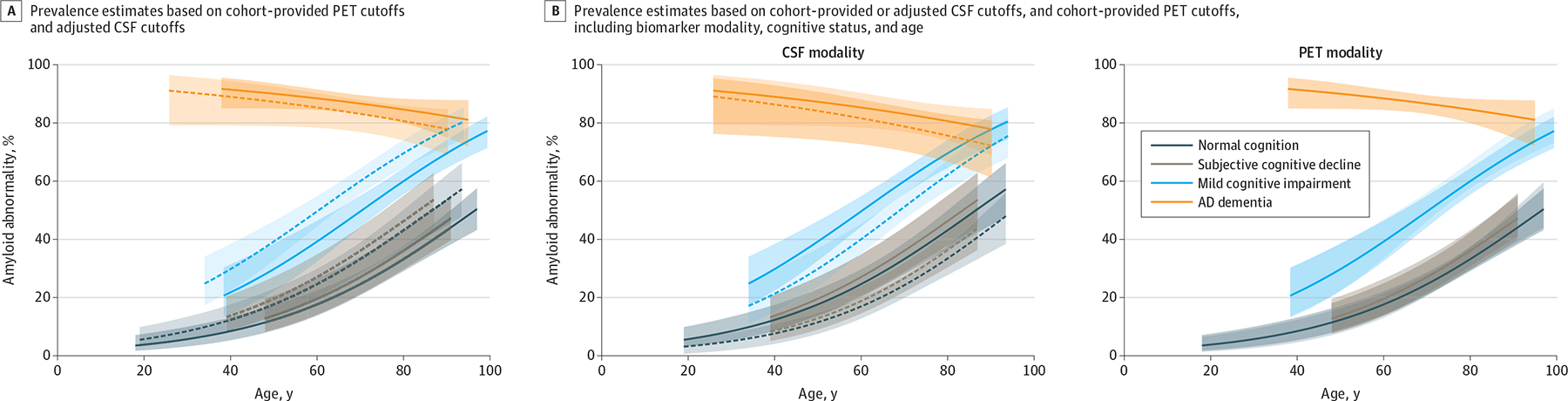
Figure 1.
Figure 1.. Estimated Prevalence of Amyloid Abnormality Based on Cohort-Provided Positron Emission Tomography (PET) Cutoffs and Adjusted Cerebrospinal Fluid (CSF) Cutoffs and Based on Adjusted CSF Cutoffs, Cohort-Provided CSF Cutoffs, and Cohort-Provided PET Cutoffs by Biomarker Modality, Cognitive Status, and Age
In panel A, the solid lines represent the estimated prevalence of amyloid abnormality based on cohort-provided PET cutoffs, and the dotted lines represent the estimated prevalence based on adjusted CSF cutoffs. For the CSF modality shown in panel B, the solid lines represent the estimated prevalence of amyloid abnormality based on adjusted CSF cutoffs, and the dotted lines represent the estimated prevalence based on cohort-provided CSF cutoffs. For the PET modality, the solid lines represent the estimated prevalence based on cohort-provided PET cutoffs. Amyloid abnormality for cohort-provided PET cutoffs and adjusted CSF cutoffs in groups with normal cognition, subjective cognitive decline, and mild cognitive impairment was modeled using age (statistical significance: P < .001), biomarker modality (statistical significance: P = .004), and cognitive status (statistical significance: P < .001) as risk factors; amyloid abnormality in the group with Alzheimer disease (AD) dementia was modeled, using age (statistical significance: P = .08) and biomarker modality (statistical significance: P = .18) as risk factors. Amyloid abnormality for cohort-provided CSF cutoffs in groups with with normal cognition, subjective cognitive decline, and mild cognitive impairment was modeled using age (statistical significance: P < .001), biomarker modality (statistical significance: P > .99), and cognitive status (statistical significance: P < .001) as risk factors; and in the group with AD dementia was modeled using age (statistical significance: P = .03) and biomarker modality (statistical significance: P = .02) as risk factors. Shaded areas indicate 95%CIs.
Figure 2.
Figure 2.. Estimated Prevalence of Amyloid Abnormality According to Cognitive Status, Biomarker Modality, Age, and Apolipoprotein E (APOE) ε4 Carrier Status
Amyloid abnormality (based on adjusted cerebrospinal fluid [CSF] cutoffs and cohort-provided positron emission tomography [PET] cutoffs) in groups with normal cognition, subjective cognitive decline, and mild cognitive impairment was modeled using age (statistical significance: P < .001), cognitive status (statistical significance: P < .001), biomarker modality (statistical significance: P = .01), APOE ε4 carrier status (statistical significance: P < .001), and APOE ε4 carrier status by age (statistical significance: P < .001) as risk factors. Shaded areas indicate 95% CIs. Amyloid abnormality in the group with Alzheimer disease (AD) dementia was modeled using age (statistical significance: P = .23) and APOE ε4 carrier status (statistical significance: P < .001) as risk factors.

Comment in

References

    1. Jack CR Jr, Bennett DA, Blennow K, et al.; Contributors. NIA-AA research framework: toward a biological definition of Alzheimer’s disease. Alzheimers Dement. 2018;14(4):535–562. doi:10.1016/j.jalz.2018.02.018 - DOI - PMC - PubMed
    1. Scheltens P, De Strooper B, Kivipelto M, et al. Alzheimer’s disease. Lancet. 2021;397(10284):1577–1590. doi:10.1016/S0140-6736(20)32205-4 - DOI - PMC - PubMed
    1. Feldman HH, Haas M, Gandy S, et al.; One Mind for Research and the New York Academy of Sciences. Alzheimer’s disease research and development: a call for a new research roadmap. Ann N Y Acad Sci. 2014;1313:1–16. doi:10.1111/nyas.12424 - DOI - PubMed
    1. Reiman EM, Langbaum JB, Tariot PN, et al. CAP–advancing the evaluation of preclinical Alzheimer disease treatments. Nat Rev Neurol. 2016;12(1):56–61. doi:10.1038/nrneurol.2015.177 - DOI - PMC - PubMed
    1. Sperling RA, Rentz DM, Johnson KA, et al. The A4 study: stopping AD before symptoms begin? Sci Transl Med. 2014;6(228):228fs13. doi:10.1126/scitranslmed.3007941 - DOI - PMC - PubMed

MeSH terms