


The haustorium as a driving force for speciation in thallus-forming Laboulbeniomycetes
- PMID: 35101145
- PMCID: PMC8805332
- DOI: 10.1186/s43008-021-00087-7
The haustorium as a driving force for speciation in thallus-forming Laboulbeniomycetes
Abstract
Laboulbeniomycetes is a class of fungi that have obligate associations with arthropod hosts, either for dispersal (order Pyxidiophorales) or as biotrophic parasites (orders Herpomycetales and Laboulbeniales). Here, we focus on Herpomycetales and Laboulbeniales, which include fungi that form thalli, 3-dimensional, multicellular units of 1000 s of cells. Based on recently published data regarding patterns of speciation, we present the One-Host-One-Parasite model (1H1P) for haustorial thallus-forming Laboulbeniomycetes. We hypothesize that taxa with haustoria, rhizoidal structures that make contact with the host's body cavity, have very strict host specificity. For taxa without haustoria, the microhabitat-as selected by the host-governs host shifting, presence or absence of the fungus, abundance, effective host range, and geographic distribution. We make suggestions for future research including fluorescent labeling of waxy lipids and mass spectrometry. These techniques have the potential to generate the data necessary to evaluate the here proposed 1H1P hypothesis for Herpomycetales and Laboulbeniales.
Keywords: Ectoparasitic fungi; Haustorium; Herpomyces; Host specificity; Integrative taxonomy; Laboulbeniales; One-Host-One-Parasite.
© 2022. The Author(s).
Conflict of interest statement
The authors declare they have no competing interests.
Figures
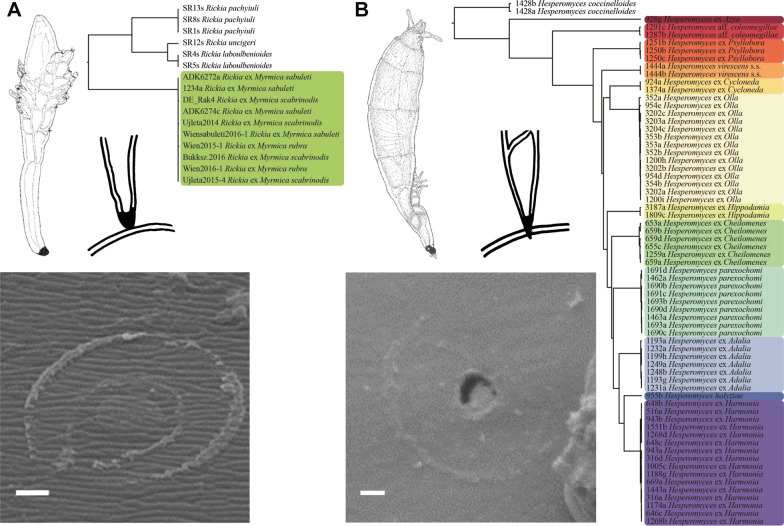
References
-
- Accioly T, Sousa JO, Moreau PA, Lécuru C, Silva BD, Roy M, Gardes M, Baseia IG, Martín MP. Hidden fungal diversity from the Neotropics: Geastrum hirsutum, G. schweinitzii (Basidiomycota, Geastrales) and their allies. PLoS ONE. 2019;14(2):e0211388. doi: 10.1371/journal.pone.0211388. - DOI - PMC - PubMed
-
- Aime MC, Miller AN, Aoki T, Bensch K, Cai L, Crous PW, Hawksworth DL, Hyde KD, Kirk PM, Lücking R, May TW, Malosso E, Redhead SA, Rossman AY, Stadler M, Thines M, Yurkov AM, Zhang N, Schoch CL. How to publish a new fungal species, or name, version 3.0. IMA Fungus. 2021;12(1):11. doi: 10.1186/s43008-021-00063-1. - DOI - PMC - PubMed
-
- Benjamin RK. Introduction and supplement to Roland Thaxter's contribution towards a monograph of the Laboulbeniaceae. Bibl Mycol. 1971;30:1–155.
-
- Benjamin RK, Shanor L. Sex of host specificity and position specificity of certain species of Laboulbenia on Bembidion picipes. Am J Bot. 1952;39(2):125–131. doi: 10.1002/j.1537-2197.1952.tb14255.x. - DOI
Grants and funding
LinkOut - more resources
Full Text Sources