. 2022 Mar;239(3):773-794.
doi: 10.1007/s00213-022-06068-x. Epub 2022 Jan 31.

Increased elasticity of sucrose demand during hyperdopaminergic states in rats

Affiliations

Increased elasticity of sucrose demand during hyperdopaminergic states in rats

A Maryse Minnaard et al. Psychopharmacology (Berl). 2022 Mar.

Abstract

Rationale: Deficits in cost-benefit decision-making are a core feature of several psychiatric disorders, including substance addiction, eating disorders and bipolar disorder. Mesocorticolimbic dopamine signalling has been implicated in various processes related to cognition and reward, but its precise role in reward valuation and cost-benefit trade-off decisions remains incompletely understood.

Objectives: We assessed the role of mesocorticolimbic dopamine signalling in the relationship between price and consumption of sucrose, to better understand its role in cost-benefit decisions.

Methods: Dopamine neurons in the ventral tegmental area (VTA) were chemogenetically activated in rats, and a behavioural economics approach was used to quantify the relationship between price and consumption of sucrose. Motivation for sucrose was also assessed under a progressive ratio (PR) schedule of reinforcement. To further gauge the role of dopamine in cost-benefit trade-offs for sucrose, the effects of treatment with D-amphetamine and the dopamine receptor antagonist alpha-flupentixol were assessed.

Results: Chemogenetic activation of VTA dopamine neurons increased demand elasticity, while responding for sucrose under a PR schedule of reinforcement was augmented upon stimulation of VTA dopamine neurons. Treatment with amphetamine partially replicated the effects of chemogenetic dopamine neuron activation, whereas treatment with alpha-flupentixol reduced free consumption of sucrose and had mixed effects on demand elasticity.

Conclusions: Stimulation of mesocorticolimbic dopaminergic neurotransmission altered cost-benefit trade-offs in a complex manner. It reduced the essential value of palatable food, increased incentive motivation and left free consumption unaltered. Together, these findings imply that mesocorticolimbic dopamine signalling differentially influences distinct components of cost expenditure processes aimed at obtaining rewards.

Keywords: Behavioural economics,; Chemogenetics,; Demand,; Dopamine,; Motivation,; Rats,; Ventral tegmental area.


Figures

Fig. 1
Fig. 1
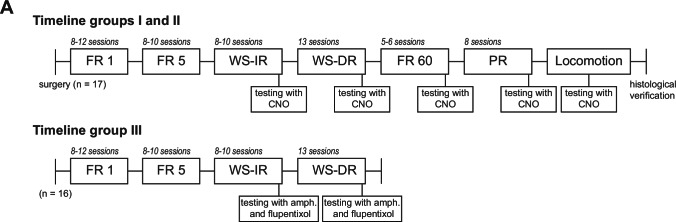
Schematic of experimental design. Timelines for experimental groups I, II and III. The number of training sessions before testing is indicated in italics above each block. WS-IR, within session increasing ratio; WS-DR, within session decreasing ratio; amph., D-amphetamine
Fig. 2
Fig. 2
Expression of AAV-hSyn-DIO-hM3Dq-mCherry in experimental group I (TH::cre +) animals. Representative example of a TH::cre + rat injected with AAV-hSyn-DIO-hM3Dq-mCherry of the ventral tegmental area (VTA). Expression is shown in coronal slices − 5.6 mm posterior to Bregma. The arrows highlight examples of neurons that co-express TH and mCherry. Atlas image adapted from Paxinos and Watson, 2004
Fig. 3
Fig. 3
The effects of CNO treatment on the number of rewards, demand elasticity (α) and intensity (Q0), and demand curve when measured under a within session increasing ratio (WS-IR) schedule in experimental groups I (TH::cre +) and II (TH::cre-). Effects of CNO on number of rewards obtained in TH::cre + rats (A) and TH::cre- rats (B) when assessed in a WS-IR task. Effects of CNO on demand elasticity (C) and demand intensity (D) based on individual demand curve analysis. Effects of CNO on population demand curve in TH::cre + rats (E) and TH::cre- rats (F). Data in panels AD are presented as the mean + SEM. ** CNO 1.0 different from vehicle, p < 0.01; ## CNO 0.3 different from vehicle, p < 0.01; *** CNO 1.0 different from vehicle, p < 0.001; ### CNO 0.3 different from vehicle, p < 0.001
Fig. 4
Fig. 4
The effects of CNO treatment on the number of rewards, demand elasticity (α) and intensity (Q0) and demand curve when measured under a within session decreasing ratio (WS-DR) schedule in experimental groups I (TH::cre +) and II (TH::cre-). Effects of CNO on number of rewards obtained in TH::cre + rats (A) and TH::cre- rats (B) when assessed in a WS-DR task. Effects of CNO on demand elasticity (C) and demand intensity (D) based on individual demand curve analysis. Effects of CNO on population demand curve in TH::cre + rats (E) and TH::cre- rats (F). Data in panels AD are presented as the mean + SEM. ** CNO 1.0 different from vehicle, p < 0.01; ## CNO 0.3 different from vehicle, p < 0.01; *** CNO 1.0 different from vehicle, p < 0.001
Fig. 5
Fig. 5
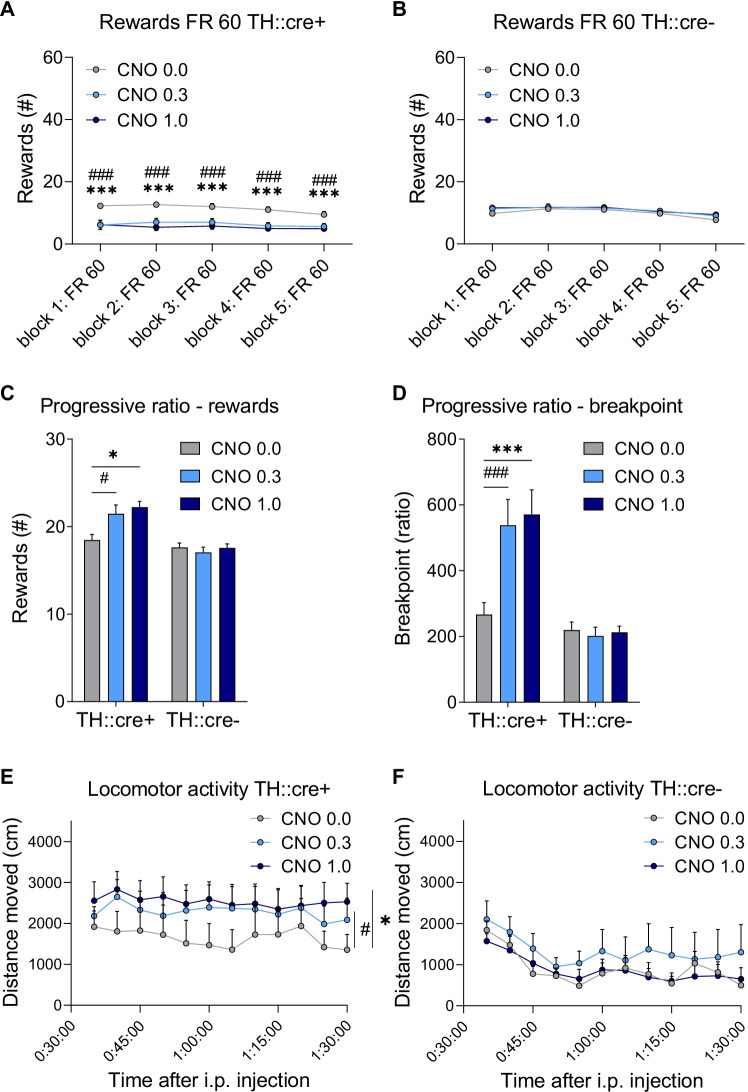
The effects of CNO treatment on performance in fixed ratio (FR) 60 sessions, progressive ratio (PR) sessions and locomotor activity in experimental groups I (TH::cre +) and II (TH::cre-). Effects of CNO on number of rewards obtained in TH::cre + rats (A) and TH::cre- rats (B) when assessed in a FR 60 task. Effects of CNO on number of rewards obtained (C) and breakpoint (D) in TH::cre + and TH::cre- rats when assessed in a PR task. Effects of CNO on distance moved in TH::cre + rats (E) and TH::cre- rats (F) when locomotor activity was assessed. Data are presented as the mean + SEM. * CNO 1.0 different from vehicle, p < 0.05; # CNO 0.3 different from vehicle, p < 0.05; *** CNO 1.0 different from vehicle, p < 0.001; ### CNO 0.3 different from vehicle, p < 0.001
Fig. 6
Fig. 6
The effects of D-amphetamine and flupentixol treatment on the number of rewards, demand elasticity (α) and intensity (Q0)and demand curve when measured under a within session increasing ratio (WS-IR) schedule in experimental group III. Effects of D-amphetamine (A) and flupentixol (B) on number of rewards obtained when assessed in a WS-IR task. Effects of D-amphetamine on demand elasticity (C) and demand intensity (D) based on individual demand curve analysis. Effects of flupentixol on demand elasticity (E) and demand intensity (F) based on individual demand curve analysis. Effects of D-amphetamine (G) and flupentixol (H) on population demand curves. Data in panels AD are presented as the mean + SEM. ** different from vehicle, p < 0.01; *** different from vehicle, p < 0.001
Fig. 7
Fig. 7
The effects of D-amphetamine and flupentixol treatment on the number of rewards, demand elasticity (α) and intensity (Q0) and demand curve when measured under a within session decreasing ratio (WS-DR) schedule in experimental group III. Effects of D-amphetamine (A) and flupentixol (B) on number of rewards obtained when assessed in a WS-DR task. Effects of D-amphetamine on demand elasticity (C) and demand intensity (D) based on individual demand curve analysis. Effects of flupentixol on demand elasticity (E) and demand intensity (F) based on individual demand curve analysis. Effects of D-amphetamine (G) and flupentixol (H) on population demand curves. Data in panels AD are presented as the mean + SEM. (A) * D-amphetamine 1.0 mg/kg different from vehicle, p < 0.05; (B) $$ p = 0.053; $ p = 0.073 (D) * D-amphetamine 0.5 mg/kg different from D-amphetamine 1.0 mg/kg, p < 0.05; (F) * flupenthixol different from vehicle p < 0.05
Fig. 8
Fig. 8
The effects of 1.0 mg/kg CNO treatment on response ratios under different schedules of reinforcement. Shown are the active lever presses (ALP) per minute under a within session increasing ratio (WS-IR) schedule, a within session decreasing ratio (WS-DR) schedule, fixed ratio (FR) 60 schedule and progressive ratio (PR) schedule of reinforcement in experimental groups I (TH::cre +) and II (TH::cre-)

References

    1. Aberman JE, Salamone JD. Nucleus accumbens dopamine depletions make rats more sensitive to high ratio requirements but do not impair primary food reinforcement. Neuroscience. 1999;92:545–552. - PubMed
    1. Aberman JE, Ward SJ, Salamone JD. Effects of dopamine antagonists and accumbens dopamine depletions on time-constrained progressive-ratio performance. Pharmacol Biochem Behav. 1998;61:341–348. - PubMed
    1. American Psychiatric Association (2013) DSM-5: Diagnostic and Statistical Manual of Mental Disorders. American Psychiatric Association, Washington, DC, USA.
    1. Avena NM, Rada P, Hoebel BG. Underweight rats have enhanced dopamine release and blunted acetylcholine response in the nucleus accumbens while bingeing on sucrose. Neuroscience. 2008;156:865–871. - PMC - PubMed
    1. Baarendse PJJ, Vanderschuren LJMJ. Dissociable effects of monoamine reuptake inhibitors on distinct forms of impulsive behavior in rats. Psychopharmacology. 2012;219:313–326. - PMC - PubMed