. 2022 Feb 1;20(2):e3001285.
doi: 10.1371/journal.pbio.3001285. eCollection 2022 Feb.

Tracking changes between preprint posting and journal publication during a pandemic

Affiliations

Tracking changes between preprint posting and journal publication during a pandemic

Liam Brierley et al. PLoS Biol. .

Abstract

Amid the Coronavirus Disease 2019 (COVID-19) pandemic, preprints in the biomedical sciences are being posted and accessed at unprecedented rates, drawing widespread attention from the general public, press, and policymakers for the first time. This phenomenon has sharpened long-standing questions about the reliability of information shared prior to journal peer review. Does the information shared in preprints typically withstand the scrutiny of peer review, or are conclusions likely to change in the version of record? We assessed preprints from bioRxiv and medRxiv that had been posted and subsequently published in a journal through April 30, 2020, representing the initial phase of the pandemic response. We utilised a combination of automatic and manual annotations to quantify how an article changed between the preprinted and published version. We found that the total number of figure panels and tables changed little between preprint and published articles. Moreover, the conclusions of 7.2% of non-COVID-19-related and 17.2% of COVID-19-related abstracts undergo a discrete change by the time of publication, but the majority of these changes do not qualitatively change the conclusions of the paper.


Conflict of interest statement

I have read the journal’s policy and the authors of this manuscript have the following competing interests: JP is the executive director of ASAPbio, a non-profit organization promoting the productive use of preprints in the life sciences. GD is a bioRxiv Affiliate, part of a volunteer group of scientists that screen preprints deposited on the bioRxiv server. GD and JAC are contributors to preLights and ASAPbio Fellows.

Figures
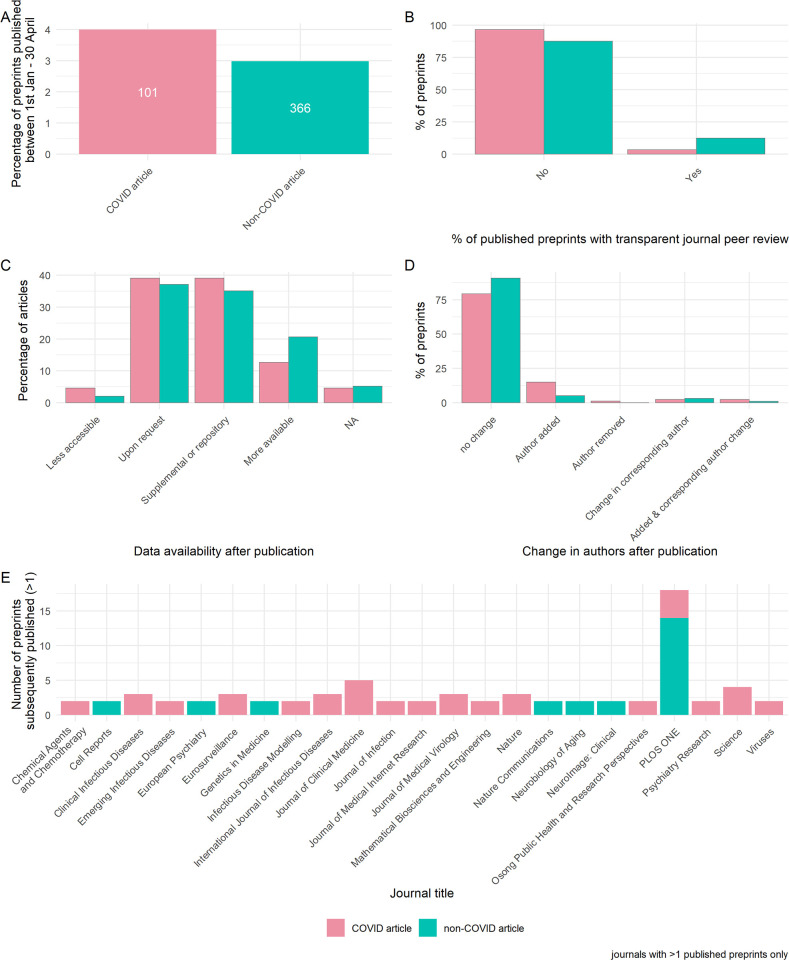
Fig 1
Fig 1. Publishing and peer review of preprints during the COVID-19 pandemic.
(A) Percentage of COVID-19 and non-COVID-19 preprints published by April 30, 2020. Labels denote absolute number. (B) Percentage of published preprints associated with transparent peer review (the publication of review reports with the journal version of the article). (C) Data availability after publication. (D) Change in authorship after publication. (E) Journals that are publishing preprints. Panel A describes all available data (n = 14,812 preprints), while panels B–E describe sample of preprints analysed in detail (n = 184). The data underlying this figure may be found at https://github.com/preprinting-a-pandemic/preprint_changes and https://zenodo.org/record/5594903#.YXUv9_nTUuU. COVID-19, Coronavirus Disease 2019.
Fig 2
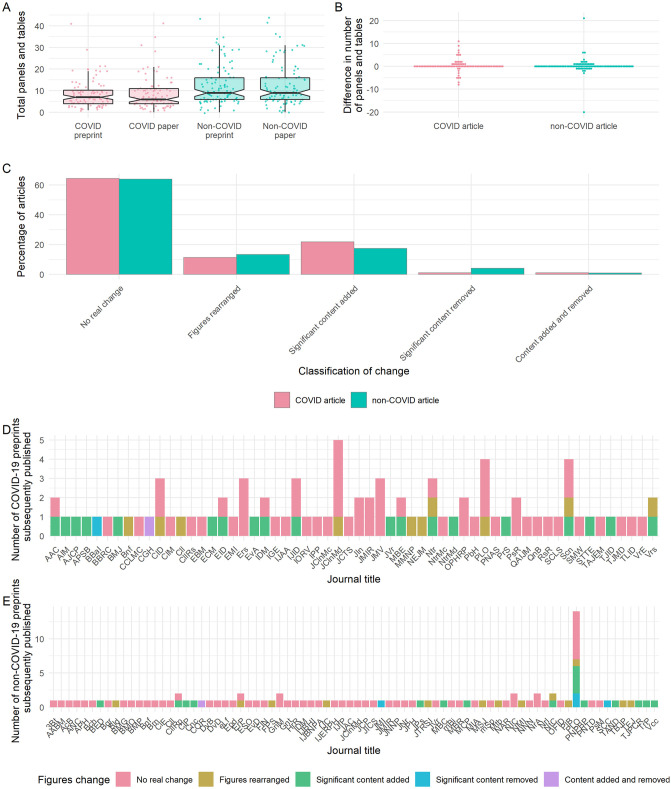
Fig 2. Preprint–publication pairs do not significantly differ in the total numbers of panels and tables.
(A) Total numbers of panels and tables in preprints and published articles. Boxplot notches denote approximated 95% CI around medians. (B) Difference in the total number of panels and tables between the preprint and published versions of articles. (C) Classification of figure changes between preprint and published articles. (D) Journals publishing COVID-19 preprints, based on annotated changes in panels. (E) Journals publishing non-COVID-19 preprints, based on annotated changes in panels. All panels describe sample of preprints analysed in detail (n = 184). See S1 Text for key to abbreviated journal labels. The data underlying this figure may be found at https://github.com/preprinting-a-pandemic/preprint_changes and https://zenodo.org/record/5594903#.YXUv9_nTUuU. CI, confidence interval; COVID-19, Coronavirus Disease 2019.
Fig 3
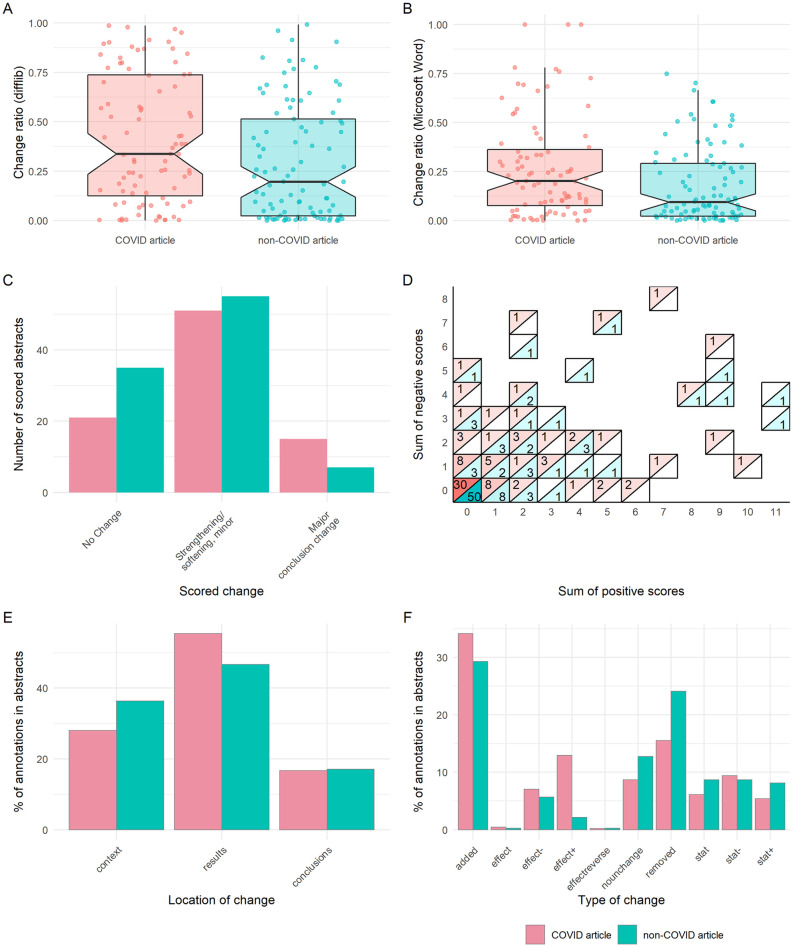
Fig 3. Preprint–publication abstract pairs have substantial differences in text, but not interpretation.
(A) Difflib calculated change ratio for COVID-19 or non-COVID-19 abstracts. (B) Change ratio calculated from Microsoft Word for COVID-19 or non-COVID-19 abstracts. (C) Overall changes in abstracts for COVID-19 or non-COVID-19 abstracts. (D) Sum of positive and negative annotations for COVID-19 or non-COVID-19 abstracts, with colour and label denoting number of abstracts with each particular sum combination. (E) Location of annotations within COVID-19 or non-COVID-19 abstracts. (F) Type of annotated change within COVID-19 or non-COVID-19 abstracts. All panels describe sample of abstracts analysed in detail (n = 184). Boxplot notches denote approximated 95% CI around medians. The data underlying this figure may be found at https://github.com/preprinting-a-pandemic/preprint_changes and https://zenodo.org/record/5594903#.YXUv9_nTUuU. CI, confidence interval; COVID-19, Coronavirus Disease 2019.
Fig 4
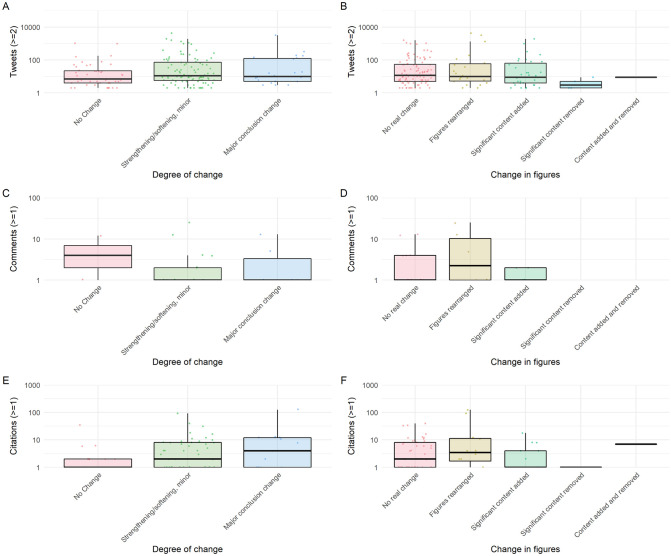
Fig 4. Altmetric data for overall degree of change in abstracts and figures.
(A) Number of tweets (at least 2) and overall abstract change. (B) Number of tweets (at least 2) and overall change in figures. (C) Number of comments (at least 1) and overall abstract change. (D) Number of comments (at least 1) and overall change in figures. (E) Number of preprint citations (at least 1) based on overall abstract change. (F) Number of preprint citations (at least 1) based on overall change in figures. The data underlying this figure may be found at https://github.com/preprinting-a-pandemic/preprint_changes and https://zenodo.org/record/5594903#.YXUv9_nTUuU.

References

    1. WHO. COVID-19 situation report 19. 2020 Aug 2 [cited 2020 May 13]. https://www.who.int/docs/default-source/coronaviruse/situation-reports/2...
    1. Zhu N, Zhang D, Wang W, Li X, Yang B, Song J, et al.. A Novel Coronavirus from Patients with Pneumonia in China, 2019. N Engl J Med. 2020;382:727–33. doi: 10.1056/NEJMoa2001017 - DOI - PMC - PubMed
    1. Coronaviridae Study Group of the International Committee on Taxonomy of Viruses. The species Severe acute respiratory syndrome-related coronavirus: classifying 2019-nCoV and naming it SARS-CoV-2. Nat Microbiol. 2020;5:536–44. doi: 10.1038/s41564-020-0695-z - DOI - PMC - PubMed
    1. Sever R, Roeder T, Hindle S, Sussman L, Black K-J, Argentine J, et al.. bioRxiv: the preprint server for biology. bioRxiv. 2019:833400. doi: 10.1101/833400 - DOI
    1. Kaiser J. Am 12:00. BioRxiv at 1 year: A promising start. In: Science | AAAS [Internet] 11 Nov 2014 [cited 2020 May 13]. https://www.sciencemag.org/news/2014/11/biorxiv-1-year-promising-start

Publication types

MeSH terms