Review
. 2022 Mar 9;122(5):5317-5364.
doi: 10.1021/acs.chemrev.1c00481. Epub 2022 Feb 1.

Magnetic Soft Materials and Robots

Affiliations
Review

Magnetic Soft Materials and Robots

Yoonho Kim et al. Chem Rev. .

Abstract

In conventional classification, soft robots feature mechanical compliance as the main distinguishing factor from traditional robots made of rigid materials. Recent advances in functional soft materials have facilitated the emergence of a new class of soft robots capable of tether-free actuation in response to external stimuli such as heat, light, solvent, or electric or magnetic field. Among the various types of stimuli-responsive materials, magnetic soft materials have shown remarkable progress in their design and fabrication, leading to the development of magnetic soft robots with unique advantages and potential for many important applications. However, the field of magnetic soft robots is still in its infancy and requires further advancements in terms of design principles, fabrication methods, control mechanisms, and sensing modalities. Successful future development of magnetic soft robots would require a comprehensive understanding of the fundamental principle of magnetic actuation, as well as the physical properties and behavior of magnetic soft materials. In this review, we discuss recent progress in the design and fabrication, modeling and simulation, and actuation and control of magnetic soft materials and robots. We then give a set of design guidelines for optimal actuation performance of magnetic soft materials. Lastly, we summarize potential biomedical applications of magnetic soft robots and provide our perspectives on next-generation magnetic soft robots.


Conflict of interest statement

The authors declare the following competing financial interest(s): Yoonho Kim and Xuanhe Zhao are inventors on patents and patent applications from Massachusetts Institute of Technology that describe fundamental principles and fabrication techniques for 3D-printed magnetic soft actuators and magnetically steerable soft continuum robots.

Figures
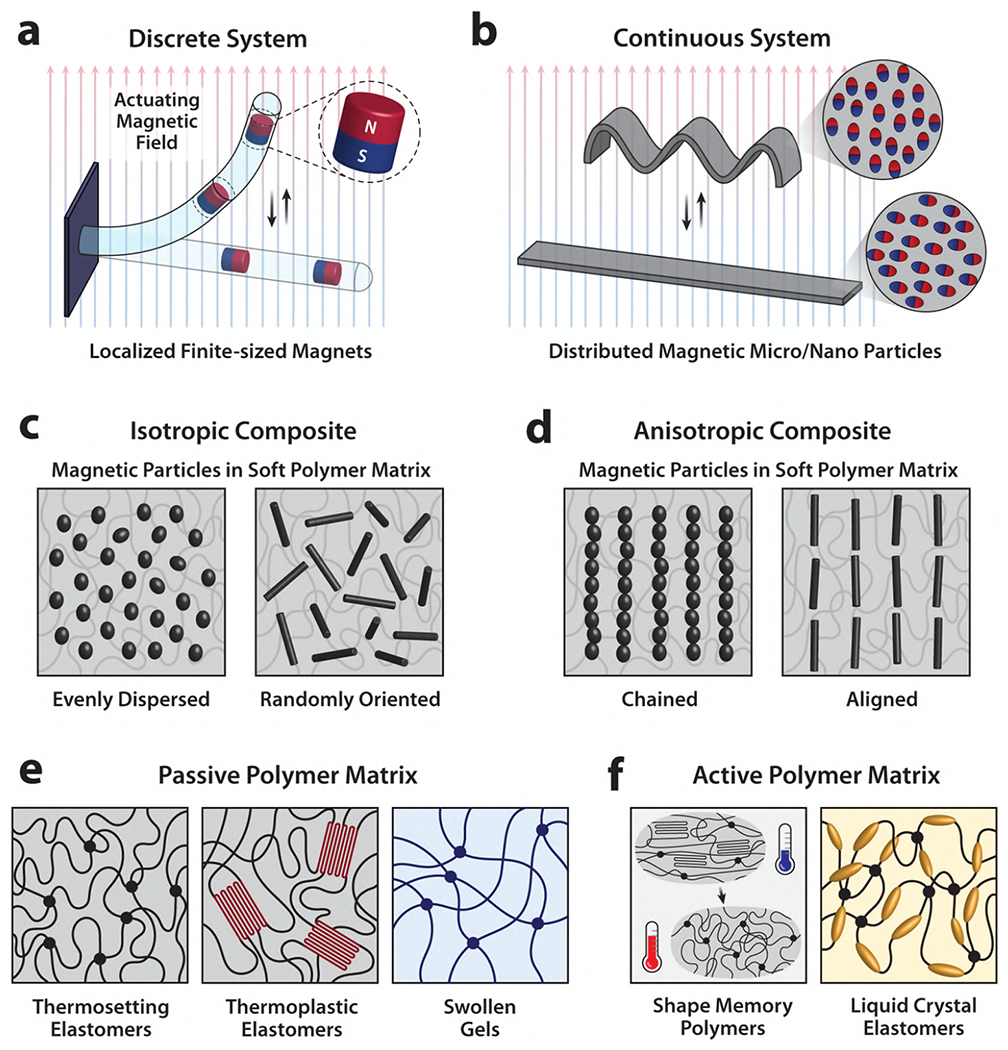
Figure 1.
Figure 1.. Classification and composition of magnetic soft materials.
Magnetic soft materials can be classified into either (a) discrete or (b) continuous systems depending on whether the magnetic components are in the form of finite-sized magnets embedded in the flexible structure or micro- or nanoparticles dispersed in the soft polymer matrix. Continuous magnetic soft materials can be further categorized into either (c) mechanically isotropic or (d) anisotropic composites depending on the microscopic structure or arrangement of the magnetic filler particles in the host polymer matrix. The polymeric component of magnetic soft materials can be classified into either (e) passive polymeric materials such as thermosetting or thermoplastic elastomers and swollen gels or (f) active polymeric materials such as shape memory polymers or liquid crystal elastomers depending on whether the polymer matrices themselves are responsive to external stimuli to change their physical properties or produce actuation via deformation.
Figure 2.
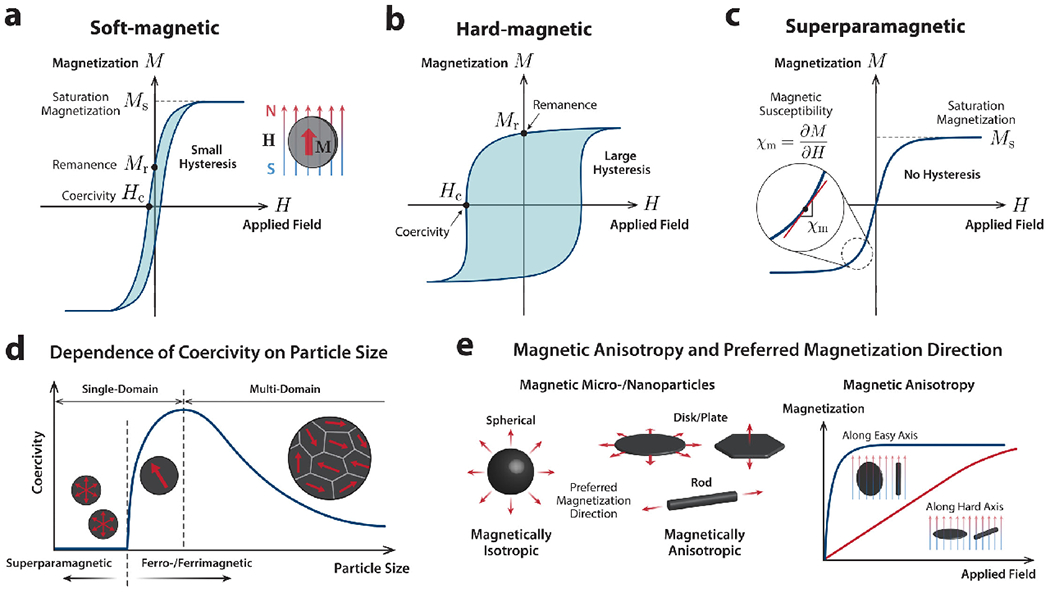
Figure 2.. Classification of magnetic materials and characteristics of magnetic particles with different sizes and shapes.
(a-c) Magnetic component of magnetic soft materials can be divided into three categories (soft-magnetic, hard-magnetic, and superparamagnetic) depending on their magnetization characteristics. In general, soft-magnetic materials are characterized by their high saturation magnetization (Ms), low coercivity (Hc), and low remanence (Mr) with narrow hysteresis curves, whereas hard-magnetic materials are characterized by large hysteresis due to their high coercivity and remanence. Superparamagnetic materials exhibit no hysteresis and become quickly saturated under relatively low fields. (d) Qualitative behavior of coercivity of magnetic particles depending on their size. The coercivity increases as the particles become smaller to approach the single-domain regime, but the coercivity disappears below a certain critical size to enter the superparamagnetic regime as the smaller particles become more susceptible to thermal fluctuation and hence cannot retain stable magnetism in the absence of external fields. (e) Magnetic particles can also be classified into magnetically isotropic or anisotropic particles depending on their particle morphology and preferred magnetization direction.
Figure 3.
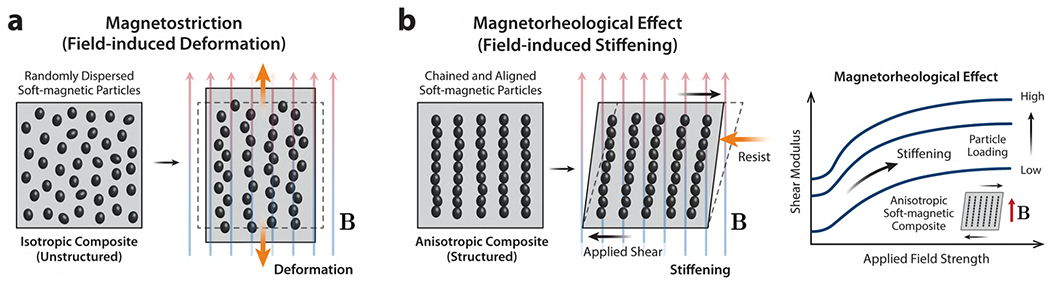
Figure 3.. Traditional magnetic soft materials and their response to externally applied magnetic fields.
(a) Field-induced deformation (magnetostriction) of isotropic soft-magnetic soft materials with randomly dispersed particles. (b) Field-induced stiffening (magnetorheological effect) of anisotropic soft-magnetic soft materials with chained particles.
Figure 4.
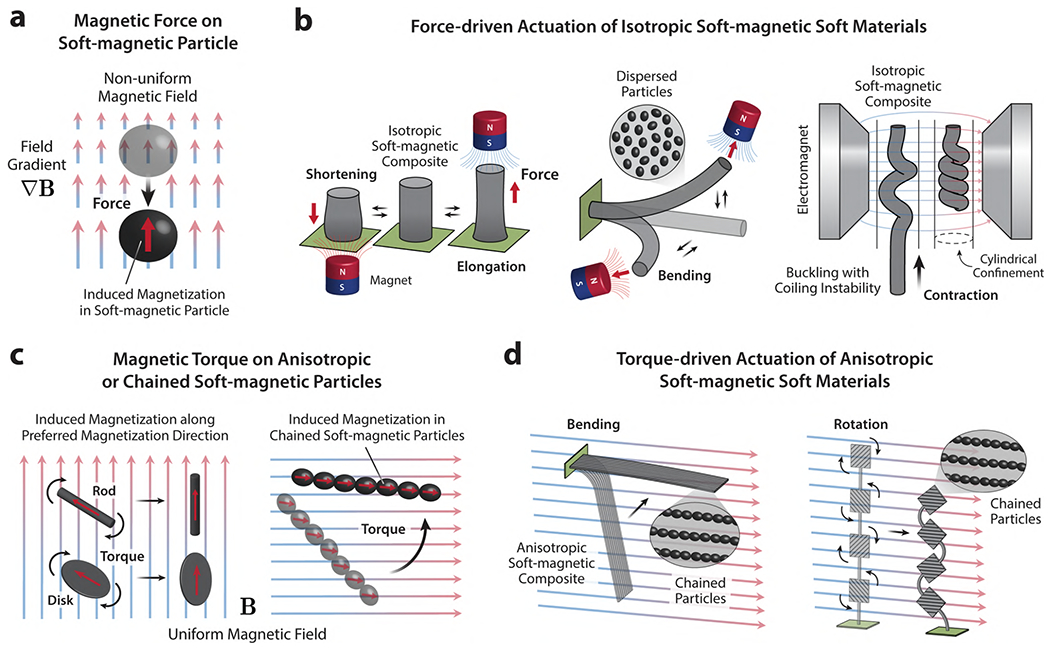
Figure 4.. Different actuation modes of soft-magnetic soft materials.
(a) Magnetic force acting on a single soft-magnetic particle under spatially nonuniform magnetic fields. (b) Force-driven actuation modes for isotropic soft-magnetic soft composites under spatially nonuniform actuating fields: shortening, elongation, bending, and contraction based on buckling and coiling instability. (c) Magnetic torque acting on anisotropic or chained soft-magnetic particles under spatially uniform magnetic fields. (d) Torque-driven actuation of anisotropic soft-magnetic soft composites with chained soft-magnetic particles. It should be noted that the principle of torque-driven actuation of anisotropic composites based on chained soft-magnetic microparticles also holds for superparamagnetic nanoparticles.,
Figure 5.
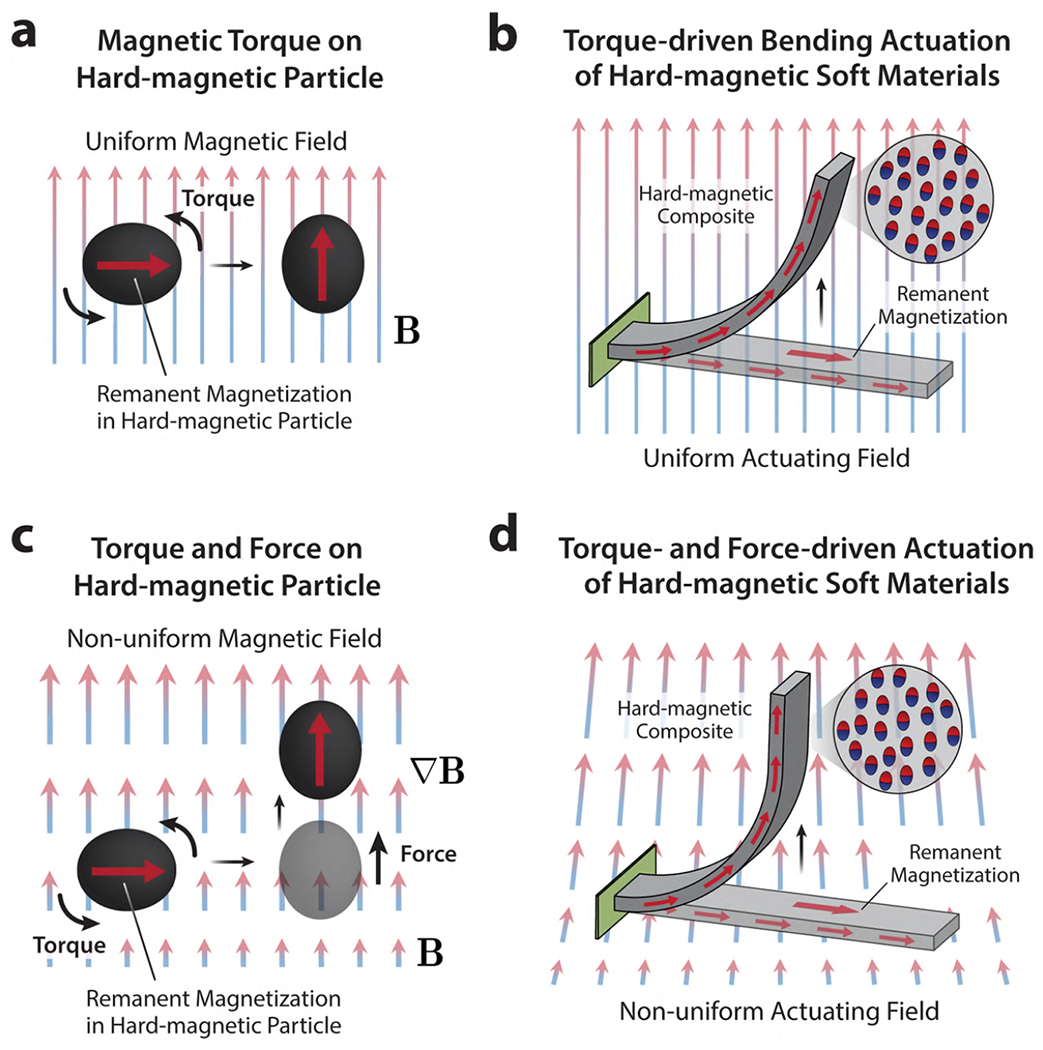
Figure 5.. Torque- and force-driven bending actuation of hard-magnetic soft materials.
(a) Magnetic torque acting on a magnetized hard-magnetic particle under a spatially uniform magnetic field. (b) Rectangular beam made of a hard-magnetic soft composite that is uniformly magnetized along the length direction and its torque-driven bending actuation under a uniform actuating field that is applied perpendicularly to the beam’s remanent magnetization. (c) Magnetic torque and force acting on a magnetized hard-magnetic particle under a spatially nonuniform magnetic field, in which the particle not only rotates due to the magnetic torque but also moves toward the direction of the increasing field due to the attractive magnetic force. (d) Bending actuation of hard-magnetic soft materials under nonuniform actuating fields is initially driven by the magnetic torque and further supported by the increasing magnetic force as the body deforms to align its remanent magnetization with the applied field.
Figure 6.
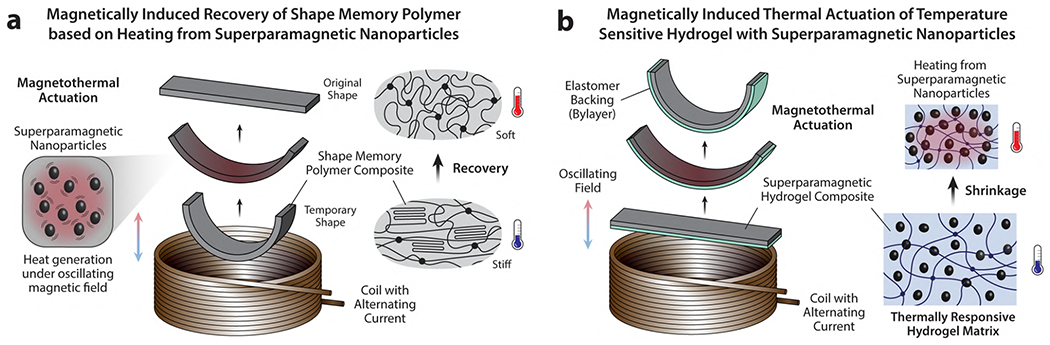
Figure 6.. Magnetothermal actuation of superparamagnetic soft materials based on thermally responsive polymer matrices.
The programmed shape changes of the composite structures are triggered by field-induced heating through thermal relaxation of the embedded superparamagnetic nanoparticles under alternating fields, which leads to (a) recovery of the shape memory polymer into the original shape or (b) deswelling (shrinkage) of the temperature-sensitive hydrogel in the form of bilayer structure.
Figure 7.
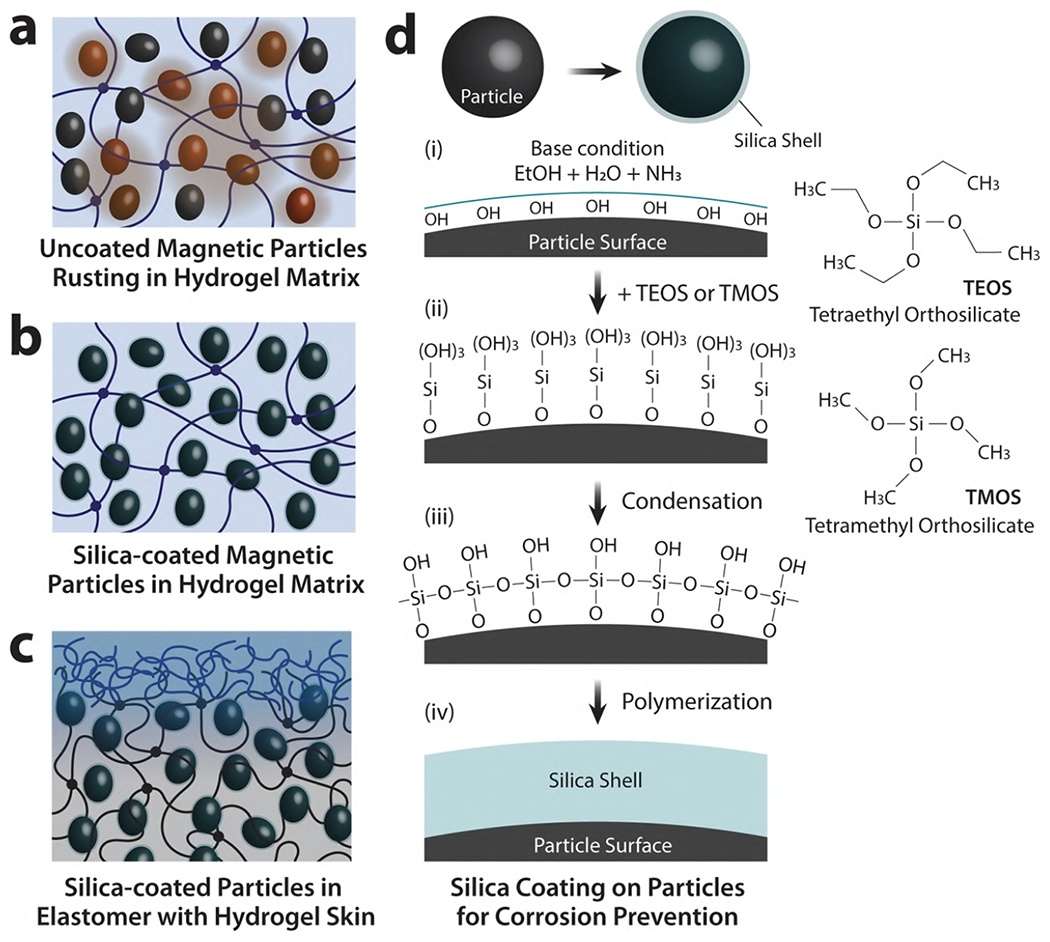
Figure 7.. Silica coating on magnetic particles for corrosion prevention.
(a) Corrosion of ferromagnetic particles in the aqueous environment of magnetic soft composites based on hydrogels. Silica-coated ferromagnetic particles for corrosion prevention in (b) hydrogel-based composites or (c) elastomer-based composites with hydrogel skin for biocompatibility and lubrication. (d) Schematic of the polycondensation reaction of tetraethyl and tetramethyl orthosilicate (TEOS/TMOS) in the presence of catalysts under basic conditions, in which the nucleation and polymerization of TEOS/TMOS give rise to cross-linked layers of silica around the magnetic particles.
Figure 8.
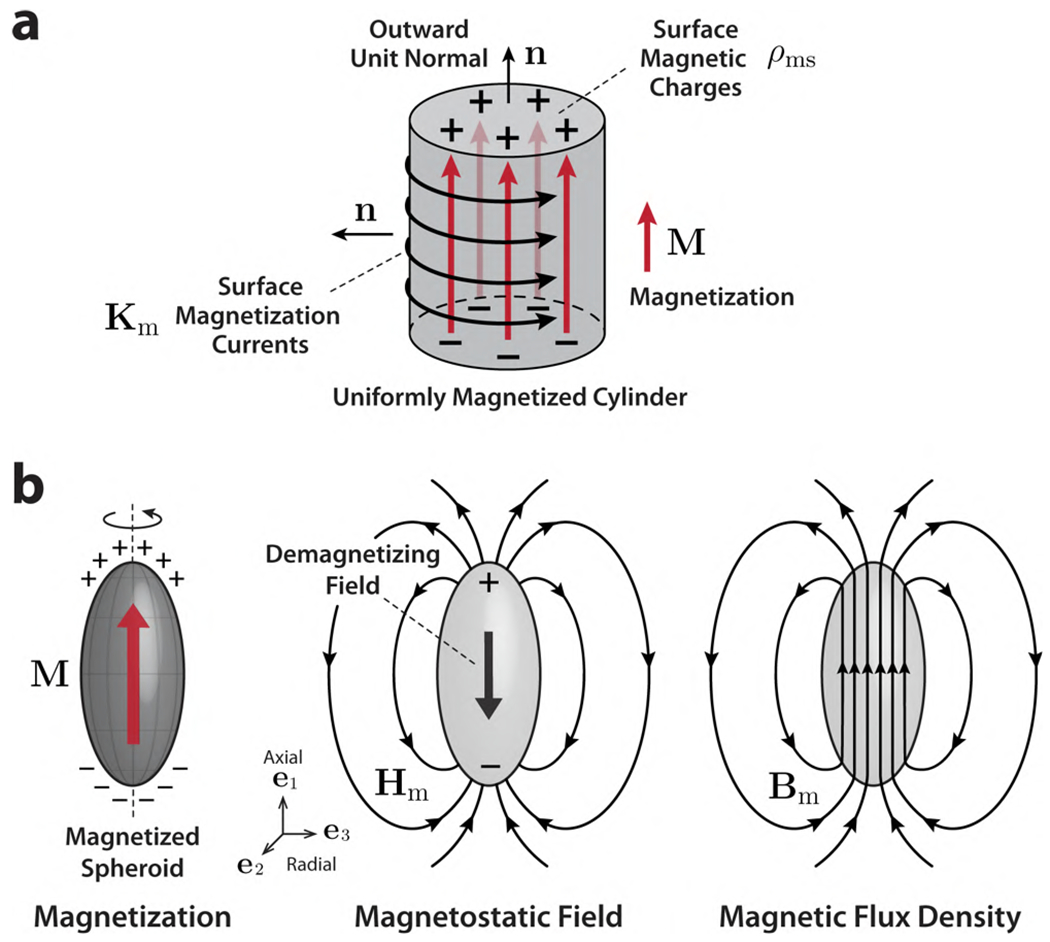
Figure 8.. Graphical representation of a uniformly magnetized body.
(a) Uniformly magnetized cylinder with graphical representations of the surface magnetic charges (ρms) and the magnetization currents (Km). (b) Magnetization (M), magnetostatic field (Hm), and magnetic flux density (Bm) of a uniformly magnetized spheroid, which represent the effect of a demagnetizing field inside the magnetized body.
Figure 9.
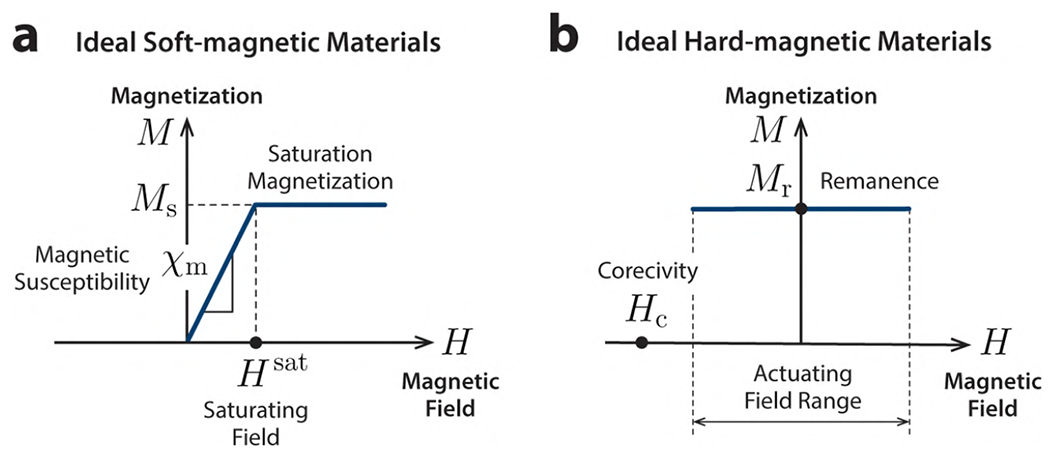
Figure 9.. Idealized magnetic constitutive laws for soft-magnetic and hard-magnetic materials.
(a) Ideal soft-magnetic materials are characterized by the linear relationship between the induced magnetization and the magnetic field with constant magnetic susceptibility before saturation and constant magnetization after saturation without magnetic hysteresis (zero remanence and coercivity). (b) Ideal hard-magnetic soft materials are characterized by large magnetic hysteresis (high remanence and coercivity) to maintain the remanence under an actuating field below the coercivity.
Figure 10.
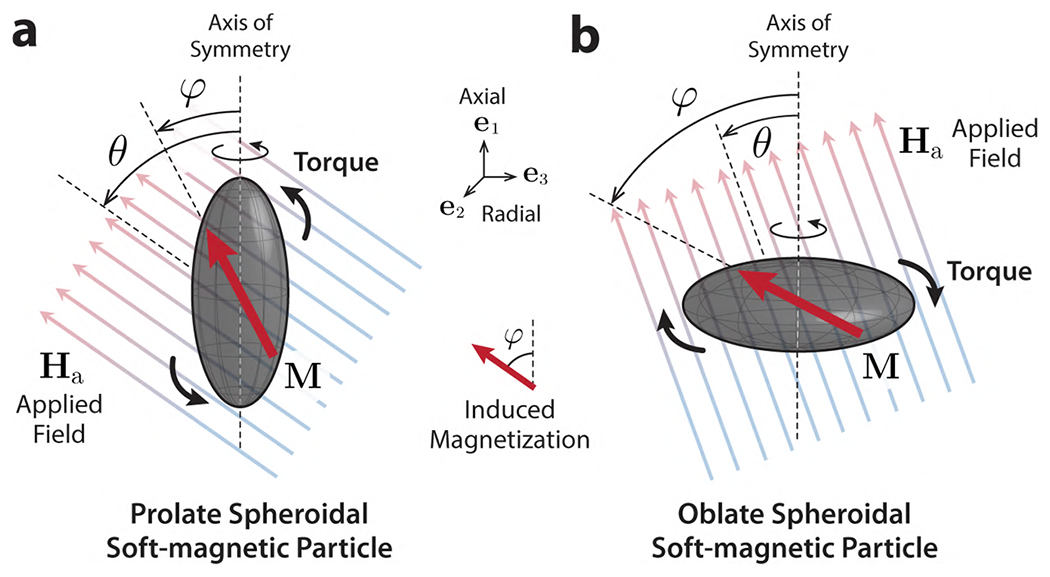
Figure 10.. Anisotropic soft-magnetic particles of spheroidal shape.
(a) Prolate and (b) oblate spheroidal (ellipsoid with axis symmetry) soft-magnetic particles under externally applied magnetic fields (at an angle θ relative to the symmetry axis) and the induced magnetization (at an angle φ relative to the symmetry axis) that is not parallel to the applied field due to the presence of shape anisotropy.
Figure 11.
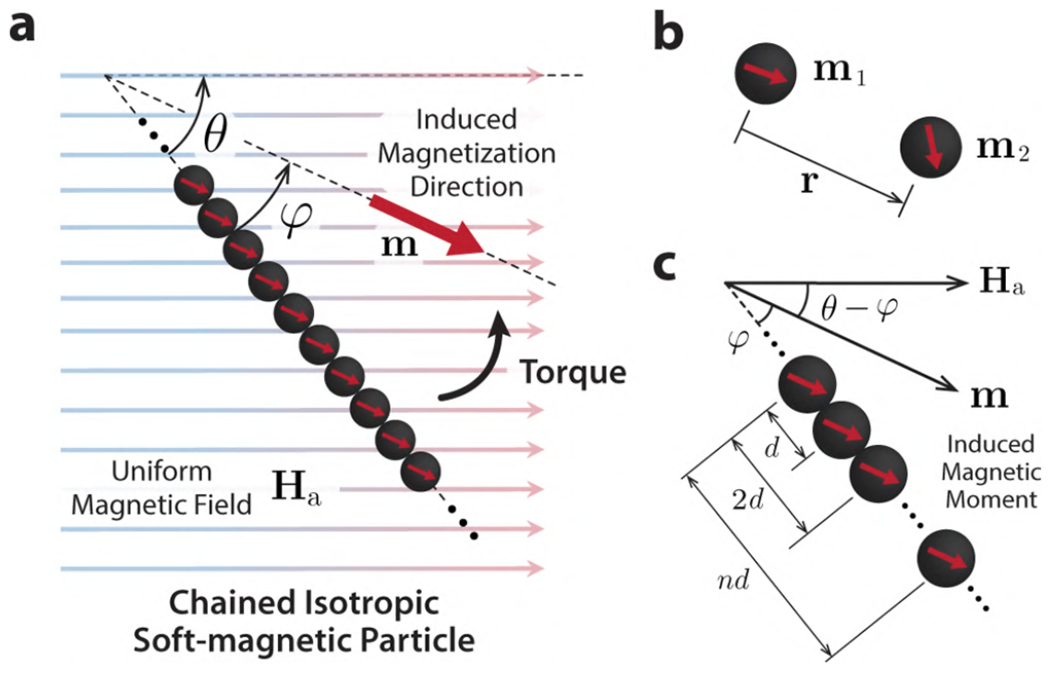
Figure 11.. Modeling of the magnetic torque produced by chained soft-magnetic particles.
(a) Isotropic (spherical) soft-magnetic particles connected to form a chain. The chain of identical isotropic particles as a whole can be considered a rod-like anisotropic particle that produces induced magnetization (at an angle φ relative to the chain) under an applied uniform field (at an angle θ relative to the chain) to generate the magnetic torque. (b) Magnetostatic interaction between two magnetic dipoles under the influence of their dipolar fields on each other. (c) Modeling the magnetostatic dipolar interaction of a particle in the chain with its neighboring particles on both sides at distances of d, 2d, …, nd under the assumption of a sufficiently long chain.
Figure 12.
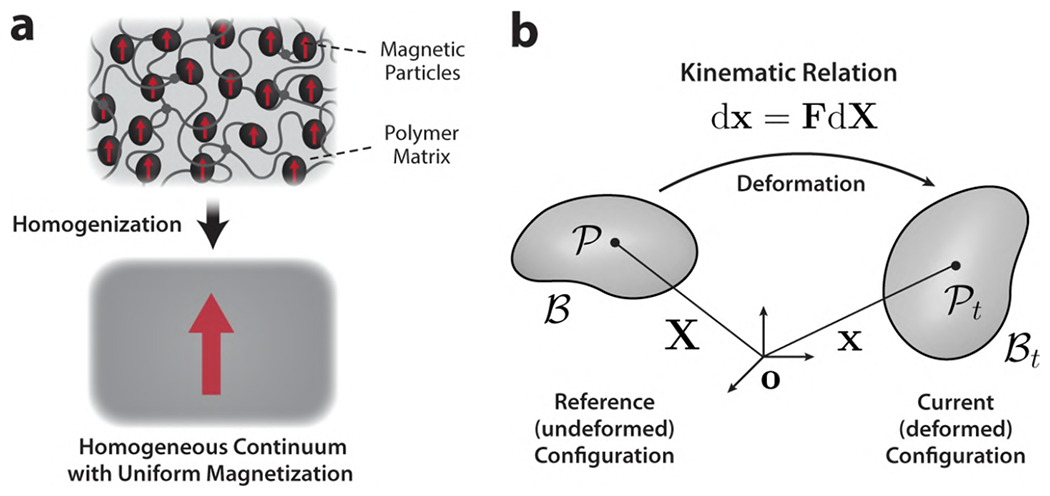
Figure 12.. Continuum mechanical framework for magnetic soft materials.
(a) Treatment of magnetic soft composites based on polymer matrices with filler particles as a homogeneous continuum with uniform magnetization for continuum mechanical approaches. (b) Kinematic relation for deformable solids in the continuum mechanical framework.
Figure 13.
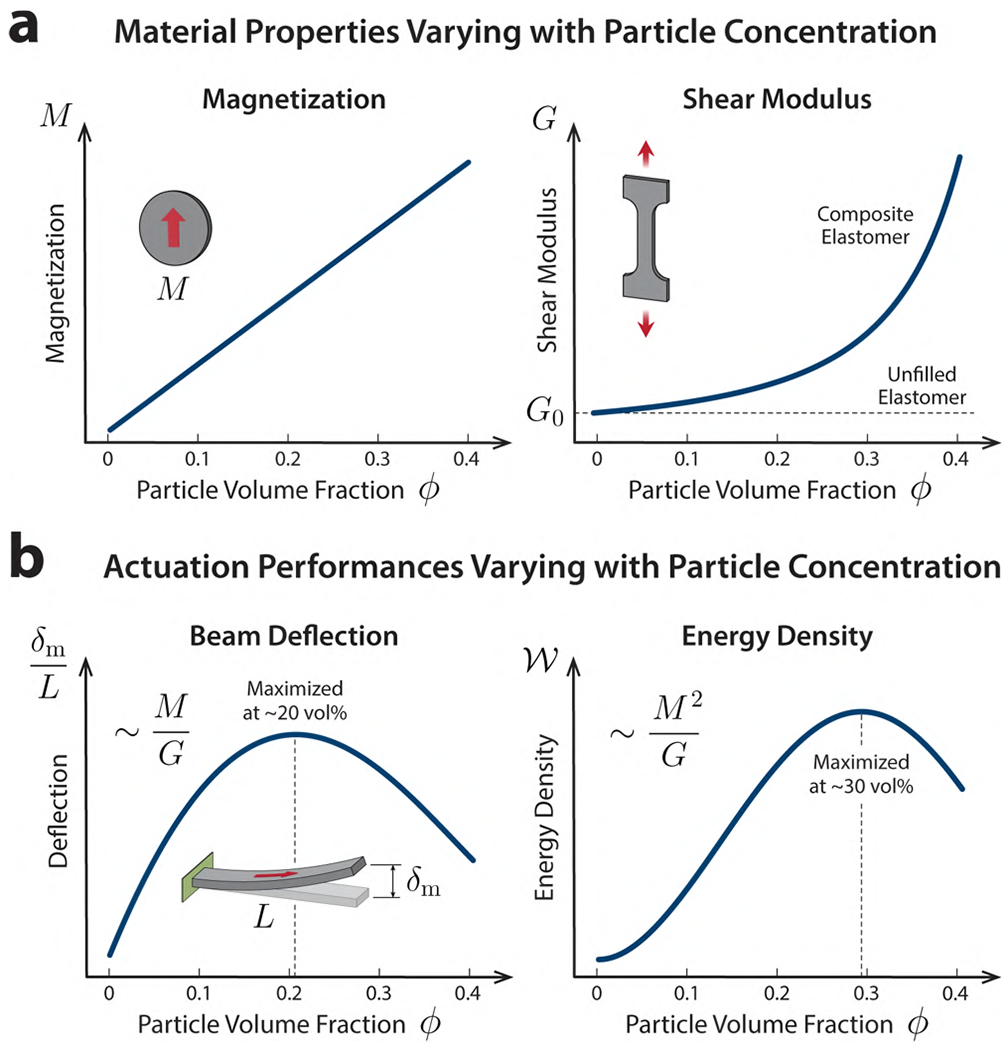
Figure 13.. Design optimization of magnetic composites based on soft polymers with embedded hard-magnetic particles.
(a) Material properties (magnetization and shear modulus) of magnetic soft composites varying with the particle volume fraction. (b) Actuation performance of magnetic soft bending actuators in terms of the free-end deflection (normalized by the beam length L) and energy density varying with the particle volume fraction.
Figure 14.
Figure 14.. Fabrication and magnetic shape-programming methods for magnetic soft materials.
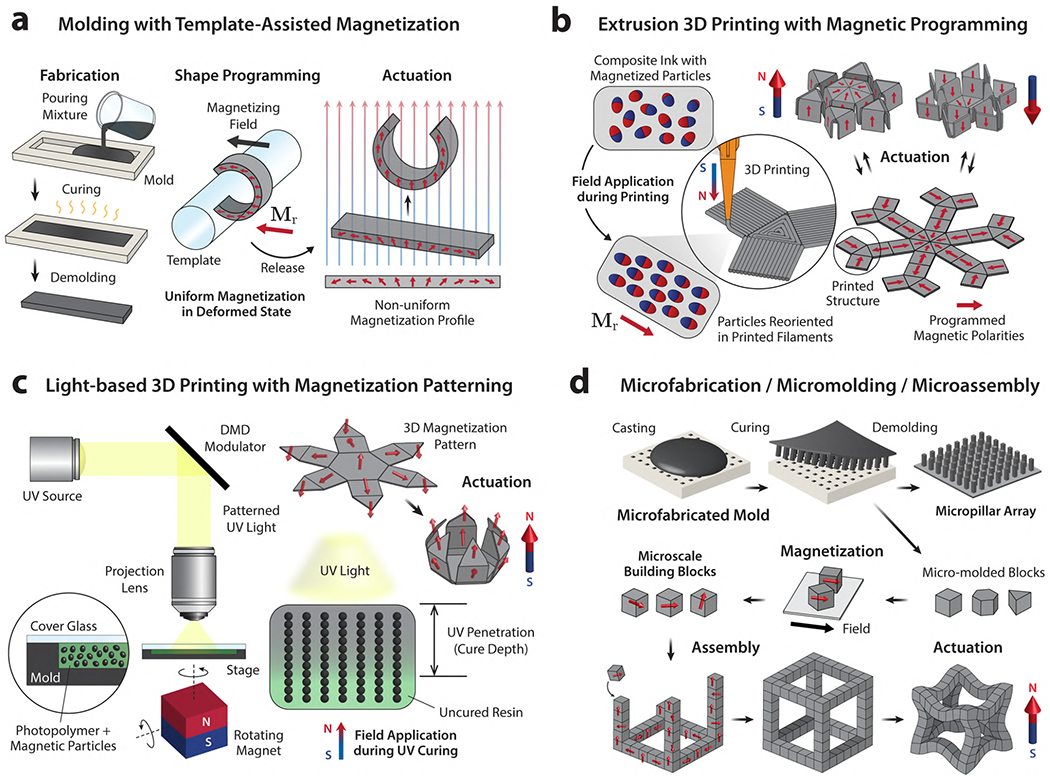
(a) Molding and casting for fabrication and templated-assisted magnetization for shape programming to obtain a nonuniform magnetization profile. (b) Extrusion-based 3D printing of magnetic composites containing magnetized particles that can be reoriented by the applied magnetic field during the printing process to program desired magnetization patterns in the printed structure. (c) Light-based 3D printing or UV photolithography of magnetic composites based on photocurable resins mixed with magnetic particles, which can be aligned to form chains along the applied field direction during the UV curing process to create desired magnetization patterns in the printed structure. (d) Fabrication of micropillar arrays or microscale building blocks through molding of magnetic soft composites using microfabricated molds. Microscale building blocks based on hard-magnetic composites can be magnetized and assembled into 3D structures capable of programmed shape changes under applied magnetic fields due to the designed magnetization patterns.
Figure 15.
Figure 15.. Head-assisted magnetic reprogramming strategies for hard-magnetic soft materials.
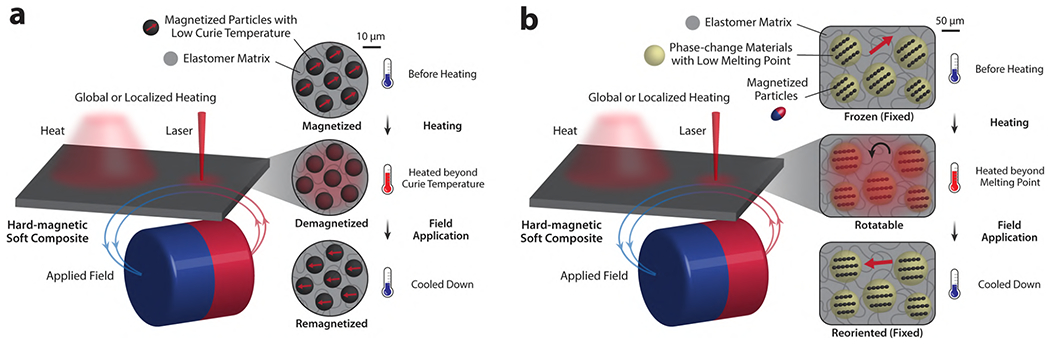
(a) Magnetic materials with low Curie temperature (above which the material loses its remanent magnetization) can be easily demagnetized upon global heating or localized laser heating above the Curie point and then remagnetized by an externally applied magnetic field during cooling. (b) Hard-magnetic particles encapsulated in phase-change materials with low melting temperature can temporarily move and rotate when heated above the melting point to reorient themselves along the applied field during the heating process. Upon cooling, the reoriented particles are immobilized within the solidified phase-change material to yield a newly programmed magnetization direction in the composite.,
Figure 16.
Figure 16.
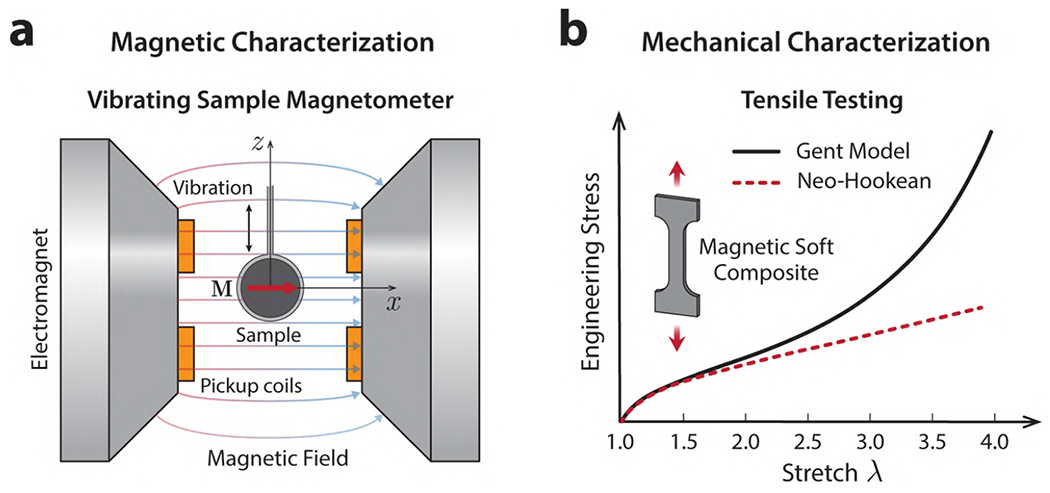
(a) Magnetic characterization of magnetic materials using a vibrating sample magnetometer (VSM) and (b) mechanical characterization of elastomeric composites through tensile testing, where the obtained stress-strain curve can be fitted with hyperelastic constitutive models such as Gent or neo-Hookean models.
Figure 17.
Figure 17.. Magnetic actuation and manipulation platforms based on permanent magnets.
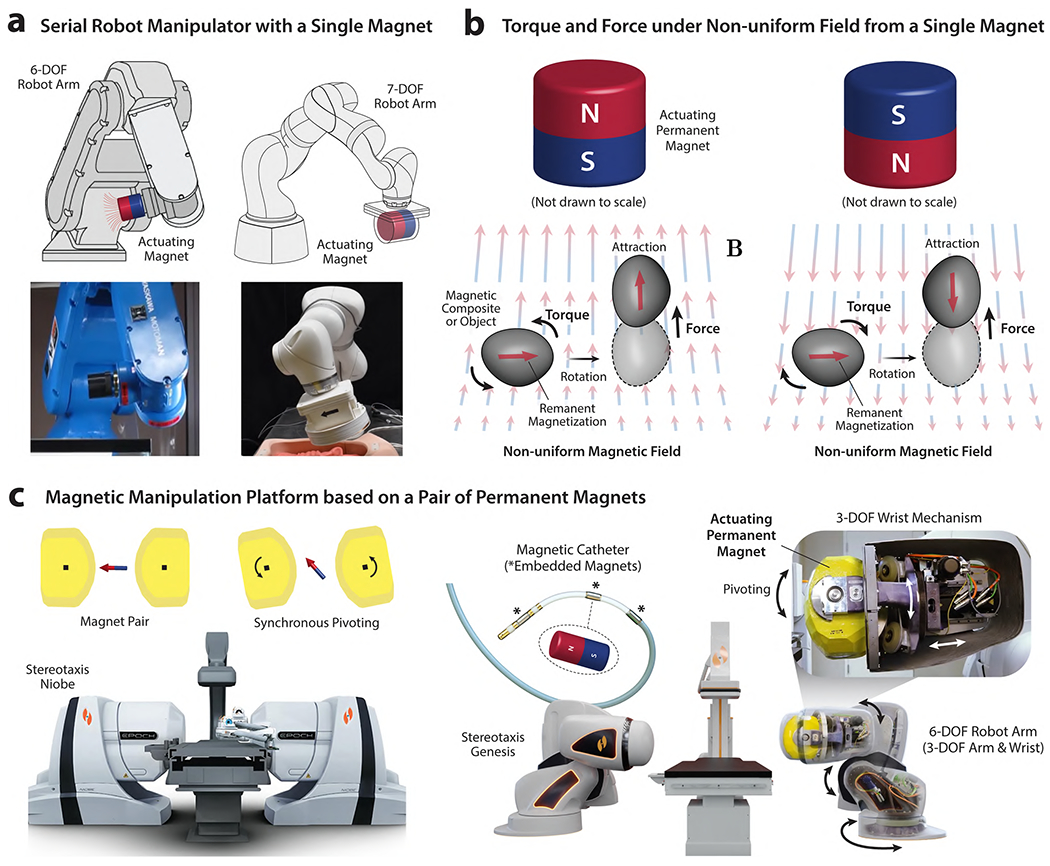
(a) Multi-DOF serial robot manipulators with a single actuating magnet attached at the end for steering untethered or tethered magnetic devices. (b) Magnetic torque and force on a hard-magnetic object in spatially nonuniform fields from a single actuating magnet. (c) Stereotaxis Niobe and Genesis platforms based on a pair of large permanent magnets for steering magnetic catheters by changing the applied field direction through synchronous pivoting of the actuating magnets. Panel (a) reproduced with permission from refs and . Copyright 2016 SAGE Publications and 2019 American Association for the Advancement of Science.
Figure 18.
Figure 18.. Magnetic actuation and manipulation platforms based on orthogonally arranged or specially shaped electromagnetic coils.
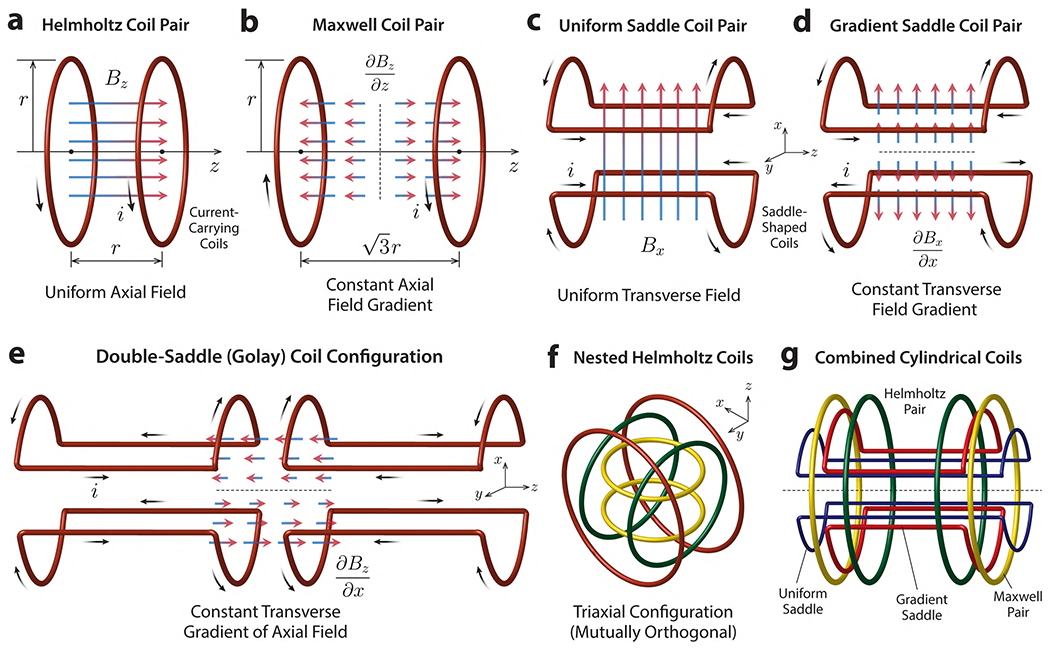
(a) Helmholtz and (b) Maxwell coil pairs for creating a uniform axial field (Helmholtz) or field gradient (Maxwell). Saddle-shaped coil pair for creating (c) a uniform transverse field or (d) a constant transverse field gradient depending on the direction of currents. (e) Golay coil configuration based on two saddle coil pairs for creating a constant transverse gradient of the axial magnetic field. (f) Nested Helmholtz coils in mutually orthogonal triaxial configuration for creating uniform actuating fields in three different directions. (g) Combination of different coil-pair types for multi-DOF magnetic manipulation based on magnetic torques and forces in a cylindrical workspace.
Figure 19.
Figure 19.. Magnetic actuation and manipulation platforms based on electromagnets.
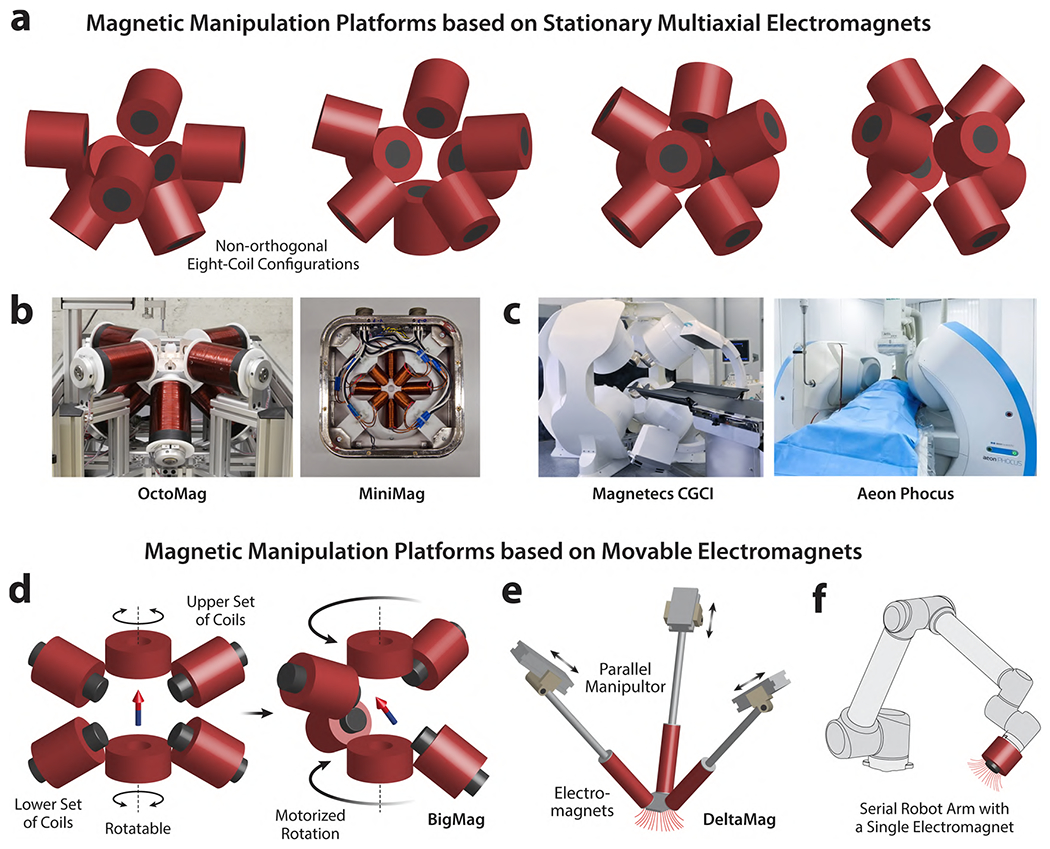
(a) Representative examples of magnetic actuation and manipulation platforms based on stationary multiaxial electromagnets in nonorthogonal eight-coil configurations, and commercially available systems for (b) table-top and (c) human-body scales. Magnetic manipulation platforms based on movable electromagnets: (d) motorized actuation of rotatable electromagnets, and (e) a parallel, or (f) a serial robot manipulator for controlling the position and orientation of the actuating electromagnet in the workspace. Photo on the right in panel (b) reproduced with permission from ref . Copyright 2014 Springer Nature.
Figure 20.
Figure 20.. Small-scale untethered soft robots based on magnetic soft materials.
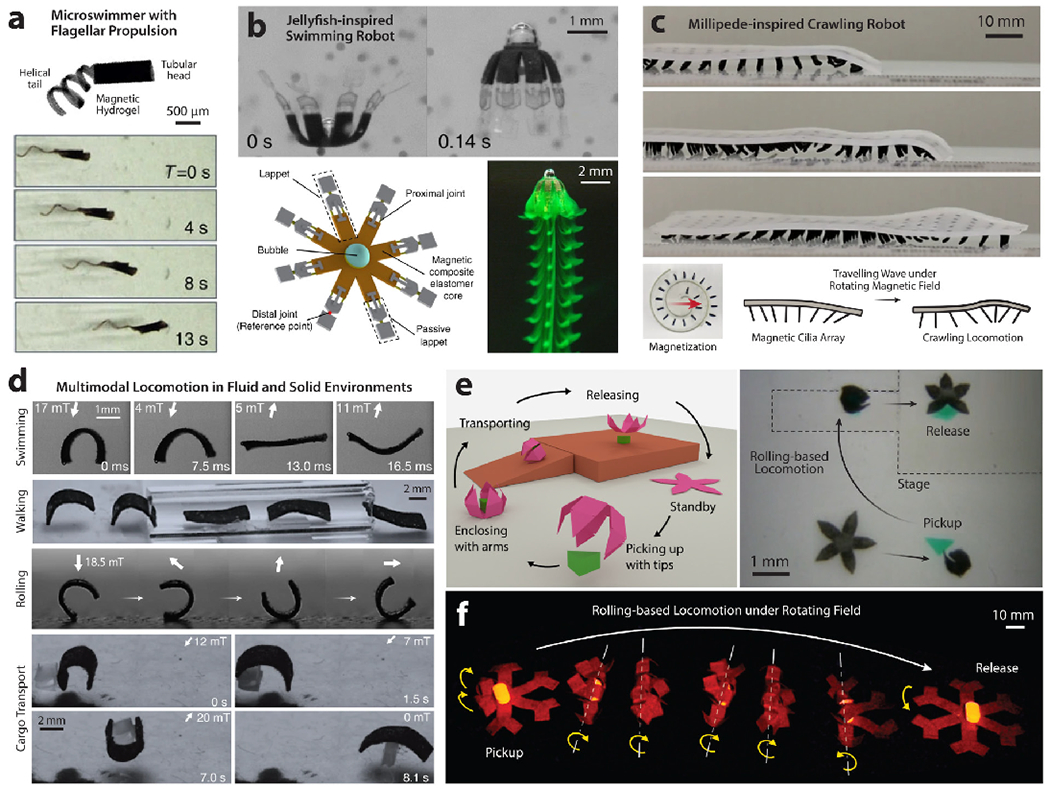
(a) Microswimmer based on magnetic hydrogel mimicking the helical propulsion of bacterial flagella under rotating magnetic fields. (b) Bioinspired magnetic soft robots based on hard-magnetic soft composites mimicking the swimming motion of a jellyfish under alternating magnetic fields. (c) Millipede-inspired crawling robot with an array of hard-magnetic cilia with different magnetization directions to produce traveling waves under a rotating magnetic field for crawling locomotion. (d-f) Magnetic soft robots based on hard-magnetic composites exhibiting multimodal locomotion such as swimming, walking, and rolling in fluid/solid environments as well as cargo transport through spatiotemporal control of the actuating magnetic fields. Panel (a) reproduced with permission from ref (Copyright 2016 Springer Nature); panel (b) from ref (Copyright 2019 Springer Nature); panel (c) from ref (Copyright 2020 Springer Nature); panel (d) from ref (Copyright 2018 Springer Nature); panel (e) from ref (Copyright 2019 American Association for the Advancement of Science); and panel (f) from ref (Copyright 2018 Springer Nature).
Figure 21.
Figure 21.. Applications of magnetic soft materials for magnetically reconfigurable active origami and metamaterials.
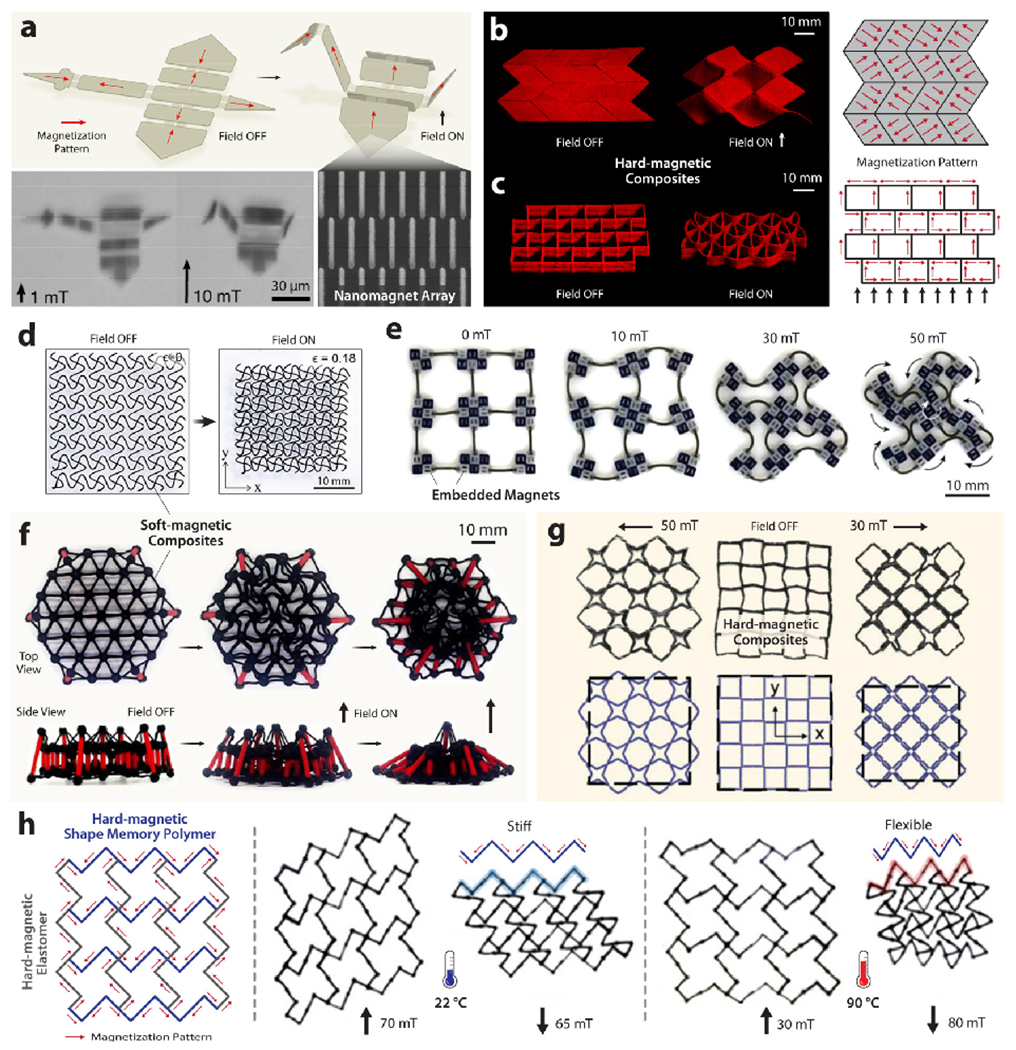
(a) Rigid panels with patterned nanomagnet arrays connected by microfabricated hinges morphing into a microscopic crane upon the application of an external magnetic field. (b) Miura-ori fold made of a hard-magnetic soft composite encoded with alternating oblique patterns of magnetic polarities. Auxetic structures with negative Poisson’s ratios based on 3D-printed (c) hard-magnetic (torque-driven) and (d) soft-magnetic (force-driven) composites exhibiting shrinkage in both length and width under applied magnetic fields. (e) Torque-driven auxetic behavior of a manually assembled structure based on embedded magnets connected by flexible members. (f) Tensegrity structure based on injection-molded soft-magnetic soft composites exhibiting force-driven auxetic behavior under an applied magnetic field. (g) 2D lattice structure based on manually assembled hard-magnetic composites connected by asymmetrically bendable joints exhibiting different torque-driven auxetic behavior depending on the applied field direction for magnetically tunable acoustic properties. (h) 3D-printed 2D lattice structure based on hard-magnetic elastomer and shape memory polymer exhibiting temperature-dependent torque-driven auxetic behavior. Panel (a) is reproduced with permission from refs and (Copyright 2019 Springer Nature); panels (b) and (c) from ref (Copyright 2018 Springer Nature); panel (d) from ref (Copyright 2019 Wiley); panel (e) from ref (Copyright 2019 American Association for the Advancement of Science); panel (f) from ref (Copyright 2020 American Association for the Advancement of Science); panel (g) from ref (Copyright 2021 Wiley); and panel (h) from ref (Copyright 2021 American Chemical Society).
Figure 22.
Figure 22.. Applications of magnetic soft materials for programmable and reconfigurable surfaces.
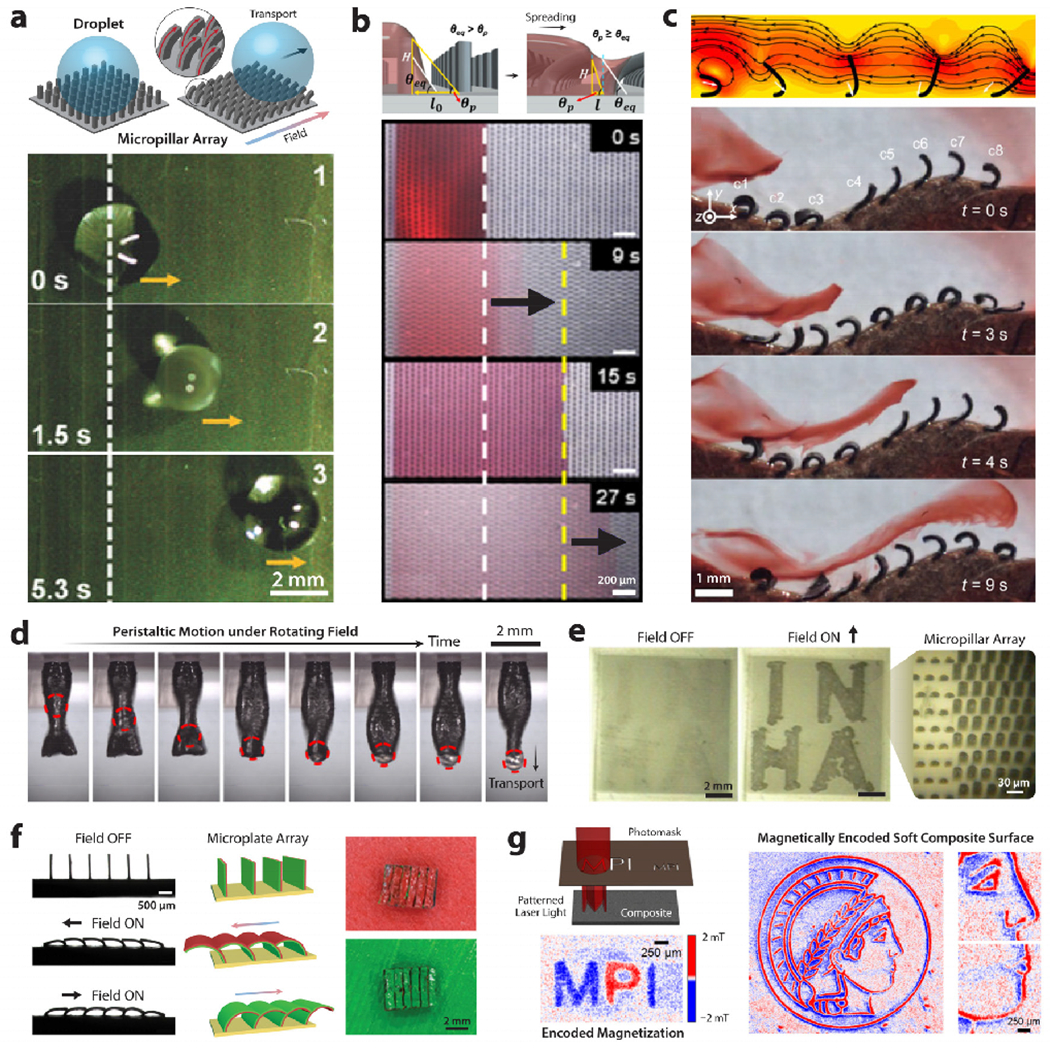
Hard-magnetic micropillar arrays (a) transporting liquid droplets and (b) spreading liquids using magnetically controlled deformation of the pillars. (c) Hard-magnetic cilia transporting fluids through traveling metachronal waves under rotating magnetic fields. (d) Peristaltic pump based on microassembled hard-magnetic composites for transporting particles or liquids under rotating magnetic fields. (e) Hard-magnetic micropillar array with encrypted patterns that can be revealed under an applied magnetic field. (f) Hard-magnetic microplate array with each side of the plate colored differently to realize magnetically controlled active camouflage. (g) Hard-magnetic soft composite based on materials with low Curie point (e.g., CrO2) and laser-assisted heating for spatially selective remagnetization (left). A magnetic soft composite surface encoded with a complex magnetization pattern through contact transfer of the magnetization profile from a magnetic master under global heating of the composite while in contact with the master surface (right). Panel (a) is reproduced with permission from ref (Copyright 2018 Wiley); panel (b) from ref (Copyright 2020 American Chemical Society); panel (c) from refs and (Copyrights 2020 American Association for the Advancement of Science and 2011 Cambridge University Press); panel (d) from ref (Copyright 2021 American Association for the Advancement of Science); panel (e) from ref (Copyright 2020 American Chemical Society); panel (f) from ref (Copyright 2019 Wiley); and panel (g) from ref (Copyright 2020 American Association for the Advancement of Science).
Figure 23.
Figure 23.. Applications of magnetic soft materials for soft and flexible electronic devices.
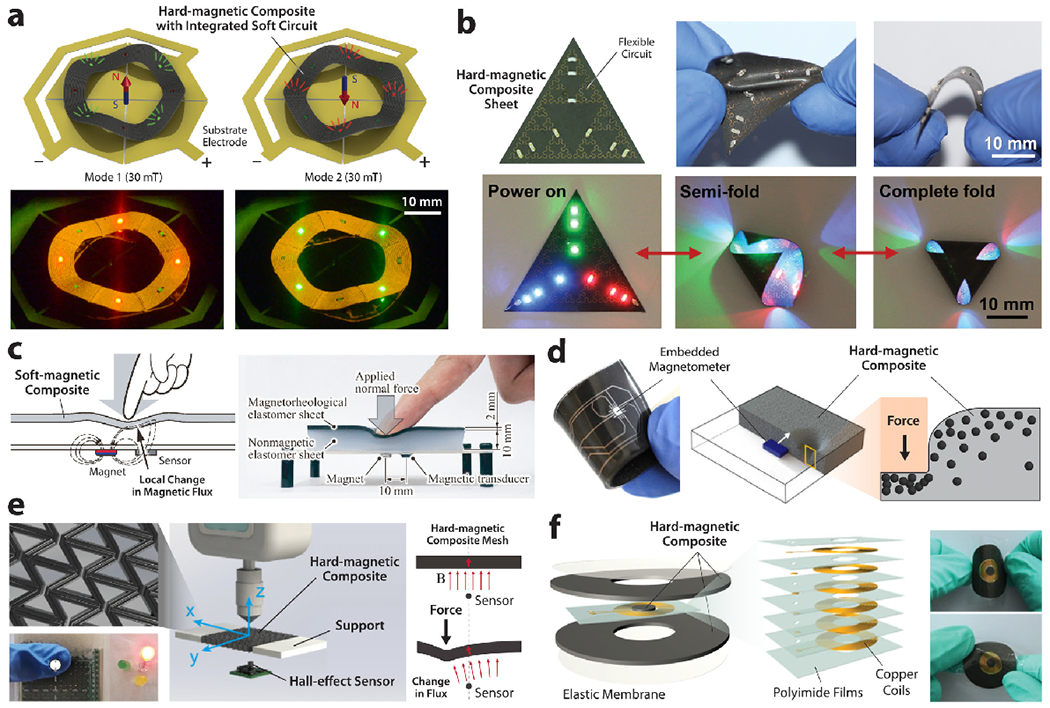
(a) Magnetically reconfigurable soft electronic device based on 3D-printed hard-magnetic composite (Figure 9b) with an integrated soft circuit to exhibit different functions corresponding to its shapes under the applied fields. (b) Hard-magnetic composite with electroplated flexible (serpentine) circuits. Tactile sensors based on (c) soft-magnetic and (d) hard-magnetic composite sheets and (e) 3D-printed hard-magnetic composite mesh with integrated hall-effect sensors to measure the change in the magnetic flux density due to the change in the position and orientation of the embedded hard- or soft-magnetic filler particles under local deformations. (f) Flexible vibration sensor based on hard-magnetic composites with integrated flexible coils. Panel (a) is reproduced with permission from ref (Copyright 2018 Springer Nature); panel (b) from ref (Copyright 2021 Wiley); panel (c) from ref (Copyright 2018 MDPI); panel (d) from ref (Copyright 2019 Wiley); panel (e) from ref (Copyright 2021 Elsevier); and panel (f) from ref (Copyright 2020 Wiley).
Figure 24.
Figure 24.. Applications of magnetic soft materials and robots for targeted delivery of therapeutics.
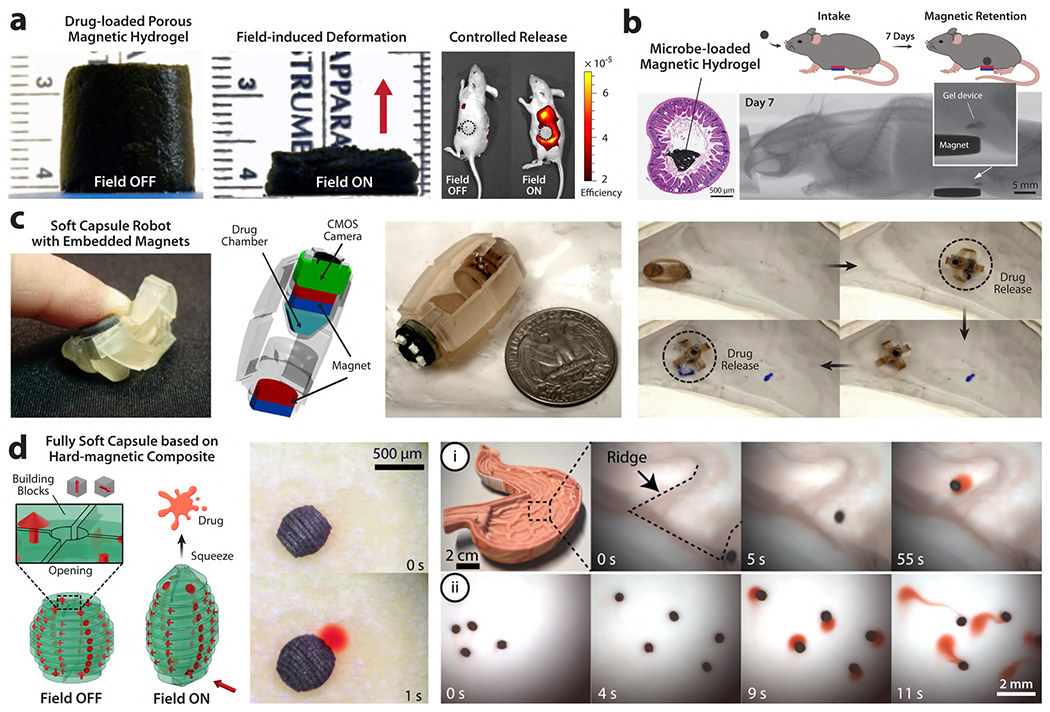
(a) Macroporous magnetic hydrogel for on-demand drug or cell delivery based on field-induced deformation. (b) Microbe-loaded magnetic hydrogel device for magnetically controlled transport and retention in the gastrointestinal tract. (c) Magnetic soft capsule robot with embedded magnets for targeted drug delivery and endoscopic imaging. (d) Magnetic soft capsules based on microassembled hard-magnetic composites (Figure 14d) that roll under weak rotating magnetic fields and squeeze themselves under a strong field to release liquid drugs. Panel (a) is reproduced with permission from ref (Copyright 2011 National Academy of Sciences); (b) from ref (Copyright 2021 Wiley); (c) from ref (Copyright 2012 IEEE); and (d) from ref (Copyright 2021 American Association for the Advancement of Science).
Figure 25.
Figure 25.. Applications of magnetic soft materials and robots for minimally invasive interventions.
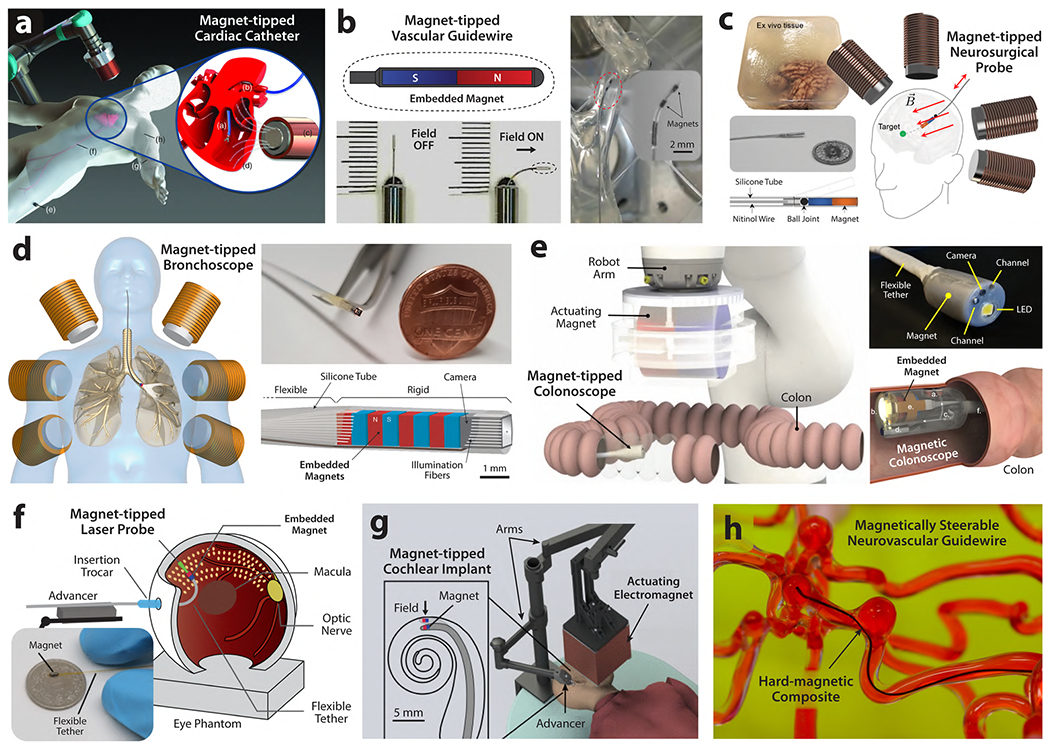
(a) Magnet-tipped catheters for cardiac applications, (b) magnet-tipped guidewires for endovascular navigation, (c) magnet-tipped flexible needles for minimally invasive neurosurgical applications. Magnetically steerable endoscopes for (d) lung airway (i.e., bronchoscope) and (e) colon lumen (i.e., colonoscope) inspections based on flexible tethered devices with embedded finite-sized magnets. (f) Magnetically steerable laser probe for ophthalmic surgical applications to treat retinal diseases. (g) Magnet-tipped cochlear implants for magnetically controlled robotic insertion. (h) Magnetically steerable guidewires based on hard-magnetic soft composites for navigation in the complex neurovasculature. Panel (a) is reproduced with permission from ref (Copyright 2018 IEEE); panel (b) from refs and (Copyrights 2006 Springer Nature and 2018 MDPI); panel (c) from ref (Copyright 2021 IEEE); panel (d) from ref (Copyright 2018 World Scientific Publishing); panel (e) from refs ,, (Copyrights 2019 IEEE, 2019 American Association for the Advancement of Science, and 2020 Springer Nature); panel (f) from ref (Copyright 2019 IEEE); panel (g) from ref (Copyright 2020 IEEE); and panel (h) from ref (Copyright 2019 American Association for the Advancement of Science).
Figure 26.
Figure 26.
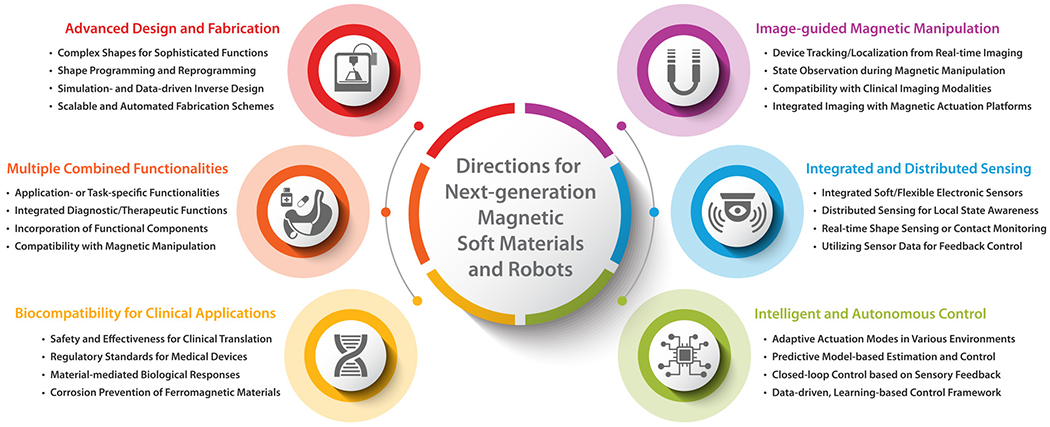
Future developments and research directions for next-generation magnetic soft materials and robots.

References

    1. Rus D; Tolley MT Design, Fabrication and Control of Soft Robots. Nature 2015, 521, 467–475. - PubMed
    1. Sitti M Miniature Soft Robots — Road to the Clinic. Nat. Rev. Mater 2018, 3, 74–75.
    1. Cianchetti M; Laschi C; Menciassi A; Dario P Biomedical Applications of Soft Robotics. Nat. Rev. Mater 2018, 3, 143–153.
    1. Ilievski F; Mazzeo AD; Shepherd RF; Chen X; Whitesides GM Soft Robotics for Chemists. Angew. Chem. Int. Ed 2011, 50, 1890–1895. - PubMed
    1. Laschi C; Mazzolai B; Cianchetti M Soft Robotics: Technologies and Systems Pushing the Boundaries of Robot Abilities. Sci. Robot 2016, 1, eaah3690. - PubMed

Publication types