. 2022 Feb 28;50(4):2074-2080.
doi: 10.1093/nar/gkac044.

Eukaryotic stress-induced mutagenesis is limited by a local control of translesion synthesis

Affiliations

Eukaryotic stress-induced mutagenesis is limited by a local control of translesion synthesis

Katarzyna H Masłowska et al. Nucleic Acids Res. .

Abstract

The DNA damage response (DDR) preserves the genetic integrity of the cell by sensing and repairing damages after a genotoxic stress. Translesion Synthesis (TLS), an error-prone DNA damage tolerance pathway, is controlled by PCNA ubiquitination. In this work, we raise the question whether TLS is controlled locally or globally. Using a recently developed method that allows to follow the bypass of a single lesion inserted into the yeast genome, we show that (i) TLS is controlled locally at each individual lesion by PCNA ubiquitination, (ii) a single lesion is enough to induce PCNA ubiquitination and (iii) PCNA ubiquitination is imperative for TLS to occur. More importantly, we show that the activation of the DDR that follows a genotoxic stress does not increase TLS at individual lesions. We conclude that unlike the SOS response in bacteria, the eukaryotic DDR does not promote TLS and mutagenesis.


Figures

Figure 1.
Figure 1.
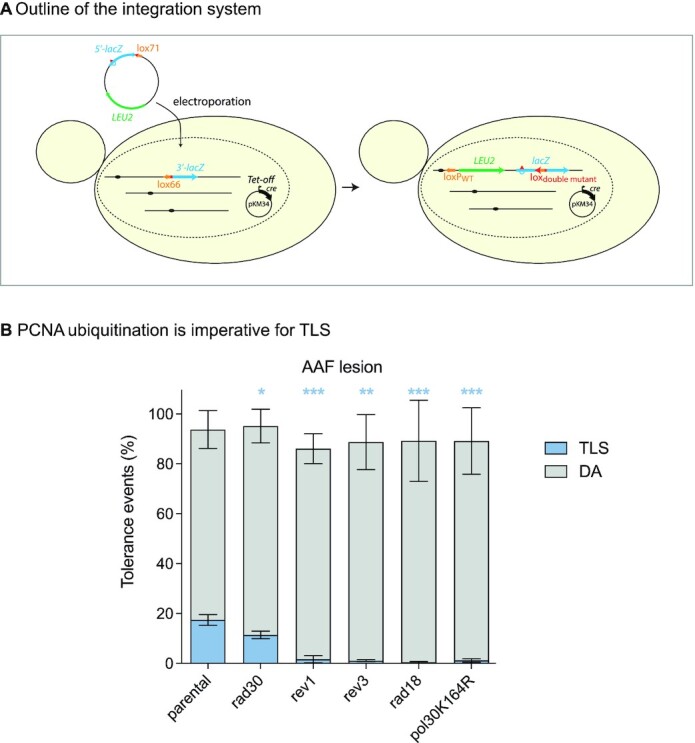
PCNA ubiquitination is imperative for TLS. (A) Outline of the integration system: A non-replicative plasmid containing a single lesion is integrated into a yeast chromosome using a Cre/lox site-specific recombination. The integrative vector carrying a selection marker (LEU2) and the 5′-end of the lacZ reporter gene containing a single lesion is introduced into a specific locus of the chromosome with the 3′-end of lacZ. The precise integration of the plasmid DNA into the chromosome restores a functional lacZ gene, enabling the phenotypical detection of TLS and DA events (as blue and white colonies on X-gal indicator media). (B) Bypass of the N2dG-AAF lesion in strains deficient in TLS polymerases (Rev1, Pol η/rad30, Pol ζ/rev3) and strains deficient in PCNA ubiquitination (rad18 and pol30K164R mutant). T-tests were performed to compare the TLS values from the different mutants to the parental strain: *p<0.05; **p<0.005; ***p<0.0005.
Figure 2.
Figure 2.
TLS is not modulated by a global stress response. (A) Partition of DNA Damage Tolerance events for different lesions (cis-syn TT dimer, (6-4)TT photoproduct and N2dG-AAF) non-treated (left) and treated with 4-NQO or UV irradiation (right) prior to the integration. No significant difference was observed between the non-treated and treated conditions. (B) Western blot analysis revealing FLAG-tagged PCNA shows that the electroporation conditions do not induce significant level of PCNA ubiquitination. Upon treatment, two bands appear that correspond to mono- and bi-ubiquitination of PCNA. In the pol30-K164R mutant, these two bands are no longer present since the site of ubiquitination of PCNA (lysine 164) is absent. In the ubc13 mutant, the polyubiquitination band is absent. (C) Western blot analysis revealing Rad53 phosphorylation in response to 4-NQO treatment.
Figure 3.
Figure 3.
UV-induced mutagenesis in E. coli and S. cerevisiae. E. coli mutants were scored as rifampicin resistant colonies, S. cerevisiae as canavanine resistant colonies. Each point represents the average and standard deviation of at least three independent experiments. The curve in red represents the fit following a quadratic equation for the Rif mutagenesis (R2= 0.93) or a linear fit for the Can mutagenesis (R2= 0.82).

References

    1. Hanawalt P.C. Historical perspective on the DNA damage response. DNA Repair (Amst). 2015; 36:2–7. - PMC - PubMed
    1. Friedberg E.C., Walker G.C., Siede W., Wood R.D., Schultz R.A., Ellenberger T.. DNA Repair And Mutagenesis. 2006; Washington, DC: Amer Society for Microbiology Press.
    1. Hoege C., Pfander B., Moldovan G.-L., Pyrowolakis G., Jentsch S.. RAD6-dependent DNA repair is linked to modification of PCNA by ubiquitin and SUMO. Nature. 2002; 419:135–141. - PubMed
    1. Branzei D., Seki M., Enomoto T.. Rad18/Rad5/Mms2-mediated polyubiquitination of PCNA is implicated in replication completion during replication stress. Gene. Cells. 2004; 9:1031–1042. - PubMed
    1. Branzei D., Szakal B.. DNA damage tolerance by recombination: molecular pathways and DNA structures. DNA Repair (Amst). 2016; 44:68–75. - PMC - PubMed

Publication types

MeSH terms

Substances

LinkOut - more resources