Statement on the active substance flupyradifurone

EFSA Panel on Plant Protection Products and their Residues (PPR) et al. EFSA J. .

Abstract

Flupyradifurone is a novel butenolide insecticide, first approved as an active substance for use in plant protection products by Commission Implementing Regulation (EU) 2015/2084. Following concerns that this substance may pose high risks to humans and the environment, the French authorities, in November 2020, asked the Commission to restrict its uses under Article 69 of Regulation (EC) No 1107/2009. To support this request, competent Authorities from France cited a series of literature papers investigating its hazards and/or exposure to humans and the environment. In addition, in June 2020, the Dutch Authorities notified the Commission, under Article 56 of Regulation (EC) No 1107/2009, of new information on flupyradifurone on the wild bee species Megachile rotundata. This notification is also referred to in the French notification on flupyradifurone. Consequently, the EFSA PPR Panel was mandated to quantify the likelihood of this body of evidence constituting proof of serious risks to humans or the environment. Therefore, the EFSA PPR Panel evaluated the likelihood of these studies indicating new or higher hazards and exposure to humans and the environment compared to previous EU assessments. A stepwise methodology was designed, including: (i) the initial screening; (ii) data extraction and critical appraisal based on the principles of OHAT/NTP; (iii) weight of evidence, including consideration of the previous EU assessments; (iv) uncertainty analysis, followed, whenever relevant, by an expert knowledge elicitation process. For the human health, only one study was considered relevant for the genotoxic potential of flupyradifurone in vitro. These data did not provide sufficient information to overrule the EU assessment, as in vivo studies already addressed the genotoxic potential of flupyradifurone. Environment: All available data investigated hazards in bee species. For honey bees, the likelihood of the new data indicating higher hazards than the previous EU assessment was considered low or moderate, with some uncertainties. However, among solitary bee species - which were not addressed in the previous EU assessment - there was evidence that Megachile rotundata may be disproportionately sensitive to flupyradifurone. This sensitivity, which may partially be explained by the low bodyweight of this species, was mechanistically linked to inadequate bodily metabolisation processes.

Keywords: bees; butenolide; environmental risk assessment; flupyradifurone; genotoxicity; insecticides; uncertainty analysis.


Figures

Figure 1
Figure 1
Summary of the RoB conducted for the in vitro lines of evidence. The results were reported per assessment endpoint categories (i.e. genotoxicity) and per specific assessment endpoint
Figure 2
Figure 2
Summary of the appraisal done on the assessment endpoints for acute exposure laboratory experiments with bees. The outcome takes into account the risk of bias and the precision for several criteria combined with a predefined algorithm (see Annex A). Green indicates low risk of bias or high precision (class 1), yellow moderate risk of bias (class 2 for external and internal validity), while red indicates high risk of bias (class 3) or low precision (class 2)
Figure 3
Figure 3
Summary of the appraisal done on the assessment endpoints for prolonged exposure laboratory experiments with bees. The outcome takes into account the risk of bias and the precision for several criteria combined with a predefined algorithm (see Annex A). Green indicates low risk of bias or high precision (class 1), yellow moderate risk of bias (class 2 for external and internal validity), while red indicates high risk of bias (class 3) or low precision (class 2)
Figure 4
Figure 4
Summary of the appraisal done on the assessment endpoints for laboratory experiments with bee larvae. The outcome takes into account the risk of bias and the precision for several criteria combined with a predefined algorithm (see Annex A). Green indicates low risk of bias or high precision (class 1), yellow moderate risk of bias (class 2 for external and internal validity), while red indicates high risk of bias (class 3) or low precision (class 2)
Figure 5
Figure 5
Summary of the appraisal done on the assessment endpoints for effect field experiments with bees. The outcome takes into account the risk of bias and the precision for several criteria combined with a predefined algorithm (see Annex A). Green indicates low risk of bias or high precision (class 1), yellow moderate risk of bias (class 2 for external and internal validity), while red indicates high risk of bias (class 3) or low precision (class 2)
Figure 6
Figure 6
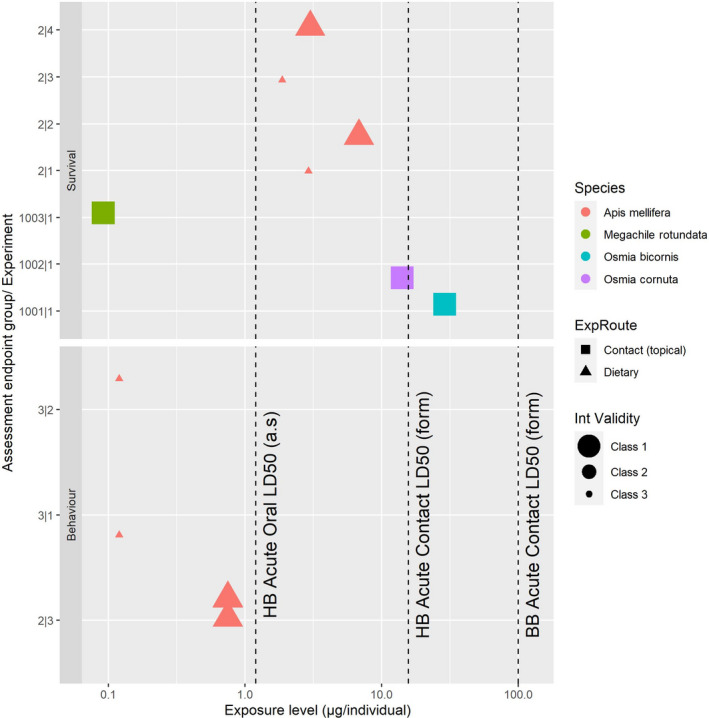
Summary plot of the acute bee data available for flupyradifurone. Each line on the y‐axis represents an experiment within a reference (e.g. XX|Y indicate experiment Y within reference XX), organised by assessment endpoint group. Colours identify the tested species, shapes the exposure route group and size of the markers identify the internal validity class (class 1 representing low risk of bias). All measured endpoints for survival are LD50, while all measured endpoints for behaviour are all NOED, with the only exception of one LOED at 0.75 µg a.s./bee for experiment 2|3. Vertical dashed lines highlight the endpoints available in the EU peer review (EFSA, 2015a)
Figure 7
Figure 7
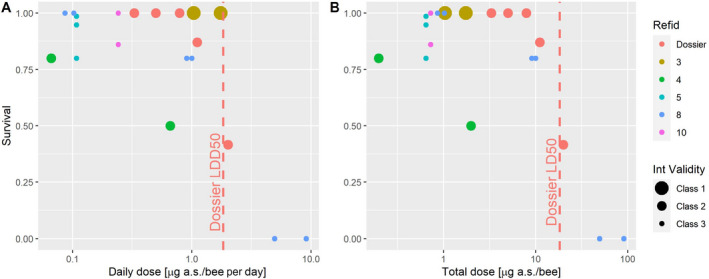
Survival data from the prolonged exposure experiments with honey bees available in the data package. The value from the dossier study is also reported with an arbitrary internal validity of 2, as it was considered acceptable but with some uncertainties in the previous peer review (EFSA, 2015a). (A) exposure as daily dose; (B) exposure as total dose. Vertical dashed lines indicate the 50% effect thresholds (as LDD50 in (A) and as LD50 in (B)) estimated in the available dossier study
Figure 8
Figure 8
Summary plot of the prolonged oral exposure of honey bees to flupyradifurone. Each line on the y‐axis represents an experiment within a reference (e.g. XX|Y indicate experiment Y within reference XX), organised by external validity class (class 1 representing low risk of bias). Colours identify the effect level, shapes the assessment endpoint group (‘other’ is used for Nosema infection intensity, as it could not be grouped with any of the other) and size of the markers identify the internal validity class (class 1 representing low risk of bias). Vertical dashed lines highlight the endpoint available in the EU peer review (EFSA, 2015a). Please note that such line represents an LDD50, while all other points from the new data are LOED and NOED. For a more informative comparisons of effect size, please see Figure 7
Figure 9
Figure 9
Summary plot of the data from experiments where honey bees were exposed to flupyradifurone as larvae. Each line on the y‐axis represents an experiment within a reference (e.g. XX|Y indicate experiment Y within reference XX), organised by external validity class (class 1 representing low risk of bias). Colours identify the effect level. Different shapes identify the assessment endpoint group (‘other’ is used for Nosema infection intensity, as it could not be grouped with any of the other). Marker size identify the internal validity (class 1 representing low risk of bias). Vertical dashed lines represent the endpoints available in the EU peer review (EFSA, 2015a). Note that three of the four survival endpoints in external class 1 are NOED, meaning that no effects were observed at the only tested dose. One point is marked as a LOED, however the corresponding effect size observed was extremely small (2–3%)
Figure 10
Figure 10
The acute toxicity of flupyradifurone, imidacloprid and thiacloprid (top to bottom) to Apis mellifera, Bombus terrestris, Megachile rotundata, Osmia bicornis and Osmia cornuta. Bee species were listed on the y axis, while the acute contact LD50 values were plotted as dots against the x axis. Unbounded (i.e. higher than) and exact values were colour coded as specified in the plot legend
Figure 11
Figure 11
The sensitivity of bees to flupyradifurone, imidacloprid and thiacloprid (top to bottom). Bee species were listed on the y axis, while the sensitivity ratio (i.e. calculated as the honey bee LD50 divided by the LD50 of other bee species) was reported on the x axis (base‐10 log scale). The dashed vertical line represents the sensitivity ratio = 10, used as default safety factor by EFSA (2013). Values on the right of the dashed line indicate higher sensitivity than what covered by previous assessments. The comparison is based on the bee 72 = h contact LD50 = 15.7 µg a.s. per bee (EFSA, 2015) from the formulation endpoint; however, the endpoint from the active substance study was higher
Figure 12
Figure 12
The interactive toxicity of imidacloprid (top) and thiacloprid (bottom) with the P450 inhibitors piperonyl butoxide (PBO – right) and 1‐aminobenzotriazole (ABT – left). The bee species were listed on the y axis, while the sensitivity ratio (i.e. the toxicity ratio of the pesticide alone/pesticide + synergist) was reported on the x axis (base‐10 log scale). Data points (dots) were colour‐coded by route of exposure, as specified in the plot legend. The dashed vertical lines represent the sensitivity ratio = 1, indicating no interactive toxicity. Data on the right side of the dashed line indicate higher sensitivity induced by the P450 inhibitor
Figure 13
Figure 13
Radioligand binding examined by displacement of tritiated imidacloprid by unlabelled imidacloprid, thiacloprid and flupyradifurone. Dots represent the half maximal inhibitory concentration IC50 (nM). Lower IC50 values indicate higher binding affinity
Figure 14
Figure 14
The resistance Ratio (RR) calculated as the ratio of the LC50s of flies expressing the transgene to the LC50s of flies not expressing the transgene (x = log scale). Values at the right of the dashed line indicate higher pesticide tolerance in transgenic flies
Figure A.1
Figure A.1
The heatmap summarising the outcome of the appraisal of bee laboratory experiments
Figure A.2
Figure A.2
The heatmap summarising the outcome of the appraisal of bee field effect experiments

References

    1. Al Naggar Y and Baer B, 2019. Consequences of a short time exposure to a sublethal dose of Flupyradifurone (Sivanto) pesticide early in life on survival and immunity in the honeybee (Apis mellifera). Scientific Reports, 9, 19753. 10.1038/s41598-019-56224-1 - DOI - PMC - PubMed
    1. Bayer , 2017a. Flupyradifurone SL 200: acute contact toxicity test with the solitary bee Osmia bicornis in the laboratory (non‐GLP study).
    1. Bayer , 2017b. Flupyradifurone SL 200: acute contact toxicity test with the solitary bee Osmia cornuta in the laboratory (non‐GLP study).
    1. Bayer , 2017c. Acute contact toxicity test with Flupyradifurone SL 200 with the solitary Leafcutter Bee (Megachile rotundata L.) in the laboratory (non‐GLP study).
    1. Beadle K, Singh KS, Troczka BJ, Randall E, Zaworra M, Zimmer CT, Hayward A, Reid R, Kor L, Kohler M, Buer B, Nelson DR, Williamson MS, Davies TGE, Field LM, Nauen R and Bass C, 2019. Genomic insights into neonicotinoid sensitivity in the solitary bee Osmia bicornis . PLoS Genetics, 15, e1007903. 10.1371/journal.pgen.1007903 - DOI - PMC - PubMed