. 2022 Mar 1;15(3):dmm049161.
doi: 10.1242/dmm.049161. Epub 2022 Mar 31.

Insights into cisplatin-induced neurotoxicity and mitochondrial dysfunction in Caenorhabditis elegans

Affiliations

Insights into cisplatin-induced neurotoxicity and mitochondrial dysfunction in Caenorhabditis elegans

Carmen Martínez-Fernández et al. Dis Model Mech. .

Abstract

Cisplatin is the most common drug in first-line chemotherapy against solid tumors. We and others have previously used the nematode Caenorhabditis elegans to identify genetic factors influencing the sensitivity and resistance to cisplatin. In this study, we used C. elegans to explore cisplatin effects on mitochondrial functions and investigate cisplatin-induced neurotoxicity through a high-resolution system for evaluating locomotion. First, we report that a high-glucose diet sensitizes C. elegans to cisplatin at the physiological level and that mitochondrial CED-13 protects the cell from cisplatin-induced oxidative stress. Additionally, by assessing mitochondrial function with a Seahorse XFe96 Analyzer, we observed a detrimental effect of cisplatin and glucose on mitochondrial respiration. Second, because catechol-O-methyltransferases (involved in dopamine degradation) are upregulated upon cisplatin exposure, we studied the protective role of dopamine against cisplatin-induced neurotoxicity. Using a Tierpsy Tracker system for measuring neurotoxicity, we showed that abnormal displacements and body postures in cat-2 mutants, which have dopamine synthesis disrupted, can be rescued by adding dopamine. Then, we demonstrated that dopamine treatment protects against the dose-dependent neurotoxicity caused by cisplatin.

Keywords: C. elegans; CRISPR-Cas9; Cisplatin; Glucose; Mitochondria; Neurotoxicity.


Conflict of interest statement

Competing interests E.N. received research support from Roche, Merck Serono, Bristol Myers Squibb and Pfizer, and participated in advisory boards or lectures from Bristol Myers Squibb, Merck Serono, Merck Sharpe & Dohme, Lilly, Roche, Pfizer, Takeda, Bayer, Boehringer Ingelheim, Amgen and AstraZeneca.

Figures
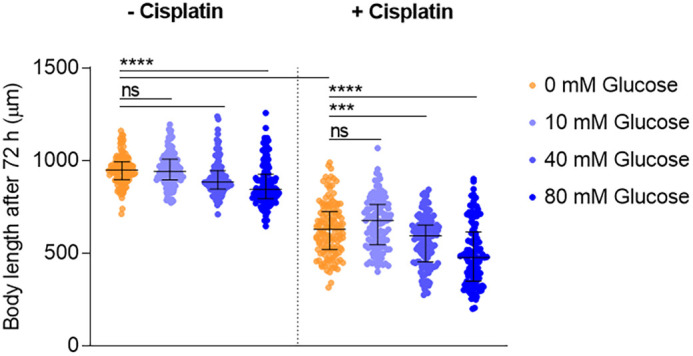
Fig. 1.
Fig. 1.
Glucose supplementation enhances cisplatin’s effect on C. elegans body length. The graph shows body length at 72 h post-seeding in L1 animals at 20°C, fed with different glucose concentrations, and exposed or not to 60 µg/ml cisplatin. Bars indicate the median and interquartile range, and dots indicate body length values of individual animals (50 animals per condition in each experiment) in three independent experiments. ns, non-significant; ***P<0.001, ****P<0.0001. Statistical analysis was performed with ordinary one-way ANOVA (Holm–Sidak's test).
Fig. 2.
Fig. 2.
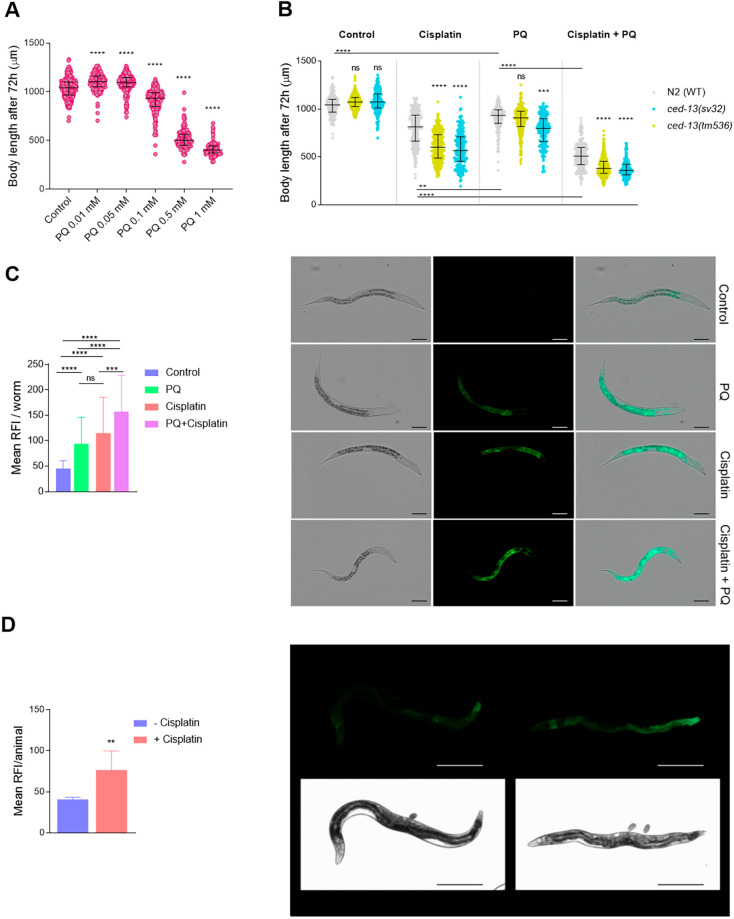
Cisplatin potentiates the effect of the pro-oxidant paraquat (PQ) and activates mitochondrial damage response pathways. (A) Dose-response curve showing PQ effect on wild-type (WT) animals' body length. Statistical analysis was performed with one-way ANOVA (Kruskal–Wallis and Dunn's tests). ****P<0.0001. (B) Additive effect of 60 µg/ml cisplatin and 0.1 mM PQ in WT and ced-13 mutants (sv32 and tm536). Statistical analysis was performed with one-way ANOVA (Kruskal–Wallis and Dunn's tests). ns, non-significant; ***P<0.001, ****P<0.0001, compared to WT in the same drug condition. Three independent experiments were performed, analyzing a total number of 150 animals per condition. (C) gst-4::GFP relative fluorescence intensity (RFI) in control, 60 µg/ml cisplatin, 0.1 mM PQ and combination of cisplatin and PQ-treated animals for 24 h from L1 stage. The experiment was performed three times, measuring 20 animals per condition. Statistical analysis was performed with one-way ANOVA (Kruskal–Wallis and Dunn's tests). ns, non-significant; ***P<0.001, ****P<0.0001. Representative differential interference contrast (DIC) and fluorescence images of animals expressing gst-4::GFP are shown on the right. Scale bars: 50 µm. (D) hsp-6::GFP relative fluorescence intensity (RFI) for control and 100 µg/ml cisplatin cisplatin-treated animals. Bars represent the mean of three independent experiments (10-15 animals per condition were analyzed in each experiment) and lines the s.d. Statistical analysis was performed with unpaired, two-tailed Student's t-test. **P<0.01. Representative DIC and fluorescence images of animals expressing hsp-6::GFP under control and cisplatin conditions are shown on the right. Scale bars: 250 µm.
Fig. 3.
Fig. 3.
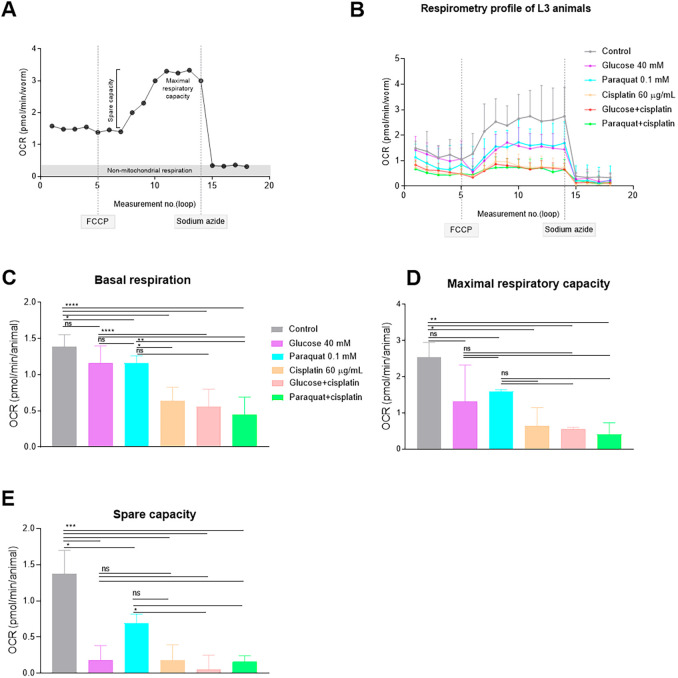
C. elegans respirometry evaluation. (A) Typical oxygen consumption rate (OCR) respirometry profile in adult C. elegans animals. Based on Koopman et al. (2016). This image is not published under the terms of the CC-BY license of this article. For permission to reuse, please see Koopman et al. (2016). Before drug injections, the respirometer informs about basal respiration. Then, FCCP injection disrupts the mitochondrial membrane potential and ATP synthesis while still allowing proton pumping, electron transport and oxygen consumption. Thus, FCCP enables the measurement of maximal respiratory capacity. The extraction of the basal respiration from the maximal respiratory capacity results in the spare respiratory capacity, a value indicating the organism’s ability to respond to increasing energy demands. Finally, injection of sodium azide blocks both cytochrome c oxidase (complex IV) and the ATP synthase (complex V), thereby shutting down the whole electron transport chain and allowing the distinguishing of non-mitochondrial oxygen consuming processes. (B) OCR profile of C. elegans L3 stage larvae in control and treated conditions. Connected points represent the median of the measures of each condition in a given loop and lines represent s.d. Dashed lines indicate FCCP and sodium azide injections. (C-E) Median and interquartile range are represented by bars and error bars, respectively, for basal respiration (C), maximal respiratory capacity (D) and spare capacity (E). This experiment was performed in triplicates, including eight biological replicates for each condition (a total of 160 animals per treatment). One-way ANOVA (Holm-Sidak's and Dunn's tests) was used to compare statistical differences between groups. ns, non-significant; *P<0.1, **P<0.01, ***P<0.001, ****P<0.0001. Data were analyzed using Agilent Seahorse XFe96 Analyzer, Seahorse Wave Desktop software and GraphPad Prism 8.0.
Fig. 4.
Fig. 4.
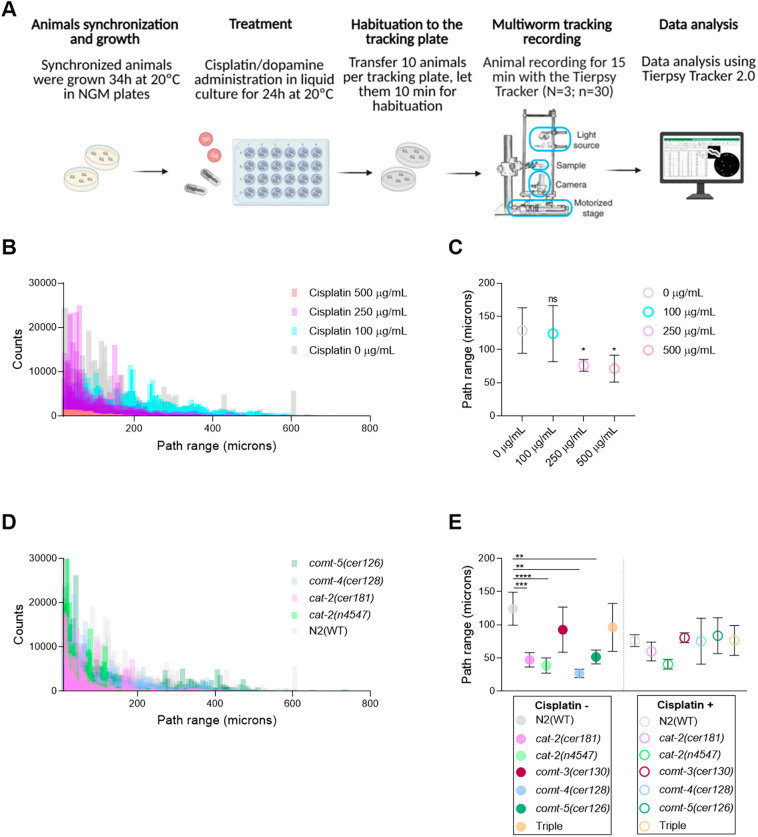
Neurotoxic evaluation using the Tierpsy Tracker in WT and dopamine (DA) signaling-related mutants. (A) Schematic representation of the experimental flow followed to evaluate neuronal functions under control and treated (cisplatin and DA) conditions. Created with Biorender.com. (B) Histograms show the dose-dependent effect of cisplatin on path range in WT animals. (C) Circles represent the mean path range of animals exposed to cisplatin; lines represent s.d. (D) Histograms represent the path range profile of WT, and cat-2, comt-4 and comt-5 mutants. (E) Circles represent the mean path range of animals exposed or not to 250 µg/ml cisplatin. Lines represent s.d. of two independent experiments. 30 animals per condition were evaluated in each experiment. Statistical analysis was performed with one-way ANOVA (Kruskal­­–Wallis and Dunn's tests). ns, non-significant; *P<0.1, **P<0.01, ***P<0.001, ****P<0.0001.
Fig. 5.
Fig. 5.
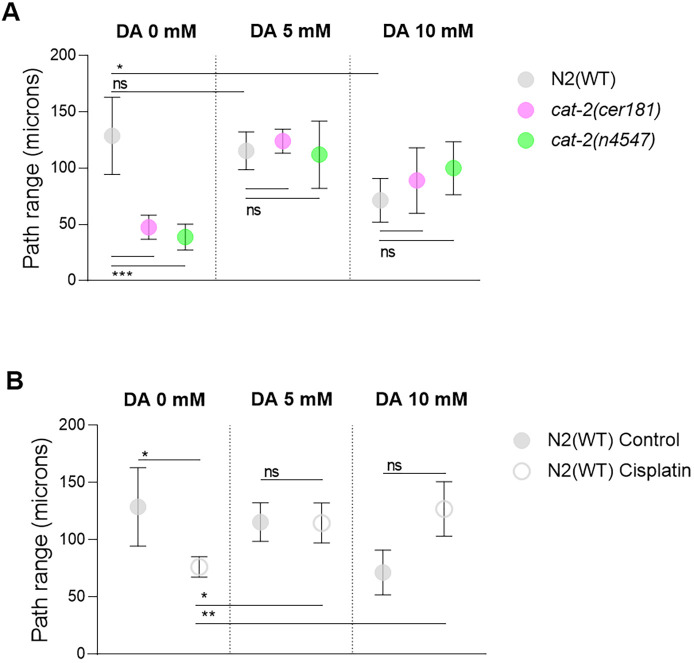
DA influences path range and protects from cisplatin-induced neurotoxicity. (A,B) DA rescues the behavioral defects of low-DA mutants (A) and 250 µg/ml cisplatin-exposed animals (B). Circles represent the mean path range of control animals or those exposed to cisplatin. Lines represent s.d. DA concentration is indicated at the top of the graphs. This experiment was performed three times. Control N2 (WT) samples are common for A and B. Three biological replicates were evaluated in each experiment, with a total of 30 animals per condition. Statistical analysis was performed with one-way ANOVA (Kruskal–Wallis and Dunn's tests). ns, non-significant; *P<0.1, **P<0.01.

References

    1. Alcántar-Fernández, J., González-Maciel, A., Reynoso-Robles, R., Pérez Andrade, M. E., Hernández-Vázquez, A. J., Velázquez-Arellano, A. and Miranda-Ríos, J. (2019). High-glucose diets induce mitochondrial dysfunction in Caenorhabditis elegans. PLoS ONE 14, e0226652. 10.1371/journal.pone.0226652 - DOI - PMC - PubMed
    1. Amable, L. (2016). Cisplatin resistance and opportunities for precision medicine. Pharmacol. Res. 106, 27-36. 10.1016/j.phrs.2016.01.001 - DOI - PubMed
    1. Arribere, J. A., Bell, R. T., Fu, B. X. H., Artiles, K. L., Hartman, P. S. and Fire, A. Z. (2014). Efficient marker-free recovery of custom genetic modifications with CRISPR/Cas9 in Caenorhabditis elegans. Genetics 198, 837-846. 10.1534/genetics.114.169730 - DOI - PMC - PubMed
    1. Barone, B. B., Yeh, H. C., Snyder, C. F., Peairs, K. S., Stein, K. B., Derr, R. L., Wolff, A. C. and Brancati, F. L. (2008). Long-term all-cause mortality in cancer patients with preexisting diabetes mellitus: a systematic review and meta-analysis. JAMA 300, 2754-2764. 10.1001/jama.2008.824 - DOI - PMC - PubMed
    1. Bergamino, M., Rullan, A. J., Saigí, M., Peiró, I., Montanya, E., Palmero, R., Ruffinelli, J. C., Navarro, A., Arnaiz, M. D., Brao, I.et al. (2019). Fasting plasma glucose is an independent predictor of survival in patients with locally advanced non-small cell lung cancer treated with concurrent chemoradiotherapy. BMC Cancer 19, 165. 10.1186/s12885-019-5370-5 - DOI - PMC - PubMed

MeSH terms