


Tongue and mouth imagery questionnaire (TMIQ) for assessing motor imagery vividness of the temporomandibular region: A reliability and validity case-control study
- PMID: 35108417
- PMCID: PMC9303445
- DOI: 10.1111/joor.13309
Tongue and mouth imagery questionnaire (TMIQ) for assessing motor imagery vividness of the temporomandibular region: A reliability and validity case-control study
Abstract
Background: To date, no validated assessment of motor imagery (MI) ability with temporomandibular disorders (TMD) exists preventing identification of good imagers and appropriate MI use during TMD rehabilitation.
Objective: To assess the reliability and construct validity of the previously developed Tongue and Mouth Imagery Questionnaire (TMIQ) compared with the gold-standard Kinaesthetic and Visual Imagery Questionnaire (KVIQ-10).
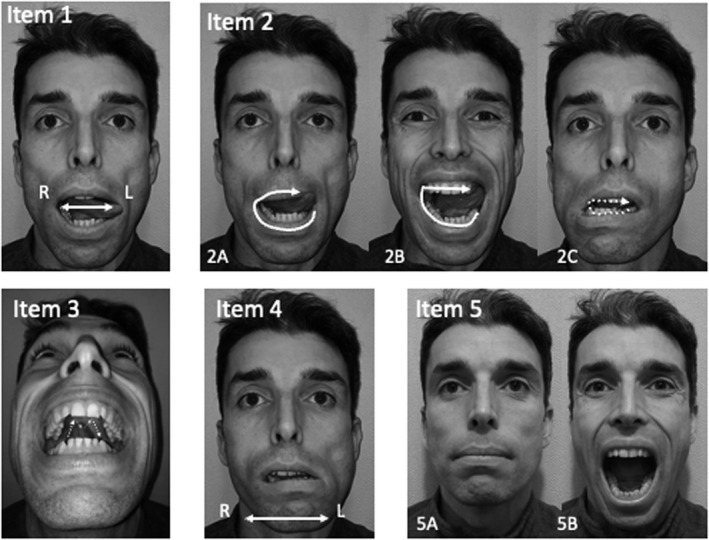
Methods: Both KVIQ-10 and TMIQ assess MI ability using vividness (i.e. clarity/brightness for visual MI, V MI; or intensity for kinesthetic MI, K MI) of MI using a 5-point Likert scale (1: no image/sensation, 5: clear/intense image/sensation). The KVIQ-10 was administered once (test) and the TMIQ twice (test-retest) to heathy participants and patients with TMD. Questionnaire validity was investigated using concurrent validity (Pearson correlation and paired t test); TMIQ-test-retest reliability (intraclass correlation coefficients, ICCs); internal consistency (Cronbach ⍺) and the factorial structure (principal factor extraction).
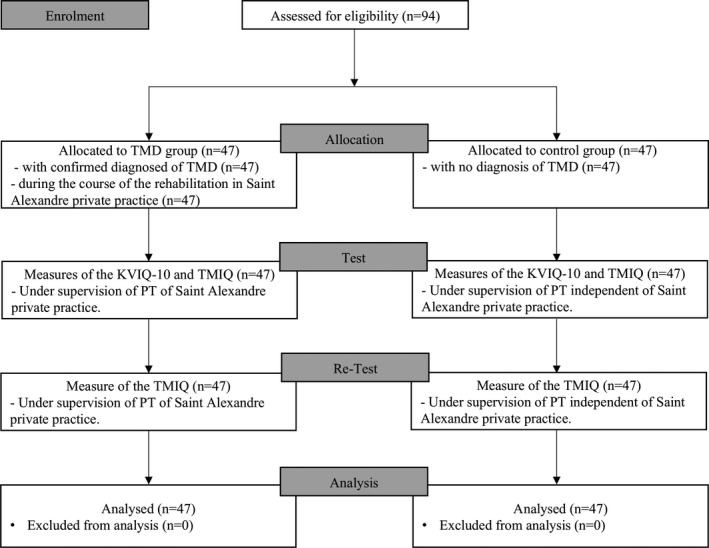
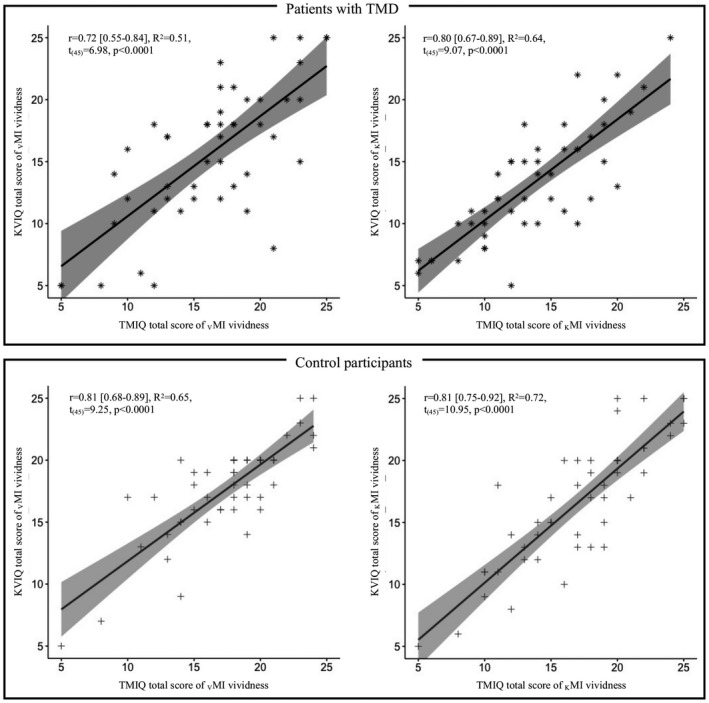
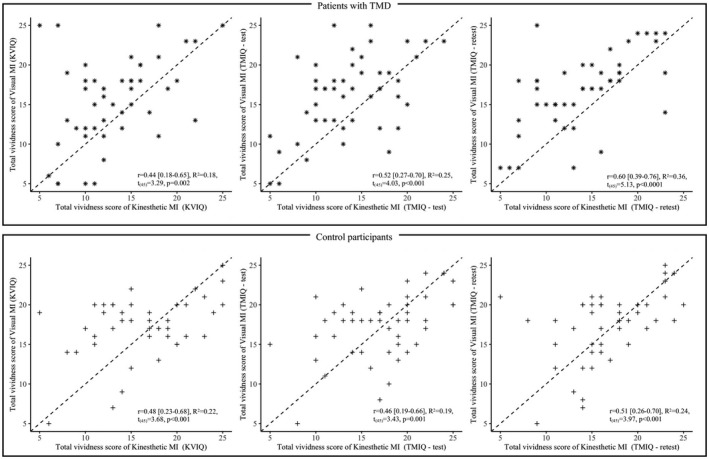
Results: A total of 94 participants were included (n = 47 per group). The mean vividness scores of the KVIQ-10 and the TMIQ were significantly correlated, and not significantly different for both groups indicating concurrent validity. ICCs in the control group (range: 0.82-0.90), and in the TMD group (range: 0.75-0.82) indicated good reproducibility. The Cronbach ⍺ values were all above 0.94, indicating excellent reliability. Two factors were extracted corresponding to V MI and K MI, and explained 66% of total variance.
Conclusion: The TMIQ is a valid and reproducible MI questionnaire showing excellent internal consistency and, therefore, can be used to assess imagined movements of the TM region in healthy individuals and patients with TMD.
Keywords: Physiotherapy; cronbach ⍺; factorial analysis; intraclass correlation coefficient; temporomandibular disorders.
© 2022 The Authors. Journal of Oral Rehabilitation published by John Wiley & Sons Ltd.
Conflict of interest statement
None declared.
Figures
References
-
- Poveda Roda R, Díaz Fernández JM, Hernández Bazán S, Jiménez Soriano Y, Margaix M, Sarrión G. A review of temporomandibular joint disease (TMJD). Part II: Clinical and radiological semiology. Morbidity processes. Med Oral Patol Oral Cir Bucal. 13(2):E102‐E109. - PubMed
-
- Schiffman E, Ohrbach R, Truelove E, et al. Diagnostic Criteria for Temporomandibular Disorders (DC/TMD) for Clinical and Research Applications: Recommendations of the International RDC/TMD Consortium Network and Orofacial Pain Special Interest Group†. J Oral Facial Pain Headache. 2014;28(1):6–27. - PMC - PubMed
-
- von Piekartz H, Paris‐Alemany A. Assessment and Brain Training of Patients Experiencing Head and Facial Pain with a Distortion of Orofacial Somatorepresentation: A Narrative Review. Appl Sci. 2021;11(15):6857. doi:10.3390/app11156857 - DOI
MeSH terms
Substances
LinkOut - more resources
Full Text Sources
Medical
