


Development of a nomogram for the prediction of in-hospital mortality in patients with acute ST-elevation myocardial infarction after primary percutaneous coronary intervention: a multicentre, retrospective, observational study in Hebei province, China
- PMID: 35110324
- PMCID: PMC8811571
- DOI: 10.1136/bmjopen-2021-056101
Development of a nomogram for the prediction of in-hospital mortality in patients with acute ST-elevation myocardial infarction after primary percutaneous coronary intervention: a multicentre, retrospective, observational study in Hebei province, China
Abstract
Objectives: To establish a clinical prognostic nomogram for predicting in-hospital mortality after primary percutaneous coronary intervention (PCI) among patients with ST-elevation myocardial infarction (STEMI).
Design: Retrospective, multicentre, observational study.
Setting: Thirty-nine hospitals in Hebei province.
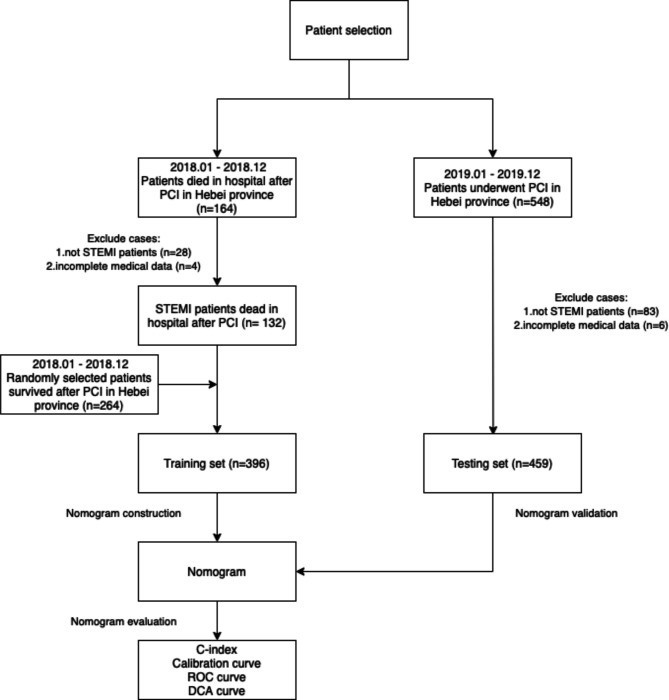
Participants: Patients with STEMI who underwent PCI from January 2018 to December 2019.
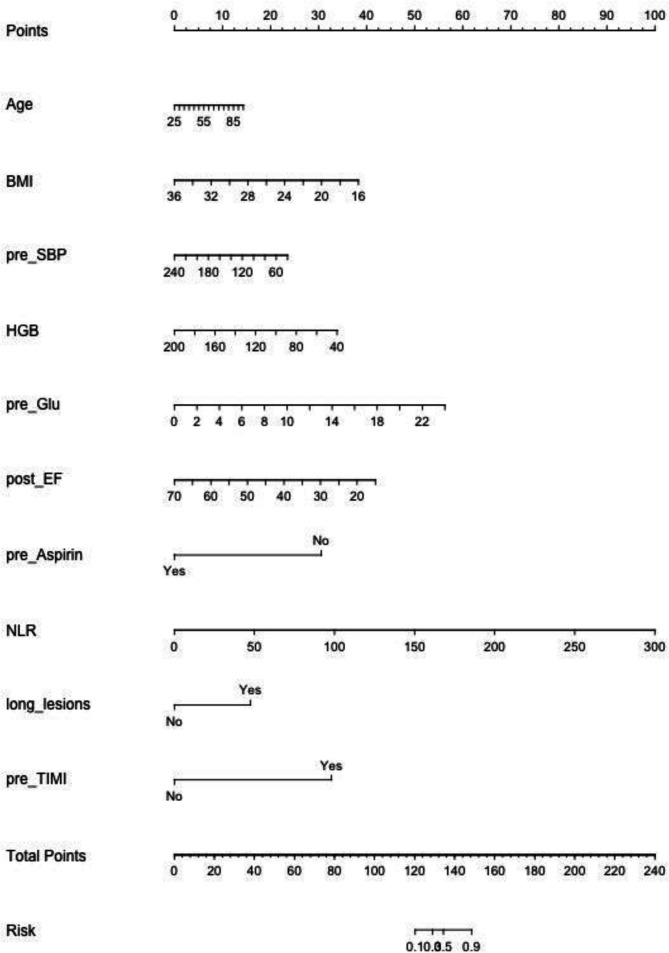
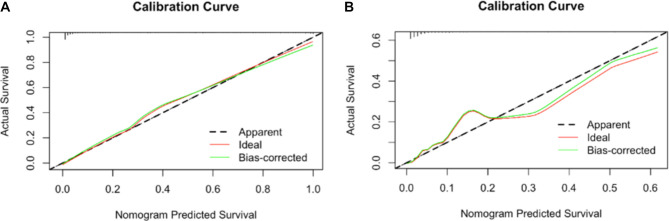
Interventions: A multivariable logistic regression model was used to identify the factors associated with in-hospital mortality, and a nomogram was established using these factors. The performance of the nomogram was evaluated by the discrimination, calibration and clinical usefulness.
Primary and secondary outcome measures: The outcome was the factors associated with in-hospital mortality.
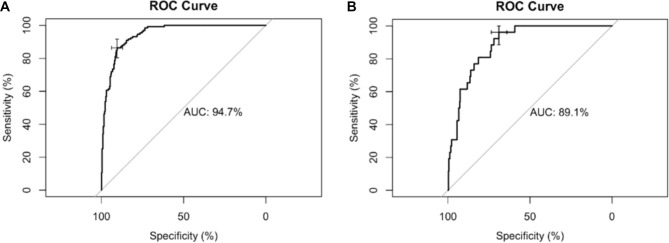
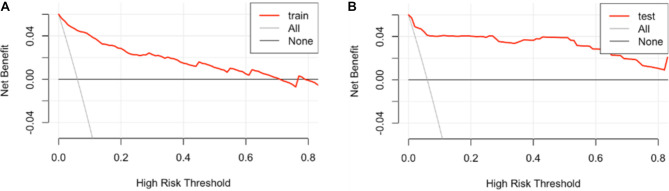
Results: This study included 855 patients, among whom 223 died in hospital. Age, body mass index, systolic pressure on admission, haemoglobin, random blood glucose on admission, ejection fraction after PCI, use aspirin before admission, long lesions, thrombolysis in myocardial infarction flow grade and neutrophils/lymphocytes ratio were independently associated with in-hospital mortality (all p<0.05). In the training set, the nomogram showed a C-index of 0.947, goodness-of-fit of 0.683 and area under the receiver operating characteristic curve (AUC) of 0.947 (95% CI 0.927 to 0.967). In the testing set, the C-index was 0.891, goodness-of-fit was 0.462 and AUC was 0.891 (95% CI 0.844 to 0.939). The results indicate that the nomogram had good discrimination and good prediction accuracy and could achieve a good net benefit.
Conclusions: A nomogram to predict in-hospital mortality in patients with STEMI after PCI was developed and validated in Hebei, China and showed a satisfactory performance. Prospective studies will be necessary to confirm the performance and clinical applicability and practicality of the nomogram.
Keywords: coronary heart disease; coronary intervention; myocardial infarction.
© Author(s) (or their employer(s)) 2022. Re-use permitted under CC BY-NC. No commercial re-use. See rights and permissions. Published by BMJ.
Conflict of interest statement
Competing interests: None declared.
Figures
References
-
- O'Gara PT, Kushner FG, Ascheim DD, et al. 2013 ACCF/AHA guideline for the management of ST-elevation myocardial infarction: a report of the American College of cardiology Foundation/American heart association Task force on practice guidelines. Circulation 2013;127:e362–425. 10.1161/CIR.0b013e3182742cf6 - DOI - PubMed
-
- Authors/Task Force Members, Piepoli MF, Hoes AW, et al. 2016 European Guidelines on cardiovascular disease prevention in clinical practice: The Sixth Joint Task Force of the European Society of Cardiology and Other Societies on Cardiovascular Disease Prevention in Clinical Practice (constituted by representatives of 10 societies and by invited experts): Developed with the special contribution of the European Association for Cardiovascular Prevention & Rehabilitation (EACPR). Eur J Prev Cardiol 2016;23:NP1–-NP96. 10.1177/2047487316653709 - DOI - PubMed
-
- Ibanez B, James S, Agewall S, et al. 2017 ESC guidelines for the management of acute myocardial infarction in patients presenting with ST-segment elevation: the task force for the management of acute myocardial infarction in patients presenting with ST-segment elevation of the European Society of cardiology (ESC). Eur Heart J 2018;39:119–77. 10.1093/eurheartj/ehx393 - DOI - PubMed
Publication types
MeSH terms
LinkOut - more resources
Full Text Sources
Miscellaneous
