. 2022 Feb 2;12(1):1746.
doi: 10.1038/s41598-022-05844-1.

Pathway-specific TNF-mediated metaplasticity in hippocampal area CA1

Affiliations

Pathway-specific TNF-mediated metaplasticity in hippocampal area CA1

Anurag Singh et al. Sci Rep. .

Abstract

Long-term potentiation (LTP) is regulated in part by metaplasticity, the activity-dependent alterations in neural state that coordinate the direction, amplitude, and persistence of future synaptic plasticity. Previously, we documented a heterodendritic metaplasticity effect whereby high-frequency priming stimulation in stratum oriens (SO) of hippocampal CA1 suppressed subsequent LTP in the stratum radiatum (SR). The cytokine tumor necrosis factor (TNF) mediated this heterodendritic metaplasticity in wild-type rodents and in a mouse model of Alzheimer's disease. Here, we investigated whether LTP at other afferent synapses to CA1 pyramidal cells were similarly affected by priming stimulation. We found that priming stimulation in SO inhibited LTP only in SR and not in a second independent pathway in SO, nor in stratum lacunosum moleculare (SLM). Synapses in SR were also more sensitive than SO or SLM to the LTP-inhibiting effects of pharmacological TNF priming. Neither form of priming was sex-specific, while the metaplasticity effects were absent in TNFR1 knock-out mice. Our findings demonstrate an unexpected pathway specificity for the heterodendritic metaplasticity in CA1. That Schaffer collateral/commissural synapses in SR are particularly susceptible to such metaplasticity may reflect an important control of information processing in this pathway in addition to its sensitivity to neuroinflammation under disease conditions.


Conflict of interest statement

The authors declare no competing interests.

Figures
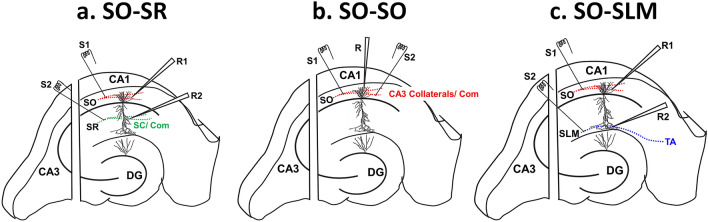
Figure 1
Figure 1
A Simplified schematic diagram of the hippocampus representing electrode placement in SR, SO and SLM. (a) SO-SR electrode placements. S1 and S2 represent stimulating electrodes, and R1 and R2 represent recording electrode placement in SO and SR, respectively. (b) SO-SO electrode placements. S1 and S2 represent the stimulation electrode placement on opposite ends in SO, while R represents the recording electrode placed at the centre of S1 and S2 (see Supplementary Fig. S1 for the test of pathway independence in SO). (c) SO-SLM electrode placements. S1 and S2 represent stimulating electrodes, and R1 and R2 represent recording electrode placements in SO and SLM, respectively. The pyramidal neuron image shows its processes extending from stratum pyramidale (SP) towards SR (apical dendrites) and SO (basal dendrites). (Com, commissural fibers; SC, Schaffer collaterals; TA, temporoammonic input; DG, dentate gyrus).
Figure 2
Figure 2
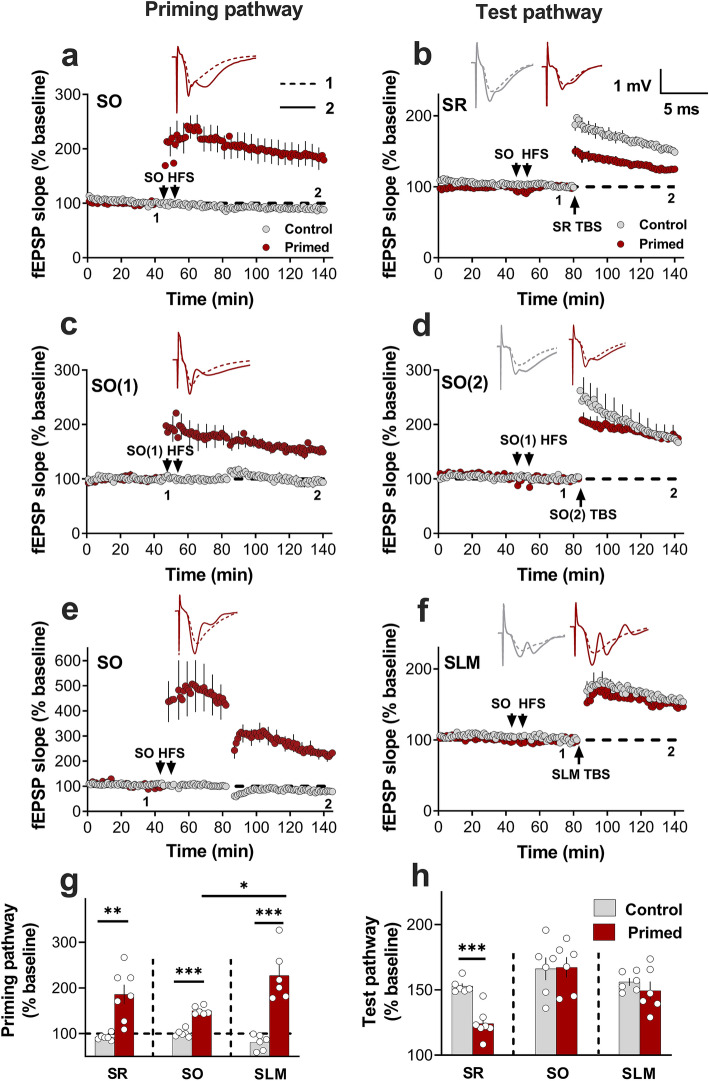
Pathway specificity of HFS priming in SO. (a) HFS priming produced significant LTP in the SO primed pathway compared to the control (non-priming) condition (Control = 89.8 ± 4%, n = 5; Primed = 185.9 ± 18%, n = 15; t(10) = 3.7, p = 0.002), and (b) produced significant inhibition of LTP in the test SR pathway when compared to the control condition (Control = 152.5 ± 10%, n = 5; Primed = 124.3 ± 6%, n = 7; t(10) = 5.12, p = 0.0004). (c) As in (a), HFS priming produced significant LTP in SO (Control = 100.6 ± 5%, n = 6; Primed = 150.4 ± 18%, n = 6; t(10) = 10.7, p = 0.0001), but (d) had no effect on LTP at neighbouring synapses in the same stratum (Control = 170.5 + 12%, n = 6; Primed = 177.6 + 9%, n = 6; t(10) = 0.2861, p = 0.78). (e) In the SLM experiment, HFS priming produced significant LTP in SO (Control = 81.07 ± 7%, n = 6; Primed = 227.3 ± 24%, n = 6; t(10) = 13.03, p =  < 0.0001) but (f) had no effect on SLM LTP (Control = 156.6 ± 3%, n = 6; Primed = 149.4 ± 8%, n = 6; t(10) = 0.88, p = 0.39). (g) Bar graph summarising the homosynaptic LTP in SO across all three experiments. The SO LTP in the SLM experiment was statistically different when compared to that in the SO experiment (p = 0.02) but not the SO LTP in the SR experiment (p = 0.243). (h) Bar graph summarising the electrical priming effects on LTP in SR, SO and SLM. For the inset waveforms in all figures, 1 represents the average of the final 10 sweeps taken before tetanization in the relevant pathway (pre) and 2 represents the average of 10 sweeps taken 50–60 min after TBS (post) of the test pathway. All data in this and other figures are presented as mean ± SEM; , p < 0.05; ∗∗, p < 0.01; ∗∗∗, p < 0.001.
Figure 3
Figure 3
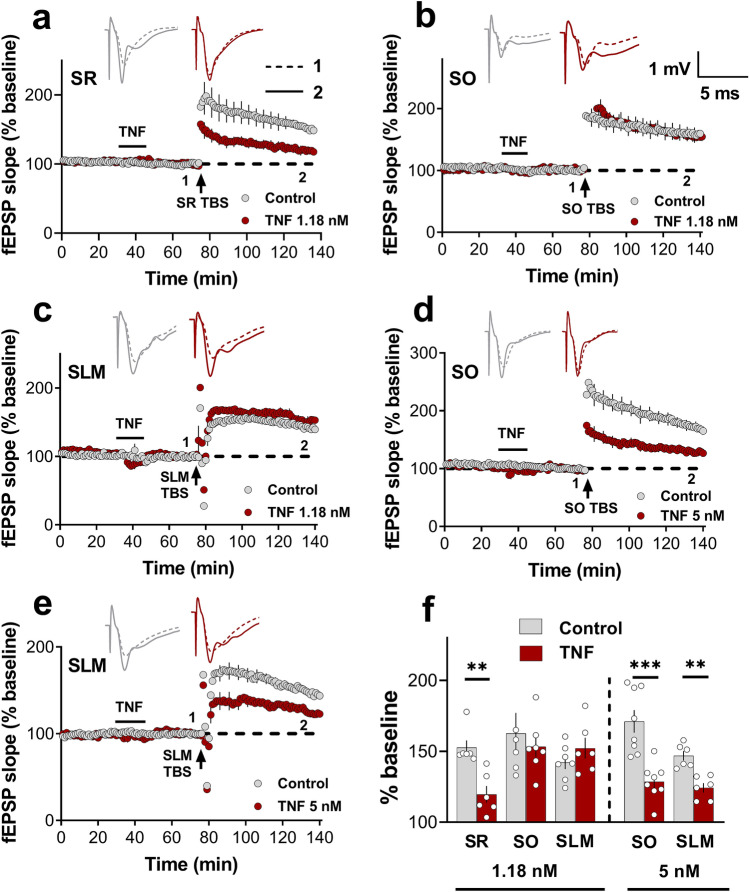
Pathway specificity of TNF priming. (a) Bath application of 1.18 TNF (bar) inhibited SR LTP (Control = 152.6 ± 7%, n = 6; TNF = 119.6 ± 5%, n = 6; t(10) = 4.24, p = 0.001). (b) Bath application of TNF had no effect on SO LTP (Control = 165.1 ± 8%, n = 9; TNF = 153.3 ± 7%, n = 7; t(14) = 0.90, p = 0.37), or (c) SLM LTP (Control = 154.7.1 ± 8%, n = 6; TNF = 152.2 ± 6%, n = 6; t(10) = 0.26, p = 0.79). (d) At 5 nM, bath application of TNF inhibited SO LTP (Control = 171.1 ± 12%, n = 8; TNF = 128.6 ± 9%, n = 8; t(14) = 4.61, p = 0.0004), and (e) SLM LTP (Control = 148 ± 7%, n = 8; TNF = 124.3 ± 4%, n = 5; t(9) = 4.33, p = 0.001). (f) Bar graph summarising the differential effects of TNF on LTP in the different strata. ∗∗, p < 0.01; ∗∗∗, p < 0.001.
Figure 4
Figure 4
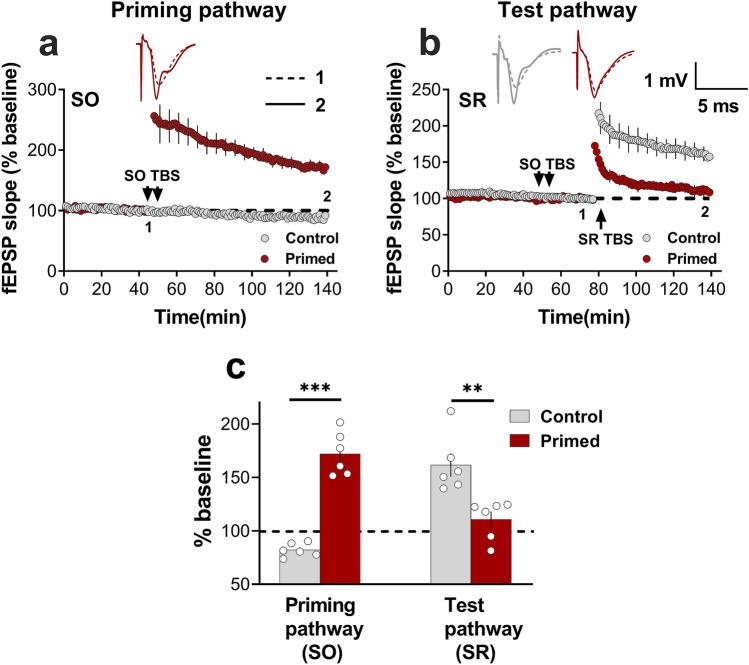
TBS priming inhibits SR LTP. (a) TBS priming produced substantial LTP in SO (Control = 88.8 ± 3%, n = 5; Primed = 166.4 ± 8%, n = 6; t(10) = 8.1, p = 0.0001), and (b) significantly inhibited LTP in SR (Control = 161.5 ± 8%, n = 6; Primed = 110.7 ± 3%, n = 6; t(10) = 3.86, p = 0.003). (c) Bar graph summarising the TBS-induced homosynaptic LTP in SO and inhibition of LTP in SR. ∗∗, p < 0.01; ∗∗∗, p < 0.001.
Figure 5
Figure 5
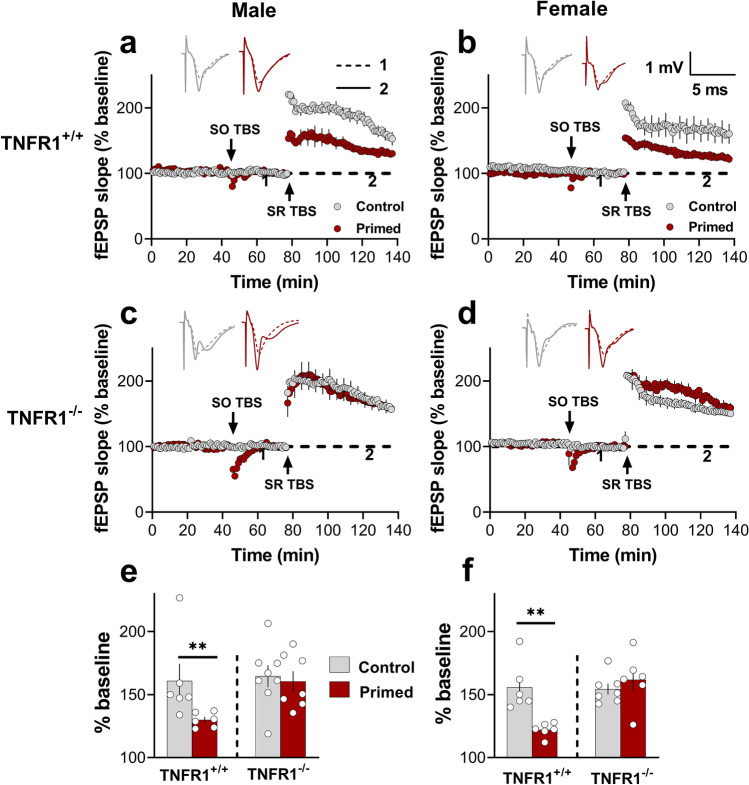
TBS priming-induced metaplasticity in SR requires TNFR1 in both male and female mice. (a) Tukey’s post-hoc analysis revealed that there was significant inhibition of LTP due to priming in the SR of TNFR1+/+ male mice (Control = 160.9 ± 15%, n = 6; Primed = 129.8 ± 8%, n = 6; p = 0.004), and (b) female mice (Control = 159.8 ± 13%, n = 6; Primed = 122.1 ± 9%, n = 6; p = 0.002, control vs. primed). (c) In contrast, the priming effect was lacking in the SR of male TNFR1-/- mice (Control = 160.5 ± 13%, n = 7; Primed = 164.6 ± 12%, n = 8; p = 0.98) and (d) female TNFR1-/- mice (Control = 154.4 ± 7%, n = 7; Primed = 161.9 ± 9%, n = 6; p = 0.91) mice. (e) Histogram summarizing the electrical priming effect in SR of male TNFR1+/+ but not TNFR1-/- mice. (f) Histogram summarizing the electrical priming effect in SR of female TNFR1+/+ but not TNFR1-/- mice. Two-way ANOVA on male and female TNFR1+/+ animals revealed a significant main effect for experimental group [F (1,20) = 12.05, p =  < 0.0001] but no significant main effect of gender [F(1,20) = 0.12, p = 0.72] or interaction [F(1,20) = 0.007, p = 0.93], and two-way ANOVA on male and female TNFR1-/- revealed no significant main effect for experimental group [F(1,24) = 0.55, p = 0.82], gender [F(1,24) = 0.32, p = 0.57], or interaction [F(1,24) = 0.04, p = 0.82]. ∗∗, p < 0.01.
Figure 6
Figure 6
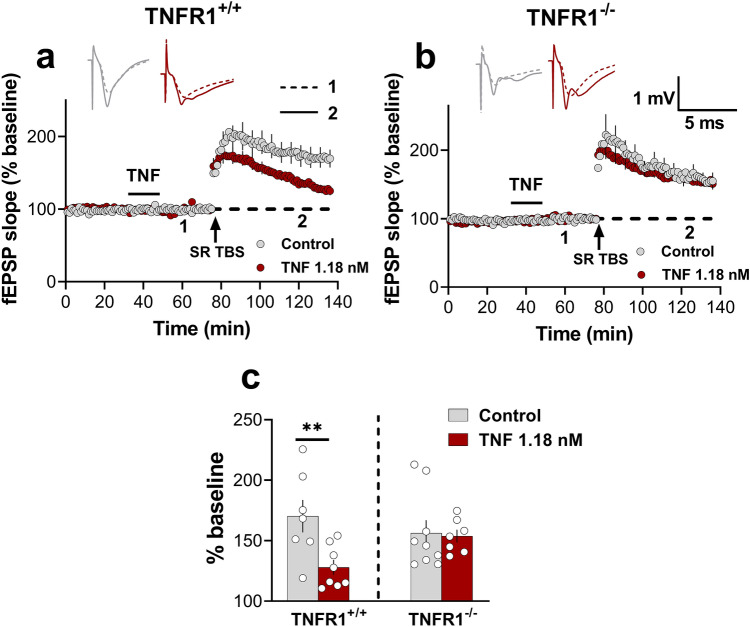
TNF-induced metaplasticity in SR requires TNFR1. (a) Bath application of 1.18 nM TNF significantly inhibited SR LTP in TNFR1+/+ male and female mice (Control = 170.3 ± 14%, n = 7; TNF = 128 ± 9%, n = 8; t(13) = 2.99, p = 0.01). (b) TNF had no effect on the LTP in TNFR1-/- male and female mice (Control = 156.3 ± 10%, n = 9; TNF = 153.8 ± 13%, n = 7; t(14) = 0.19, p = 0.84). (c) Bar graph summarising the TNF-mediated priming effect in TNFR1+/+ mice but not in TNFR1-/- mice. ∗∗, p < 0.01.

References

    1. Abraham WC, Bear MF. Metaplasticity: The plasticity of synaptic plasticity. Trends Neurosci. 1996;19:126–130. - PubMed
    1. Abraham WC. Metaplasticity: Tuning synapses and networks for plasticity. Nat. Rev. Neurosci. 2008;9:387. - PubMed
    1. Jones OD, Hulme SR, Abraham WC. Purinergic receptor- and gap junction-mediated intercellular signalling as a mechanism of heterosynaptic metaplasticity. Neurobiol. Learn. Mem. 2013;105:31–39. doi: 10.1016/j.nlm.2013.05.010. - DOI - PubMed
    1. Hulme SR, Jones OD, Raymond CR, Sah P, Abraham WC. Mechanisms of heterosynaptic metaplasticity. Philos. Trans. R. Soc. Lond. B Biol. Sci. 2014;369:20130148. - PMC - PubMed
    1. Butler MP, O'Connor JJ, Moynagh PN. Dissection of tumor-necrosis factor-alpha inhibition of long-term potentiation (LTP) reveals a p38 mitogen-activated protein kinase-dependent mechanism which maps to early-but not late-phase LTP. Neuroscience. 2004;124:319–326. - PubMed

Publication types

MeSH terms

Substances