


[Intensive Care Unit-Acquired Weakness : A nationwide survey on diagnostics, monitoring and treatment strategies on German intensive care units]
- PMID: 35112164
- PMCID: PMC9352631
- DOI: 10.1007/s00101-022-01089-9
[Intensive Care Unit-Acquired Weakness : A nationwide survey on diagnostics, monitoring and treatment strategies on German intensive care units]
Abstract
Background: Intensive care unit-acquired weakness (ICU-AW) is one of the most frequent causes of neuromuscular dysfunction in intensive care medicine. To date no evidence-based recommendations exist for the diagnostics, monitoring or further intensive care treatment.
Objective: To evaluate the current clinical practice of diagnostics, monitoring and treatment strategies of ICU-AW on intensive care units in Germany.
Material and methods: We conducted an online survey with a self-designed questionnaire and invited 448 members of the Scientific Working Group for Intensive Care Medicine (WAKI) and the Scientific Working Group for Neuroanesthesia (WAKNA) to participate.
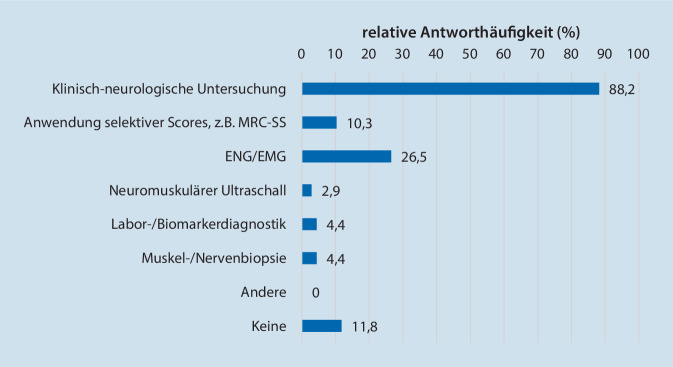
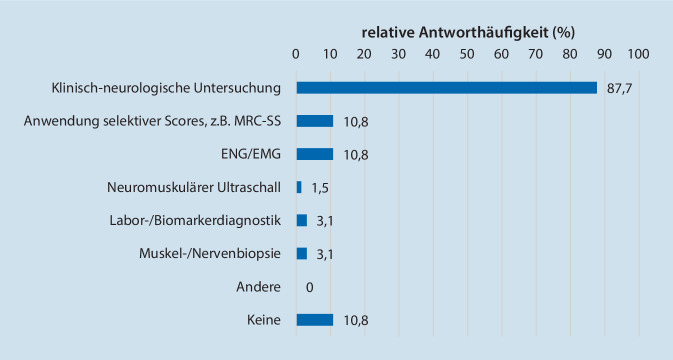
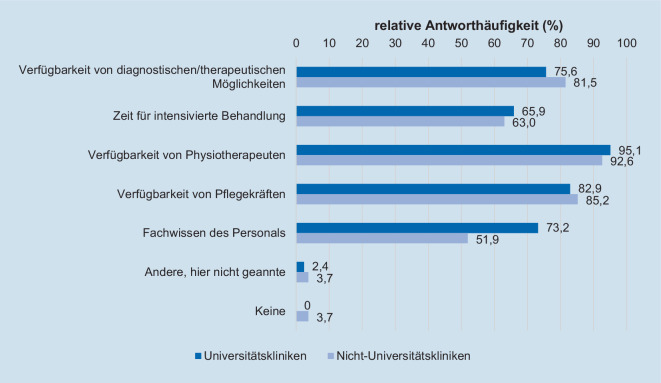
Results: A total of 68/448 (15.2%) questionnaires were analyzed. Of the participants 13.4% (9/67) stated that a structured diagnostic approach for the detection of ICU-AW is applied in their units. The clinical examination was the preferred method for screening (60/68; 88.2%) and follow-up (57/65; 87.7%). Scores, such as the Medical Research Council sum score (MRC-SS) seem to be less important for the screening (7/68; 10.3%) and follow-up assessment (7/65; 10.8%). Mobilization with physiotherapy (45/68; 66.2%) is the most common strategy applied to treat ICU-AW. A lack of physiotherapists (64/68; 94.1%) and intensive care nurses (57/68; 83.8%) are the main deficits identified in the care of patients with ICU-AW. The majority of the study participants (62/68; 91.2%) would welcome evidence-based guidelines for diagnostics, monitoring and treatment approaches in ICU-AW.
Discussion: To date comprehensive recommendations for diagnostics, monitoring, prevention and treatment of ICU-AW are still lacking in German intensive care units. The introduction of new diagnostic approaches could help to detect ICU-AW and therefore to initiate earlier preventive and treatment approaches.
Zusammenfassung: HINTERGRUND: Die „Intensive Care Unit-Acquired Weakness“ (ICU-AW) ist eine der häufigsten Ursachen für eine neuromuskuläre Dysfunktion in der Intensivmedizin. Gegenwärtig fehlen evidenzbasierte Empfehlungen zur Diagnostik, zum Monitoring und zu therapeutischen Maßnahmen.
Ziel der arbeit: Die Erfassung des derzeitigen Vorgehens bei Diagnostik, Monitoring und präventiven und therapeutischen Ansätzen bei der ICU-AW auf deutschen Intensivstationen.
Material und methoden: Onlinebefragung von 448 Mitgliedern des Wissenschaftlichen Arbeitskreises Intensivmedizin (WAKI) und des Wissenschaftlichen Arbeitskreises Neuroanästhesie (WAKNA).
Ergebnisse: Insgesamt wurden 68/448 (15,2 %) Fragebogen ausgewertet. Bei 13,4 % (9/67) der Befragten existiert ein strukturiertes diagnostisches Vorgehen zur Detektion der ICU-AW. Für Screening (60/68; 88,2 %) und Verlaufsbeurteilung (57/65; 87,7 %) wird die klinische Untersuchung präferiert. Etablierte Scores, wie der „Medical Research Council sum score“ (MRC-SS) spielen für Screening und Verlaufskontrolle der ICU-AW eine untergeordnete Rolle (7/68; 10,3 % und 7/65; 10,8 %). Mobilisation (45/68; 66,2 %) und Sedativareduktion (38/68; 55,9 %) stellen die häufigsten präventiven und therapeutischen Ansätze dar. Ein Mangel an Physiotherapeuten (64/68; 94,1 %) und Pflegekräften (57/68; 83,8 %) wird als Hauptdefizit bei der Versorgung von Patienten mit ICU-AW identifiziert. Insgesamt 91,2 % (62/68) der Befragten befürworten die Erstellung evidenzbasierter Empfehlungen zur Diagnostik, zum Monitoring und zu therapeutischen Ansätzen bei ICU-AW.
Diskussion: Ein einheitliches Konzept für Diagnostik, Monitoring, Prävention und Therapie der ICU-AW auf deutschen Intensivstationen fehlt weitgehend. Innovative diagnostische Ansätze könnten in Zukunft helfen, Patienten mit einem hohem Risiko für eine ICU-AW frühzeitig zu detektieren, präventive Maßnahmen einzuleiten sowie wertvolle prognostische Informationen zu gewinnen.
Keywords: Crit care medicine; Critical illness; Critical illness myopathy; Critical illness polyneuropathy; Surveys and questionnaires.
© 2022. The Author(s).
References
MeSH terms
LinkOut - more resources
Full Text Sources