Common disease-associated gene variants in a Saudi Arabian population
- PMID: 35112591
- PMCID: PMC8812157
- DOI: 10.5144/0256-4947.2022.29
Common disease-associated gene variants in a Saudi Arabian population
Abstract
Background: Screening programs for the most prevalent conditions occurring in a country is an evidence-based prevention strategy. The burden of autosomal recessive disease variations in Saudi Arabia is high because of the highly consanguineous population. The optimal solution for estimating the carrier frequency of the most prevalent diseases is carrier screening.
Objectives: Identify the most influential recessive alleles associated with disease in the Saudi population.
Design: We used clinical whole-exome sequencing data from an in-house familial database to evaluate the most prevalent genetic variations associated with disease in a Saudi population.
Settings: King Abdullah International Medical Research Center (KAIMRC) and King Abdulaziz Medical City.
Methods: Whole exome sequencing data obtained from clinical studies of family members, a cohort of 1314 affected and unaffected individuals, were filtered using the in-house pipeline to extract the most prevalent variant in the dataset.
Main outcome measures: Most prevalent genetic variations associated with disease in the Saudi population.
Sample size: 1314 affected and unaffected individuals.
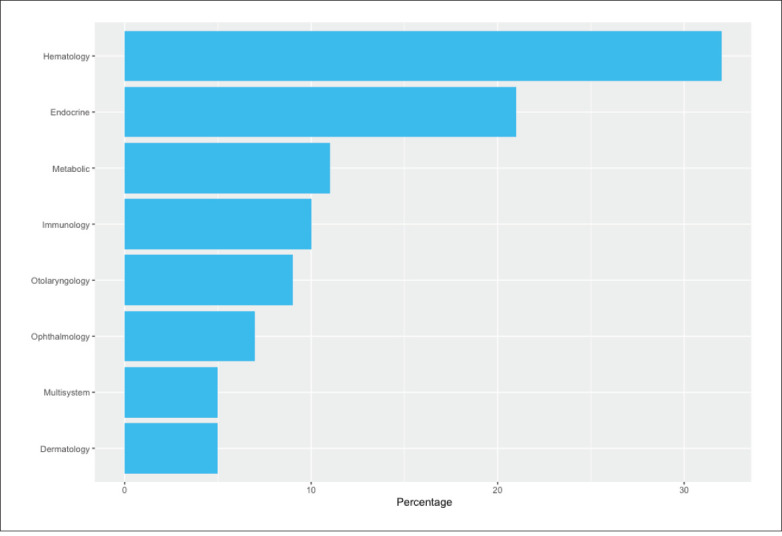
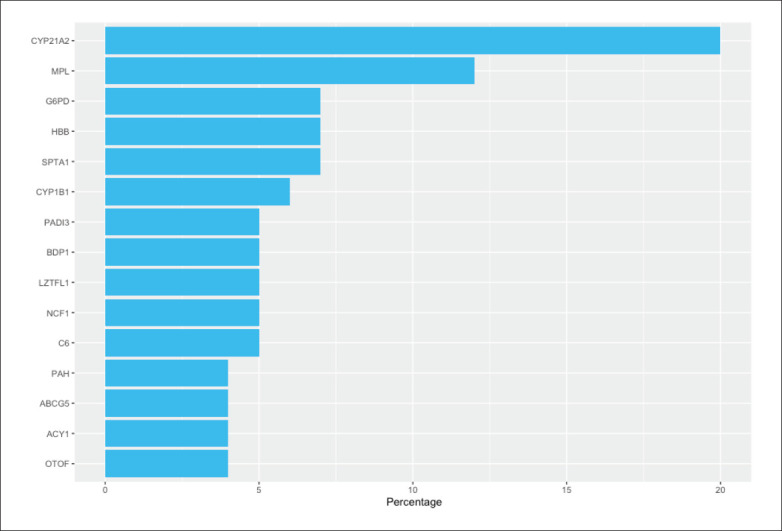
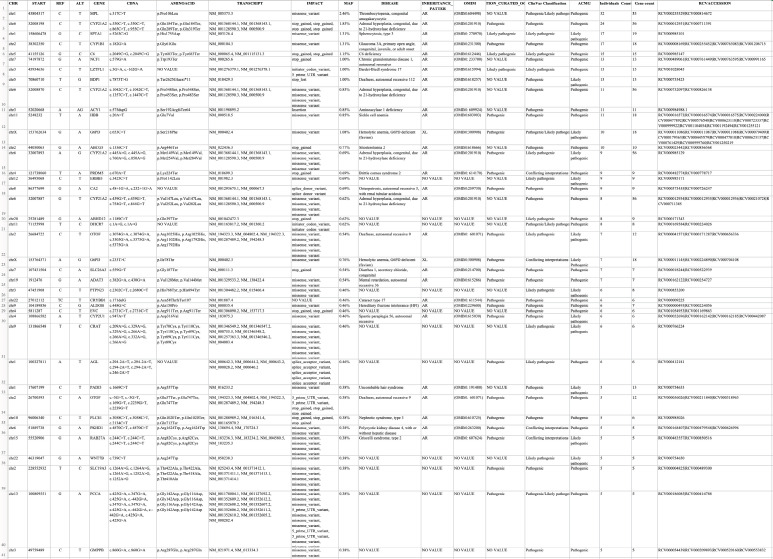
Results: We identified 37 autosomal recessive variants and two heterozygous X-linked variants in 35 genes associated with the most prevalent disorders, which included hematologic (32%), endocrine (21%), metabolic (11%) and immunological (10%) diseases.
Conclusion: This study provides an update of the most frequently occurring alleles, which support future carrier screening programs.
Limitations: Single center that might represent the different regions but may be biased. In addition, most of the families included in the database are part of the proband's genetic identification for specific phenotypes.
Conflict of interest: None.
Figures
References
-
- Hernande-Nieto C, Alkon-Meadows T, Lee J, Cacchione T, Iyune-Cojab E, Garza-Galvan M, et al.. Expanded carrier screening for preconception reproductive risk assessment: Prevalence of carrier status in a Mexican population. Prenat Diagn. 2020;40(5):635–43. - PubMed
-
- Monies D, Abouelhoda M, Assoum M, Moghrabi N, Rafiullah R, Almontashiri N, et al.. Lessons Learned from Large-Scale, First-Tier Clinical Exome Sequencing in a Highly Consanguineous Population. Am J Hum pGenet [Internet]. 2019;104(6):1182–201. Available from: 10.1016/j.ajhg.2019.04.011 - DOI - PMC - PubMed
-
- Abouelhoda M, Sobahy T, El-Kalioby M, Patel N, Shamseldin H, Monies D, et al.. Clinical genomics can facilitate countrywide estimation of autosomal recessive disease burden. Genet Med. 2016;18(12):1244–9. - PubMed
-
- Delatycki MB, Alkuraya F, Archibald A, Castellani C, Cornel M, Grody WW, et al.. International perspectives on the implementation of reproductive carrier screening. Prenat Diagn. 2020;40(3):301–10. - PubMed
MeSH terms
LinkOut - more resources
Full Text Sources
Medical
Research Materials