


Can we Save the rectum by watchful waiting or TransAnal surgery following (chemo)Radiotherapy versus Total mesorectal excision for early REctal Cancer (STAR-TREC)? Protocol for the international, multicentre, rolling phase II/III partially randomized patient preference trial evaluating long-course concurrent chemoradiotherapy versus short-course radiotherapy organ preservation approaches
- PMID: 35114057
- PMCID: PMC9311773
- DOI: 10.1111/codi.16056
Can we Save the rectum by watchful waiting or TransAnal surgery following (chemo)Radiotherapy versus Total mesorectal excision for early REctal Cancer (STAR-TREC)? Protocol for the international, multicentre, rolling phase II/III partially randomized patient preference trial evaluating long-course concurrent chemoradiotherapy versus short-course radiotherapy organ preservation approaches
Abstract
Aim: Organ-saving treatment for early-stage rectal cancer can reduce patient-reported side effects compared to standard total mesorectal excision (TME) and preserve quality of life. An optimal strategy for achieving organ preservation and longer-term oncological outcomes are unknown; thus there is a need for high quality trials.
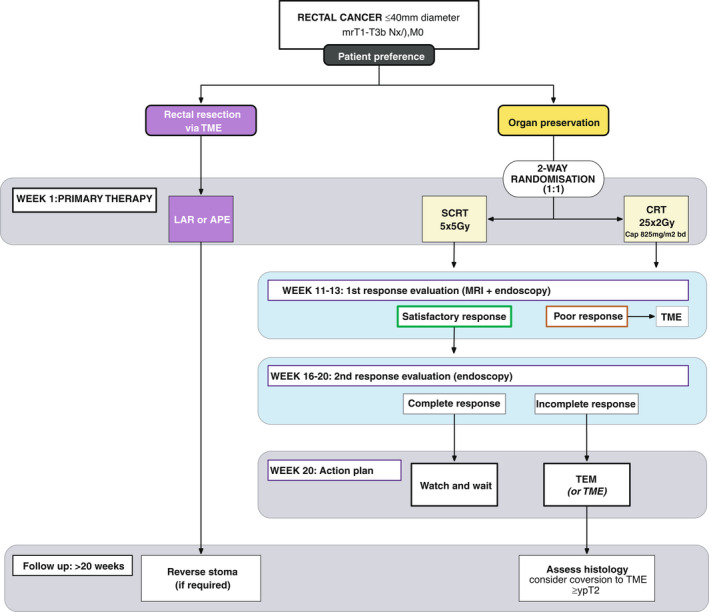
Method: Can we Save the rectum by watchful waiting or TransAnal surgery following (chemo)Radiotherapy versus Total mesorectal excision for early REctal Cancer (STAR-TREC) is an international three-arm multicentre, partially randomized controlled trial incorporating an external pilot. In phase III, patients with cT1-3b N0 tumours, ≤40 mm in diameter, who prefer organ preservation are randomized 1:1 between mesorectal long-course chemoradiation versus mesorectal short-course radiotherapy, with selective transanal microsurgery. Patients preferring radical surgery receive TME. STAR-TREC aims to recruit 380 patients to organ preservation and 120 to TME surgery. The primary outcome is the rate of organ preservation at 30 months. Secondary clinician-reported outcomes include acute treatment-related toxicity, rate of non-operative management, non-regrowth pelvic tumour control at 36 months, non-regrowth disease-free survival at 36 months and overall survival at 60 months, and patient-reported toxicity, health-related quality of life at baseline, 12 and 24 months. Exploratory biomarker research uses circulating tumour DNA to predict response and relapse.
Discussion: STAR-TREC will prospectively evaluate contrasting therapeutic strategies and implement new measures including a smaller mesorectal target volume, two-step response assessment and non-operative management for complete response. The trial will yield important information to guide routine management of patients with early-stage rectal cancer.
Keywords: chemoradiotherapy; circulating free tumour DNA; complete response; early rectal cancer; organ preservation; short-course radiotherapy; transanal endoscopic microsurgery; watch and wait.
© 2022 The Authors. Colorectal Disease published by John Wiley & Sons Ltd on behalf of Association of Coloproctology of Great Britain and Ireland.
Conflict of interest statement
No conflicts.
Figures
References
-
- Ferlay J, Ervik M, Lam F, Colombet M, Mery L, Pineros M, et al. Global Cancer Observatory: Cancer Today. Lyon: International Agency for Research on Cancer; 2020. https://gco.iarc.fr/today/home (Accessed 28 July 2021).
-
- Boyle J, Braun M, Hill J, Kuryba A, van Meulen J & Walker K et al. National bowel cancer audit: annual report; 2018. https://www.nboca.org.uk/content/uploads/2018/12/NBOCA‐annual‐report2018... (Accessed 10 March 2021).
-
- Gollins S, Moran B, Adams R, Cunningham C, Bach S, Myint AS, et al. Association of Coloproctology of Great Britain & Ireland (ACPGBI): Guidelines for the Management of Cancer of the Colon, Rectum and Anus (2017) ‐ Multidisciplinary Management. Colorectal Dis. 2017;19(Suppl 1):37–66. - PubMed
-
- NICE Colorectal cancer NG151. National Institute for Health and Care Excellence. 2020. https://www.nice.org.uk/guidance/ng151 (Accessed 10 March 2021).
-
- McNair AG, Heywood N, Tiernan J, Verjee A, Bach SP, Fearnhead NS, et al. A national patient and public colorectal research agenda: integration of consumer perspectives in bowel disease through early consultation. Colorectal Dis. 2017;19(1):O75–85. - PubMed
