


Revised recommendations on standards and norms for palliative care in Europe from the European Association for Palliative Care (EAPC): A Delphi study
- PMID: 35114839
- PMCID: PMC9006395
- DOI: 10.1177/02692163221074547
Revised recommendations on standards and norms for palliative care in Europe from the European Association for Palliative Care (EAPC): A Delphi study
Abstract
Background: In 2009, the EAPC published recommendations on standards and norms for palliative care in Europe, and a decade later, wished to update them to reflect contemporary practice.
Aim: To elicit consensus on standards and norms for palliative care in Europe, taking account of developments since 2009.
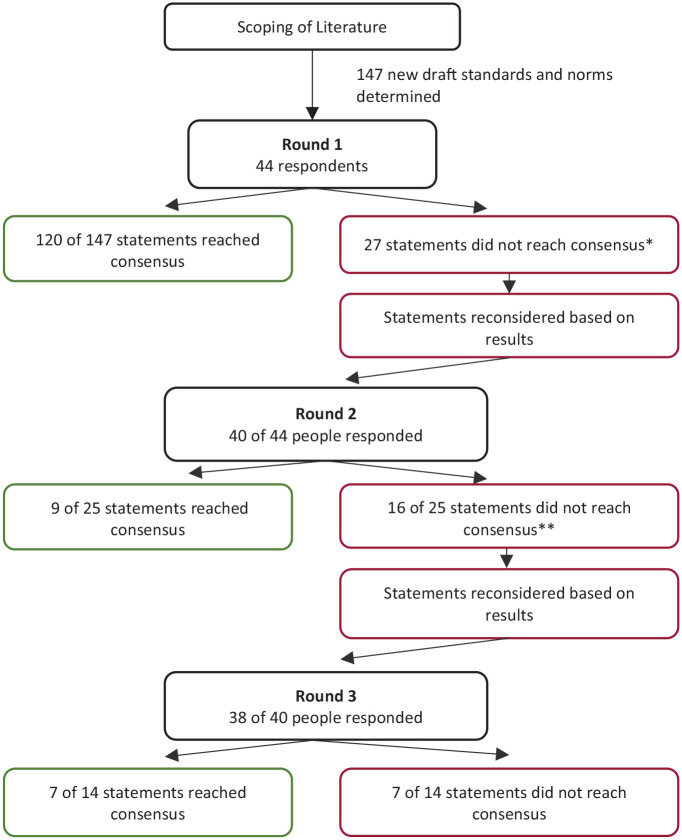
Design: A Delphi technique used three sequential online survey rounds, and a final expert consultation (EAPC Board). The original 2009 questionnaire with 134 statements was updated with 13 new concepts and practices following a scoping of the literature between 2009 and 2020 (total: 147 statements).
Setting/participants: One contact of Boards of 52 national European organisations affiliated to the EAPC were invited to participate, with subsequent rounds sent to respondees. The EAPC Board (n = 13) approved final recommendations.
Results: In Round 1: 30 organisations (14 organisations × two people, 16 organisations × one person, total n = 44) in 27 countries responded (response rate 58% organisations, 82% countries), Round 2 (n = 40), Round 3 (n = 38). 119 statements reached consensus in Round 1, 9 in Round 2, 7 in Round 3. In total 135/145 statements in five domains (terminology, philosophy, levels, delivery, services) reached consensus (defined as >75% agreement), (122) were original EAPC recommendations with 13 new recommendations included emerging specialisms: neonatal, geriatric and dementia care, and better care practices. Seven statements failed to reach consensus and four were removed as irrelevant or repetition.
Conclusions: Most recommendations on standards and norms for palliative care in Europe remain unchanged since 2009. Evolving concepts in palliative care can be used to support advocacy.
Keywords: Delivery of Health Care; Delphi technique; Palliative care; end-of-life care; surveys and questionnaires.
Conflict of interest statement
Figures
References
-
- Ryan S, Wong J, Chow R, et al.. Evolving definitions of palliative care: upstream migration or confusion? Curr Treat Options Oncol 2020; 21(3): 20. - PubMed
-
- Van Mechelen W, Aertgeerts B, De Ceulaer K, et al.. Defining the palliative care patient: a systematic review. Palliat Med 2013; 27(3): 197–208. - PubMed
-
- Sepúlveda C, Marlin A, Yoshida T, et al.. Palliative care: the World Health Organization’s global perspective. J Pain Symptom Manag 2002; 24(2): 91–96. - PubMed
-
- World Health Organization. Strengthening of palliative care as a component of integrated treatment throughout the life course. J Pain Palliat Care Pharmacother 2014; 28(2): 130–134. - PubMed
Publication types
MeSH terms
LinkOut - more resources
Full Text Sources
Medical
