Clinical Trial
. 2022 Feb 23;40(9):1253-1260.
doi: 10.1016/j.vaccine.2022.01.043. Epub 2022 Jan 31.

Phase I interim results of a phase I/II study of the IgG-Fc fusion COVID-19 subunit vaccine, AKS-452

Affiliations
Clinical Trial

Phase I interim results of a phase I/II study of the IgG-Fc fusion COVID-19 subunit vaccine, AKS-452

Yester F Janssen et al. Vaccine. .

Abstract

To address the coronavirus disease 2019 (COVID-19) pandemic caused by infection with severe acute respiratory syndrome coronavirus 2 (SARS-CoV-2), a recombinant subunit vaccine, AKS-452, is being developed comprising an Fc fusion protein of the SARS-CoV-2 viral spike protein receptor binding domain (SP/RBD) antigen and human IgG1 Fc emulsified in the water-in-oil adjuvant, Montanide™ ISA 720. A single-center, open-label, phase I dose-finding and safety study was conducted with 60 healthy adults (18-65 years) receiving one or two doses 28 days apart of 22.5 µg, 45 µg, or 90 µg of AKS-452 (i.e., six cohorts, N = 10 subjects per cohort). Primary endpoints were safety and reactogenicity and secondary endpoints were immunogenicity assessments. No AEs ≥ 3, no SAEs attributable to AKS-452, and no SARS-CoV-2 viral infections occurred during the study. Seroconversion rates of anti-SARS-CoV-2 SP/RBD IgG titers in the 22.5, 45, and 90 µg cohorts at day 28 were 70%, 90%, and 100%, respectively, which all increased to 100% at day 56 (except 89% for the single-dose 22.5 µg cohort). All IgG titers were Th1-isotype skewed and efficiently bound mutant SP/RBD from several SARS-CoV-2 variants with strong neutralization potencies of live virus infection of cells (including alpha and delta variants). The favorable safety and immunogenicity profiles of this phase I study (ClinicalTrials.gov: NCT04681092) support phase II initiation of this room-temperature stable vaccine that can be rapidly and inexpensively manufactured to serve vaccination at a global scale without the need of a complex distribution or cold chain.

Keywords: AKS-452; COVID-19; Coronavirus; Fc-fusion; Infectious disease; Pandemic; Prophylaxis; SARS-CoV-2; Vaccine.


Conflict of interest statement

Declaration of Competing Interest The authors declare the following financial interests/personal relationships which may be considered as potential competing interests: The following authors declare the following financial interests/personal relationships which may be considered as potential competing interests: the following authors were employed by and received monetary compensation from Akston Biosciences, Inc.: DGA, ARD, MMS, SM, RR, EKG, TS, SK, JRH, NJS, VR, SN, TML, TZ. No other authors were personally compensated by Akston Biosciences.

Figures
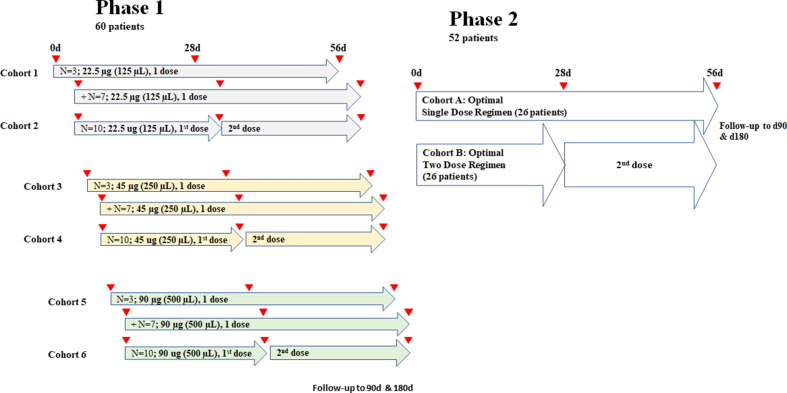
Fig. 1
Fig. 1
AKS-452 pH 1/2 clinical study design. Phase 1 was a 6 × 3 (Sentinel) + 6 × 7 (Expansion) design. The first 3 (sentinel) subjects of cohorts 1, 3 and 5 were vaccinated in a consecutive order, in which the first subject was observed 2 h post-vaccination before the second subject of the respective cohort received vaccination, and the third subject was treated in a similar fashion. After the third subject in a cohort had been vaccinated and observed for 2 h, the next 7 subjects of the respective cohort were vaccinated simultaneously and in a shorter period (total n = 10). Subjects of cohorts 2, 4 and 6 received injections simultaneously with the expansion group of the respective single-dose cohort, because dosages had been considered safe. Based on safety and immunogenicity (seroconversion/titers) of Phase 1 cohorts, optimal dose levels for one-dose and two-dose strategy will be selected for Phase 2 cohorts.
Fig. 2
Fig. 2
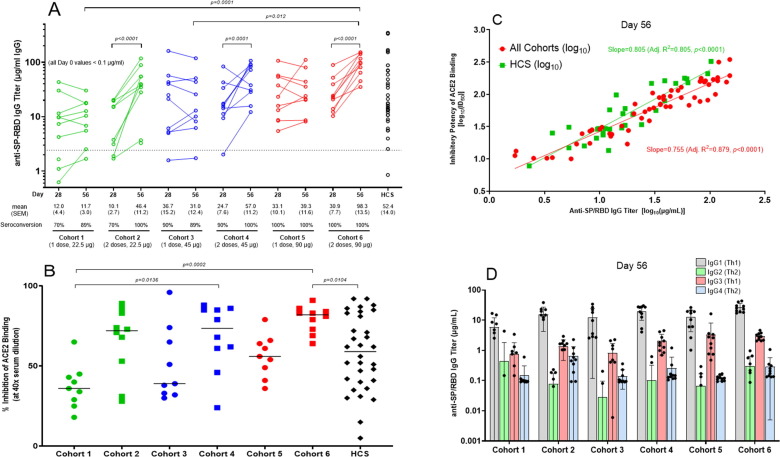
AKS-452 Phase 1 study immunogenicity. (A) Serum samples were obtained at Day 0, 28, and 56 of initial vaccine dose and assessed for anti-SP/RBD IgG binding titers via ELISA and presented per subject (all Day 0 samples were < lower limit of quantitation; not shown). Seroconversion was defined as > 2.42 µg/mL IgG (derived from validation studies with COVID-19 naïve subject samples; see Methods). Human Convalescent serum (HCS) was used as a comparator for samples from vaccinated subjects. Statistical comparisons between Day for each cohort and between cohorts were performed using a model with cohort and Day as fixed effects and a random subject effect. p-values were adjusted for multiplicity. (B) % Inhibition at a 1:40 dilution of sera of Day 56 serum samples were derived via a human ACE2 binding to SP/RBD ELISA. Statistical comparisons between cohorts were performed using a model with cohort as a fixed effect. p-values were adjusted for multiplicity. (C) Comparison of IgG titer vs. inhibitory potency (inhibitory dilution 50% in ACE2 binding assay, ID50) of Day 56 sera for vaccinated subjects and HCS. Linear regression was performed on log transformed data. The slope for HCS was found to be significantly higher (p < 0.0001). (D) Anti-SP/RBD IgG isotype titers were obtained via isotype-specific ELISAs (mean µg/mL ± SD).
Fig. 3
Fig. 3
AKS-452 Phase 1 study mutant SP/RBD immunogenicity. Serum samples obtained on Day 56 of initial vaccine dose and human convalescent sera (HCS) were assessed for titers of IgG binding to different mutant SARS-CoV-2 SP/RBD recombinant proteins via ELISA presented via combined cohorts of one vs. two doses (A). Statistical comparison of group means within a particular SP/RBD variant ELISA was performed with the 2-tailed t-test using unequal variance (GraphPad Prism). (B) Ratios of mutant/wild-type (WT, Washington) strain titers are presented in which the mean ratios of each of the 6 cohorts were used to calculate the grand mean and SEM for each relative mutant titer.
Fig. 4
Fig. 4
AKS-452 Phase 1 study mutant SP/RBD immunogenicity and viral neutralization. Serum samples obtained on Day 56 of initial vaccine dose and human convalescent sera (HCS) were assessed for % neutralization (at 1:40 dilution of serum) of wild-type (Washington) and mutant (alpha and delta) live virus strains to infect live VERO E6 cells via the Plaque Reduction Neutralization Test. Statistical comparison of group means within a particular SP/RBD variant assay was performed with the 2-tailed t-test using unequal variance (GraphPad Prism). *denotes p < 0.05; all cohort means within a viral strain were significantly different from the respective HCS mean (p < 0.05) unless otherwise denoted by the “not significant” designation, ns.

References

    1. University JH. COVID-19 Dashboard by the Center for Systems Science and Engineering (CSSE) at Johns Hopkins University;https://www.covidtracker.com/.
    1. Heaton P.M. The Covid-19 Vaccine-Development Multiverse. N Engl J Med. 2020;383(20):1986–1988. - PMC - PubMed
    1. Karnik M., Beeraka N.M., Uthaiah C.A., Nataraj S.M., Bettadapura A.D.S., Aliev G., et al. A Review on SARS-CoV-2-Induced Neuroinflammation, Neurodevelopmental Complications, and Recent Updates on the Vaccine Development. Mol Neurobiol. 2021;58(9):4535–4563. - PMC - PubMed
    1. Ramasamy M.N., Minassian A.M., Ewer K.J., Flaxman A.L., Folegatti P.M., Owens D.R., et al. Safety and immunogenicity of ChAdOx1 nCoV-19 vaccine administered in a prime-boost regimen in young and old adults (COV002): a single-blind, randomised, controlled, phase 2/3 trial. Lancet. 2020;396(10267):1979–1993. - PMC - PubMed
    1. Zhu F.-C., Guan X.-H., Li Y.-H., Huang J.-Y., Jiang T., Hou L.-H., et al. Immunogenicity and safety of a recombinant adenovirus type-5-vectored COVID-19 vaccine in healthy adults aged 18 years or older: a randomised, double-blind, placebo-controlled, phase 2 trial. Lancet. 2020;396(10249):479–488. - PMC - PubMed

Publication types

Supplementary concepts

Associated data