


Data Sources for Drug Utilization Research in Brazil-DUR-BRA Study
- PMID: 35115935
- PMCID: PMC8805708
- DOI: 10.3389/fphar.2021.789872
Data Sources for Drug Utilization Research in Brazil-DUR-BRA Study
Abstract
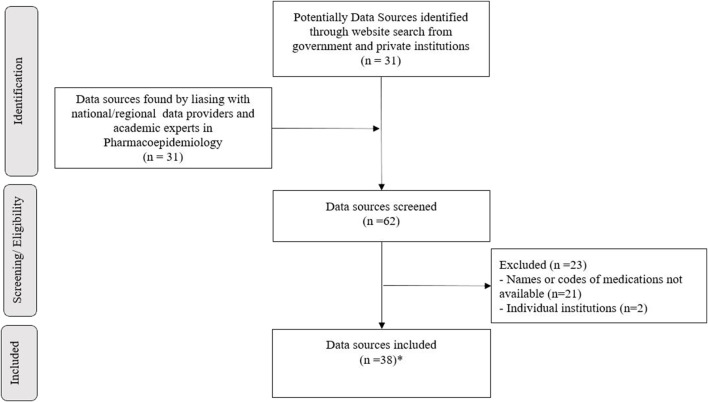
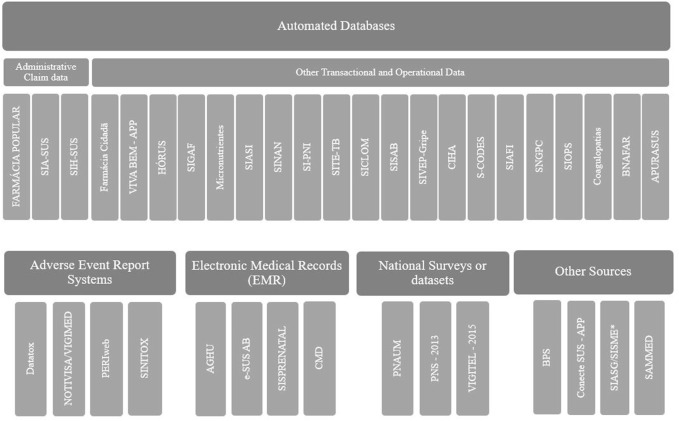
Background: In Brazil, studies that map electronic healthcare databases in order to assess their suitability for use in pharmacoepidemiologic research are lacking. We aimed to identify, catalogue, and characterize Brazilian data sources for Drug Utilization Research (DUR). Methods: The present study is part of the project entitled, "Publicly Available Data Sources for Drug Utilization Research in Latin American (LatAm) Countries." A network of Brazilian health experts was assembled to map secondary administrative data from healthcare organizations that might provide information related to medication use. A multi-phase approach including internet search of institutional government websites, traditional bibliographic databases, and experts' input was used for mapping the data sources. The reviewers searched, screened and selected the data sources independently; disagreements were resolved by consensus. Data sources were grouped into the following categories: 1) automated databases; 2) Electronic Medical Records (EMR); 3) national surveys or datasets; 4) adverse event reporting systems; and 5) others. Each data source was characterized by accessibility, geographic granularity, setting, type of data (aggregate or individual-level), and years of coverage. We also searched for publications related to each data source. Results: A total of 62 data sources were identified and screened; 38 met the eligibility criteria for inclusion and were fully characterized. We grouped 23 (60%) as automated databases, four (11%) as adverse event reporting systems, four (11%) as EMRs, three (8%) as national surveys or datasets, and four (11%) as other types. Eighteen (47%) were classified as publicly and conveniently accessible online; providing information at national level. Most of them offered more than 5 years of comprehensive data coverage, and presented data at both the individual and aggregated levels. No information about population coverage was found. Drug coding is not uniform; each data source has its own coding system, depending on the purpose of the data. At least one scientific publication was found for each publicly available data source. Conclusions: There are several types of data sources for DUR in Brazil, but a uniform system for drug classification and data quality evaluation does not exist. The extent of population covered by year is unknown. Our comprehensive and structured inventory reveals a need for full characterization of these data sources.
Keywords: Brazil; data sources; database management systems; databases (all types); drug utilisation research; health information systems; pharmaceutical preparations; pharmacoepidemiology.
Copyright © 2022 Leal, Osorio-de-Castro, Souza, Ferre, Mota, Ito, Elseviers, Lima, Zimmernan, Fulone, Carvalho-Soares and Lopes.
Conflict of interest statement
The authors declare that the research was conducted in the absence of any commercial or financial relationships that could be construed as a potential conflict of interest.
Figures
References
-
- Agência Nacional de Vigilância Sanitária (2019). Sistema Nacional de Gerenciamento de Produtos Controlados (SNGPC). Available at: http://portal.anvisa.gov.br/produtos_controlados (Accessed June 24, 2019).
-
- Alves J. M., Albino D. B. L., Resener M. C., Zannin M., Savaris A., von Wangenheim C. G., et al. (2016). “Quality Evaluation of Poison Control Information Systems: A Case Study of the DATATOX System,” in 2016 IEEE 29th International Symposium on Computer-Based Medical Systems (CBMS), Belfast and Dublin, Ireland, 20-24 June 2016 (IEEE; ), 30–35. 10.1109/CBMS.2016.53 - DOI
LinkOut - more resources
Full Text Sources
Miscellaneous
