. 2022 Jan 18:12:831785.
doi: 10.3389/fpls.2021.831785. eCollection 2021.

Engineering a Plant-Derived Astaxanthin Synthetic Pathway Into Nicotiana benthamiana

Affiliations

Engineering a Plant-Derived Astaxanthin Synthetic Pathway Into Nicotiana benthamiana

Quinton M Allen et al. Front Plant Sci. .

Abstract

Carotenoids have been shown to be essential for human nutrition. Consumption of carotenoid-rich fruits and vegetables can reduce the risk of many diseases. The ketocarotenoid astaxanthin has become a commercially valuable compound due to its powerful antioxidant properties compared to other carotenoids. It is naturally produced in certain algae, bacteria, and the flowers of some species of the genus Adonis, although it is produced in such small quantities in these organisms that it is costly to extract. Chemical synthesis of this compound has also shown limited success with a high proportion of esterified forms of astaxanthin being produced, which decreases antioxidant properties by the conversion of hydroxyl groups to esters. Previously, transgenic astaxanthin-producing plants have been created using a β-carotene ketolase enzyme of either bacterial or algal origin. However, a novel astaxanthin pathway exists in the flowering plants of the genus Adonis which has not been utilized in the same manner. The pathway involves two unique enzymes, β-ring-4-dehydrogenase and 4-hydroxy-β-ring-4-dehydrogenase, which add the necessary hydroxyl and ketone groups to the rings of β-carotene. In the present study, Nicotiana benthamiana plants were transformed with chimeric constructs coding for these two enzymes. The regenerated, transgenic plants accumulate astaxanthin and their growth (height and weight) was unaffected, when compared to non-transformed N. benthamiana and to plants transformed with the bacterial β-carotene ketolase. The accumulation of astaxanthin also improved seedling survivability under harsh UV light, mitigated reactive oxygen accumulation, and provided a phenotype (color) that allowed the efficient identification and recovery of transgenic plants with and without selection.

Keywords: Adonis aestivalis; Agrobacterium-mediated transformation; Brevundimonas sp. SD212; Nicotiana benthamiana; astaxanthin.


Conflict of interest statement

The authors declare that the research was conducted in the absence of any commercial or financial relationships that could be construed as a potential conflict of interest.

Figures

Figure 1
Figure 1
(A) Two routes of astaxanthin biosynthesis from β-carotene in nature. The pathway with green arrows details the three-step reaction involving the two enzymes in Adonis aestivalis. The pathway with blue arrows details the two-step reaction involving two enzymes from Brevundimonas sp. SD 212. The two separate blue pathways indicate that the two steps can occur in either order. (B) Simplified carotenoid pathway present in most higher plants. The names of the compounds are color coded to symbolize the actual color of the molecules. Names written in black are colorless in nature. Abscisic acid is not a full-length carotenoid, but rather an important apocarotenoid derivative. (A) modified from Cunningham and Gantt (2011) and (B) modified from Wei et al. (2014).
Figure 2
Figure 2
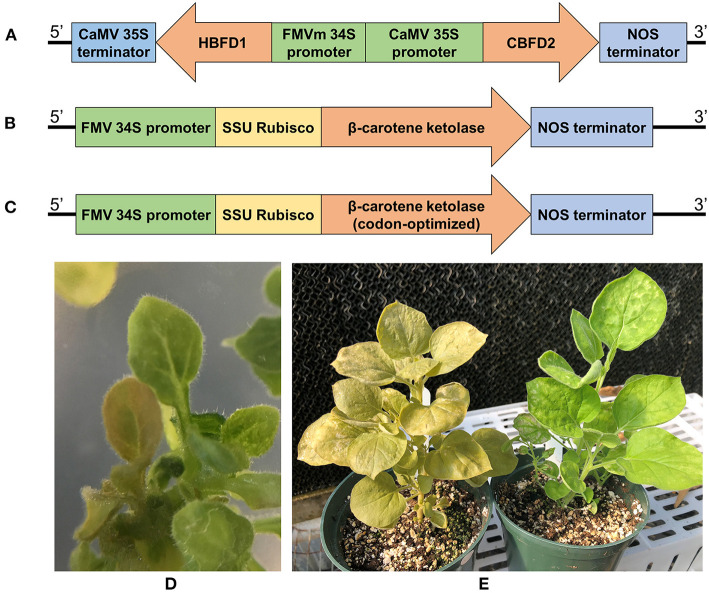
(A–C) Schematic representation of the gene constructs used to induce astaxanthin production in the transgenic plants. All constructs were cloned in pCAMBIA2201 which contains GUS and Kanamycin resistance genes for expression in plants and chloramphenicol resistance for bacterial selection (not shown). (A) pCAMBIA2201-HBFD1-CBFD2 plasmid contains the two astaxanthin inducing chimeric genes, HBFD1 and CBFD2, from Adonis aestivalis, (B) pCAMBIA2201-crtW plasmid contains the β-carotene ketolase, (C) pCAMBIA2201-Cit/crtW plasmid contains the plant codon-optimized cDNA for β-carotene ketolase. FMVm 34S promoter, Figwort mosaic virus minimal 34S promoter; CaMV 35S T, Cauliflower mosaic virus 35S terminator; NOS, nopaline synthase terminator. (D) Transformed T0 Nicotiana benthamiana plant showing the characteristic copper color. (E) Color comparison between astaxanthin and non-astaxanthin accumulating plants 3 months after transformation. On the left is a pCAMBIA2201-HBFD1-CBFD2 transformant and on the right is a pCAMBIA2201 empty vector transformant. This copper-colored phonotype was consistent between all astaxanthin-accumulating plants regardless of the construct harbored.
Figure 3
Figure 3
Identification of astaxanthin in T1 N. benthamiana plants through the mass peaks of product ions generated by HPLC/ESI(+)-MS/MS. The graph shows the 379.2 m/z mass peak from a plant expressing crtW (A), Cit/crtW (B), HBFD1 and CBFD2 (C), empty vector (D) and an astaxanthin analytical standard (E). HPLC/ESI(+)-MS/MS = high performance liquid chromatography, coupled with tandem mass spectrometry with positive electrospray ionization.
Figure 4
Figure 4
Flg22-triggered oxidative burst assays in T1 N. benthamiana leaf disks. The luminescence readings are from (A) empty vector and non-transformed control plants, (B) plants expressing crtW, (C) plants expressing Cit/crtW, and (D) plants expressing HBFD1-CBFD2. Assay solution containing 500 nM flg22 was added to the leaf disks at 0 min and luminescence measurements started immediately. For each sample analyzed, a control sample was included containing no flg22 (-flg22) in the assay mix, which is represented by the dashed lines on each chart.

References

    1. Ahmad T., Sablok G., Tatarinova T. V., Xu Q., Deng X.-X., Guo W.-W. (2013). Evaluation of codon biology in citrus and Poncirus trifoliata based on genomic features and frame corrected expressed sequence tags. DNA Res. 20, 135–150. 10.1093/dnares/dss039 - DOI - PMC - PubMed
    1. Boutrot F., Segonzac C., Chang K. N., Qiao H., Ecker J. R., Zipfel C., et al. (2010). Direct transcriptional control of the Arabidopsis immune receptor FLS2 by the ethylene-dependent transcription factors EIN3 and EIL1. Proc. Natl. Acad. Sci. U. S. A. 107, 14502–14507. 10.1073/pnas.1003347107 - DOI - PMC - PubMed
    1. Cunningham F. X., Gantt E. (2005). A study in scarlet: enzymes of ketocarotenoid biosynthesis in the flowers of Adonis aestivalis. Plant J. 41, 478–492. 10.1111/j.1365-313X.2004.02309.x - DOI - PubMed
    1. Cunningham F. X., Gantt E. (2011). Elucidation of the pathway to astaxanthin in the flowers of Adonis aestivalis. Plant Cell 23, 3055–3069. 10.1105/tpc.111.086827 - DOI - PMC - PubMed
    1. Dammermann W., Wollenberg L., Bentzien F., Lohse A., Lüth S. (2013). Toll like receptor 2 agonists lipoteichoic acid and peptidoglycan are able to enhance antigen specific IFNγ release in whole blood during recall antigen responses. J. Immunol. Methods 396, 107–115. 10.1016/j.jim.2013.08.004 - DOI - PubMed