. 2021 Nov 26:36:201-210.
doi: 10.1016/j.jare.2021.11.012. eCollection 2022 Feb.

Natural triterpenoids from licorice potently inhibit SARS-CoV-2 infection

Affiliations

Natural triterpenoids from licorice potently inhibit SARS-CoV-2 infection

Yang Yi et al. J Adv Res. .

Abstract

Introduction: The COVID-19 global epidemic caused by severe acute respiratory syndrome coronavirus (SARS-CoV-2) is a great public health emergency. Discovering antiviral drug candidates is urgent for the prevention and treatment of COVID-19.

Objectives: This work aims to discover natural SARS-CoV-2 inhibitors from the traditional Chinese herbal medicine licorice.

Methods: We screened 125 small molecules from Glycyrrhiza uralensis Fisch. (licorice, Gan-Cao) by virtual ligand screening targeting the receptor-binding domain (RBD) of SARS-CoV-2 spike protein. Potential hit compounds were further evaluated by ELISA, SPR, luciferase assay, antiviral assay and pharmacokinetic study.

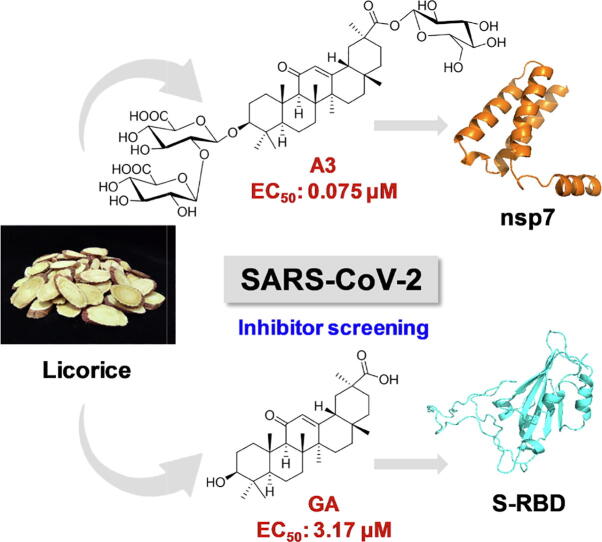
Results: The triterpenoids licorice-saponin A3 (A3) and glycyrrhetinic acid (GA) could potently inhibit SARS-CoV-2 infection, with EC50 of 75 nM and 3.17 µM, respectively. Moreover, we reveal that A3 mainly targets the nsp7 protein, and GA binds to the spike protein RBD of SARS-CoV-2.

Conclusion: In this work, we found GA and A3 from licorice potently inhibit SARS-CoV-2 infection by affecting entry and replication of the virus. Our findings indicate that these triterpenoids may contribute to the clinical efficacy of licorice for COVID-19 and could be promising candidates for antiviral drug development.

Keywords: COVID-19; Glycyrrhetinic acid; Licorice; Licorice-saponin A3; SARS-CoV-2.


Figures

None
Graphical abstract
Fig. 1
Fig. 1
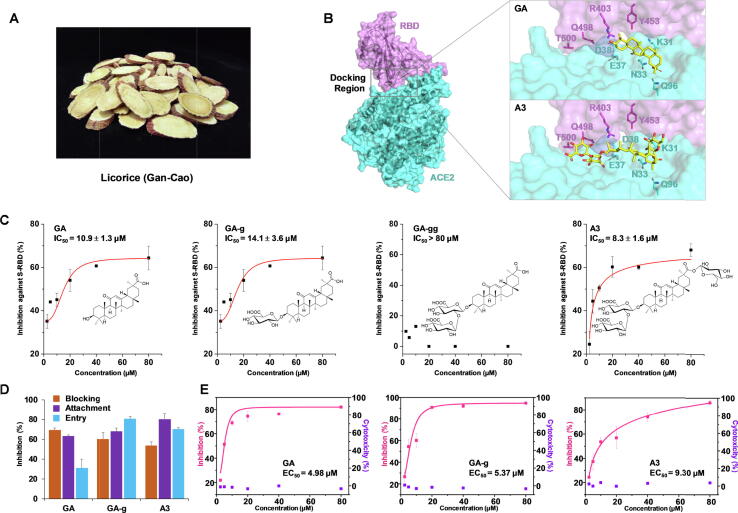
Screening of licorice compounds by molecular docking, ELISA, and pseudovirus infection assay. (A) Picture of the Chinese herbal medicine licorice (Gan-Cao). (B) The active pocket of SARS-CoV-2 spike protein RBD and ACE2, showing the binding of glycyrrhetinic acid (GA) and licorice-saponin A3 (A3) with surrounding amino acid residues. (C) Inhibitory activities of GA, GA-g, GA-gg, and A3 against SARS-CoV-2 spike protein by ELISA, n ≥ 3. Spike protein (0.5 µg/mL) was coated onto 96-well microplates. After incubation with test drugs (1 h), ACE2 (0.5 µg/mL) was added and incubated with the spike protein for 1 h. Structures of the test compounds are shown. (D) Inhibitory activities of GA, GA-g, and A3 at 10 µM at different steps of pseudovirus infection in Vero E6 cells, n ≥ 3. Luminescence was captured to display the viral infection and the inhibition efficiency. (E) Inhibition of pseudovirus infection of GA, GA-g, and A3 in the blocking assay. Cytotoxicities of the drugs against the Vero E6 cells were tested by CCK-8 assay. For each group, n ≥ 3.
Fig. 2
Fig. 2
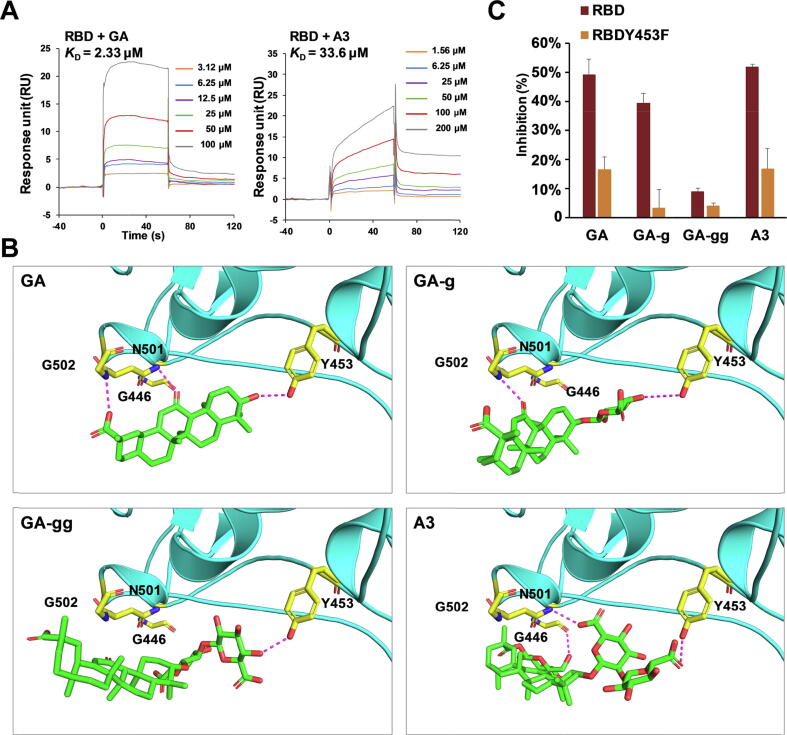
Structure-activity relationship for the binding of licorice triterpenoids with the spike RBD. (A) SPR analysis of GA and A3 binding to the RBD, respectively. The affinity constant KD values of GA and A3 with RBD were calculated by kinetics analysis. (B) Molecular docking of GA, GA-g, GA-gg, and A3 with RBD (PDB ID: 6M0J), showing the hydrogen bonds (magenta dashes). (C) Inhibitory activities of GA, GA-g, GA-gg and A3 (10 µM) against RBD and the Y453F mutant determined by ELISA, n ≥ 3. RBD and RBD-Y453F (0.5 µg/mL), ACE2 (0.5 µg/mL) were used.
Fig. 3
Fig. 3
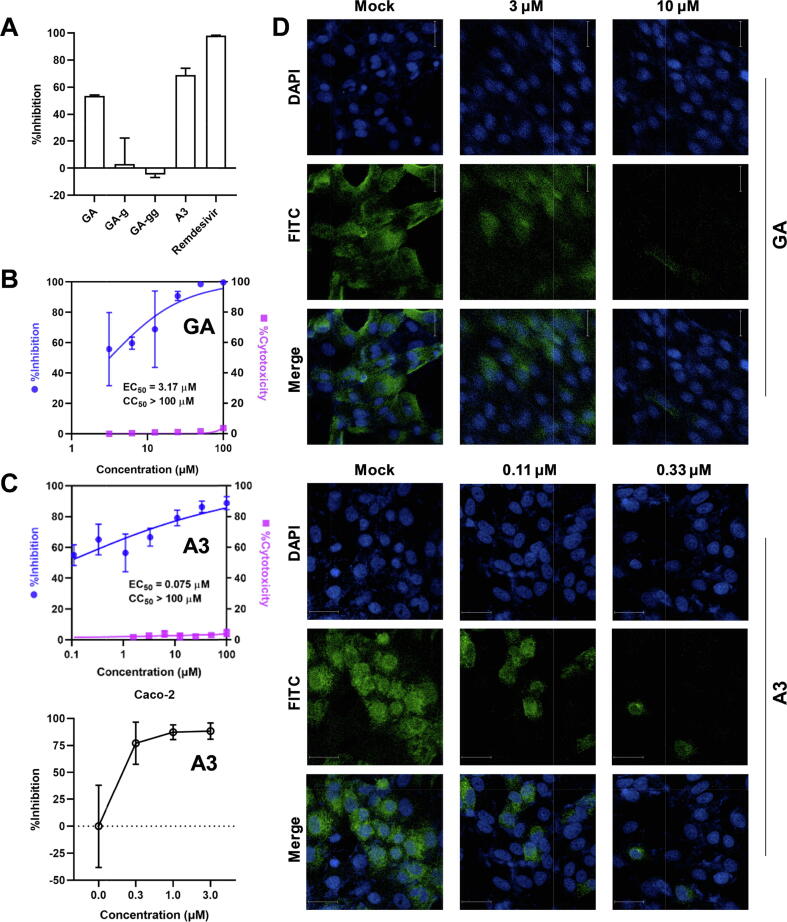
Glycyrrhetinic acid (GA) and licorice-saponin A3 inhibit the infection of SARS-CoV-2 in vitro. (A) Antiviral activities of GA, GA-g, GA-gg, and A3 against SARS-CoV-2 in Vero E6 cells at 3 μM, n ≥ 3. Remdesivir (3 μM) was the positive control. (B) and (C) Dose-dependent inhibition of GA and A3 on SARS-COV-2 infection, n ≥ 3. Vero E6 cells and Caco-2 cells incubated with SARS-CoV-2 at an MOI = 0.01 were treated with increasing concentrations of GA and A3 for 24 h, respectively. qRT-PCR was applied to quantify the copy number of viral ORF1ab RNA in the culture medium. (D) IFA analysis of the inhibition of GA and A3 on SARS-CoV-2 replication. Infected cells were fixed at 24 h post-infection after treatment with 3 µM and 10 µM of GA and 0.11 µM and 0.33 µM of A3, respectively, and were subjected to IFA using the primary antibody against viral spike protein.
Fig. 4
Fig. 4
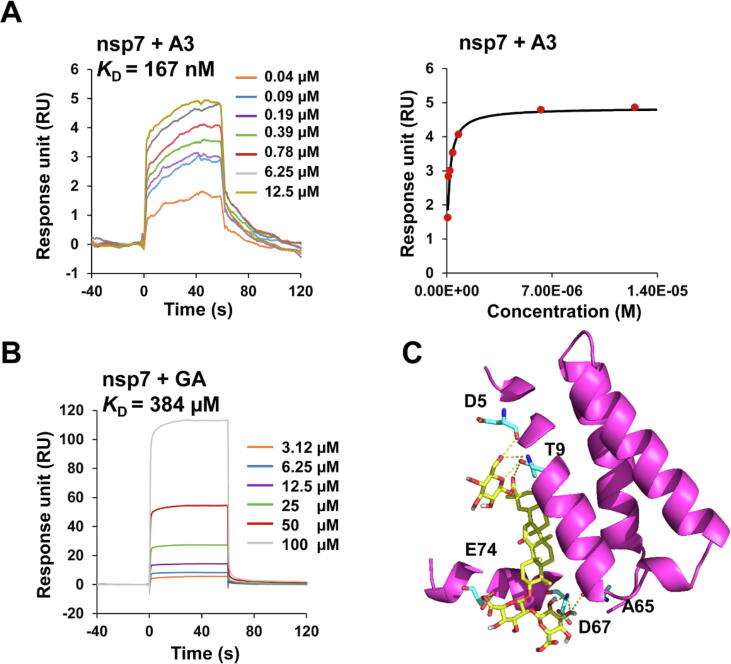
Binding of A3 with nsp7. (A) and (B) SPR analysis of A3 and GA binding to nsp7, respectively. The affinity constant K D values of A3 and GA with nsp7 were calculated by the steady state affinity method and kinetics analysis, respectively. (C) Molecular docking of A3 with nsp7 (PDB ID:7JIT). Seven hydrogen bonds (yellow dashes) were formed by A3 and residues D5, T9, A65, D67 and E74.
Fig. 5
Fig. 5
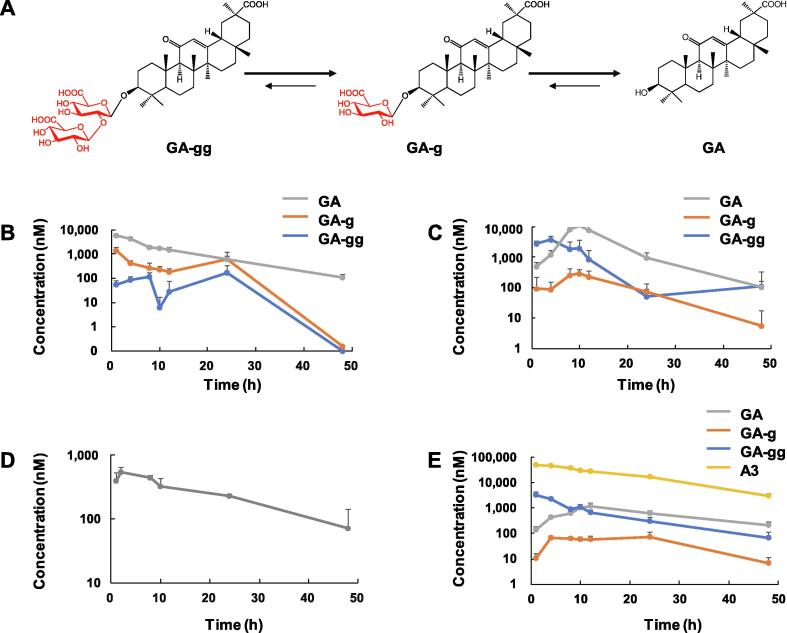
Metabolism and pharmacokinetics of licorice triterpenoids after oral administration in rats. (A) The metabolic pathway of GA and GA-gg. (B) and (C) Time-plasma concentration curves of GA-gg, GA-g, and GA in rats after oral administration of GA (B, 40 mg/kg, i.g., GA, AUCtotal = 0.026 h*g/L, t1/2 = 9.91 h), and GA-gg (C, 40 mg/kg, i.g., GA, Tmax = 8 h, AUCtotal = 0.046 h*g/L, t1/2 = 8.21 h). (D) Time-lung tissue concentration curves of GA in rats after oral administration of GA (40 mg/kg, i.g., Tmax = 2 h, AUCtotal = 0.006 h*g/L, t1/2 = 18.17 h). For each group, n = 4. (E) Time-plasma concentration curves of GA-gg, GA-g, GA, and A3 in rats after intravenous injection of A3 (20 mg/kg, i.v., A3, AUCtotal = 0.99 h*g/L, t1/2 = 10.31 h).

References

    1. Cavanagh D. In: Coronaviruses with special emphasis on first insights concerning SARS. Schmidt A., Weber O., Wolff M.H., editors. Birkhauser Basel; Basel: 2005. Coronaviridae: a review of coronaviruses and toroviruses; pp. 1–54.
    1. Graham R.L., Donaldson E.F., Baric R.S. A decade after SARS: strategies for controlling emerging coronaviruses. Nat Rev Microbiol. 2013;11:836–848. - PMC - PubMed
    1. Zhou P., Yang X.-L., Wang X.-G., Hu B., Zhang L., Zhang W., et al. A pneumonia outbreak associated with a new coronavirus of probable bat origin. Nature. 2020;579(7798):270–273. - PMC - PubMed
    1. Kimura I, Kosugi1 Y, Wu J. SARS-CoV-2 Lambda variant exhibits higher infectivity and immune resistance. bioRxiv preprint 2021. 10.1101/2021.07.28.454085. - DOI - PMC - PubMed
    1. Riemersma KK, Grogan, BE, Kita-Yarbro A, Shedding of Infectious SARS-CoV-2 Despite Vaccination. medRxiv preprint 2021. 10.1101/2021.07.31.21261387. - DOI - PMC - PubMed

Publication types