


Urolithins: a Comprehensive Update on their Metabolism, Bioactivity, and Associated Gut Microbiota
- PMID: 35118817
- PMCID: PMC9787965
- DOI: 10.1002/mnfr.202101019
Urolithins: a Comprehensive Update on their Metabolism, Bioactivity, and Associated Gut Microbiota
Abstract
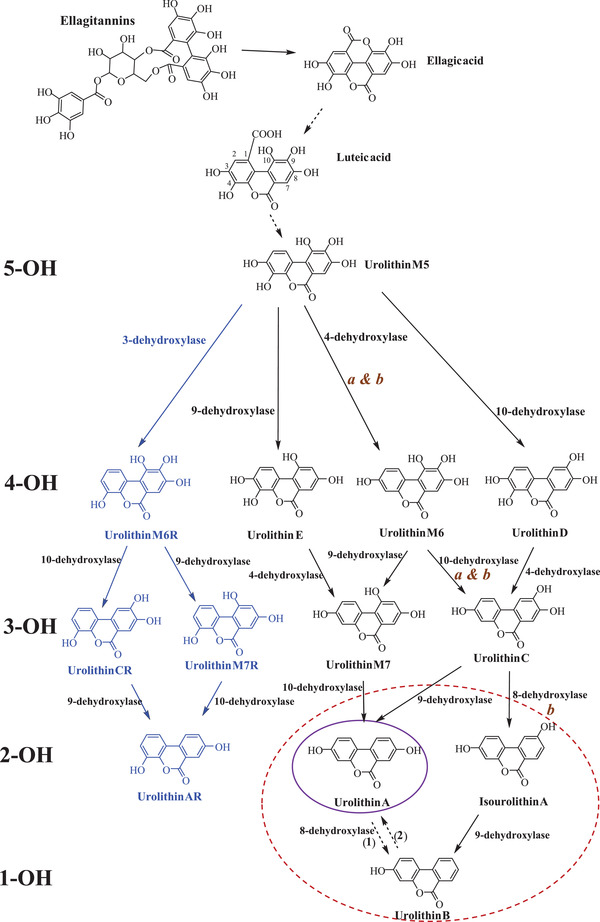
Urolithins, metabolites produced by the gut microbiota from the polyphenols ellagitannins and ellagic acid, are discovered by the research group in humans almost 20 years ago. Pioneering research suggests urolithins as pleiotropic bioactive contributors to explain the health benefits after consuming ellagitannin-rich sources (pomegranates, walnuts, strawberries, etc.). Here, this study comprehensively updates the knowledge on urolithins, emphasizing the review of the literature published during the last 5 years. To date, 13 urolithins and their corresponding conjugated metabolites (glucuronides, sulfates, etc.) have been described and, depending on the urolithin, detected in different human fluids and tissues (urine, blood, feces, breastmilk, prostate, colon, and breast tissues). There has been a substantial advance in the research on microorganisms involved in urolithin production, along with the compositional and functional characterization of the gut microbiota associated with urolithins metabolism that gives rise to the so-called urolithin metabotypes (UM-A, UM-B, and UM-0), relevant in human health. The design of in vitro studies using physiologically relevant assay conditions (molecular forms and concentrations) is still a pending subject, making some reported urolithin activities questionable. In contrast, remarkable progress has been made in the research on the safety, bioactivity, and associated mechanisms of urolithin A, including the first human interventions.
Keywords: ellagitannins; gut microbiota; metabotype; polyphenol; urolithins.
© 2022 The Authors. Molecular Nutrition & Food Research published by Wiley-VCH GmbH.
Conflict of interest statement
The authors declare no conflict of interest.
Figures
References
-
- Cerdá B., Llorach R., Cerón J. J., Espín J. C., Tomás‐Barberán F. A., Eur. J. Nutr. 2003, 42, 18. - PubMed
-
- Cerdá B., Cerón J. J., Tomás‐Barberán F. A., Espín J. C., J. Agric. Food Chem. 2003, 31, 3493. - PubMed
-
- Cerdá B., Espín J. C., Parra S., Martínez P., Tomás‐Barberán F. A., Eur. J. Nutr. 2004, 43, 205. - PubMed
-
- Tomás‐Barberán F. A., González‐Sarrías A., García‐Villalba R., Nuñez‐Sánchez M. A., Selma M. V., García‐Conesa M. T., Mol. Nutr. Food Res. 2017, 1, 1500901. - PubMed
-
- García‐Villalba R., Vissenaekens H., Pitart J., Romo‐Vaquero M., Espín J. C., Grootaert C., Selma M. V., Raes K., Smagghe G., Possemiers S., Van Camp J., Tomás‐Barberán F. A., J. Agric. Food Chem. 2017, 65, 5480. - PubMed
Publication types
MeSH terms
Substances
LinkOut - more resources
Full Text Sources
Other Literature Sources
