. 2022 Feb 4;8(5):eabj8750.
doi: 10.1126/sciadv.abj8750. Epub 2022 Feb 4.

A developmental reduction of the excitation:inhibition ratio in association cortex during adolescence

Affiliations

A developmental reduction of the excitation:inhibition ratio in association cortex during adolescence

Bart Larsen et al. Sci Adv. .

Abstract

Adolescence is hypothesized to be a critical period for the development of association cortex. A reduction of the excitation:inhibition (E:I) ratio is a hallmark of critical period development; however, it has been unclear how to assess the development of the E:I ratio using noninvasive neuroimaging techniques. Here, we used pharmacological fMRI with a GABAergic benzodiazepine challenge to empirically generate a model of E:I ratio based on multivariate patterns of functional connectivity. In an independent sample of 879 youth (ages 8 to 22 years), this model predicted reductions in the E:I ratio during adolescence, which were specific to association cortex and related to psychopathology. These findings support hypothesized shifts in E:I balance of association cortices during a neurodevelopmental critical period in adolescence.


Figures
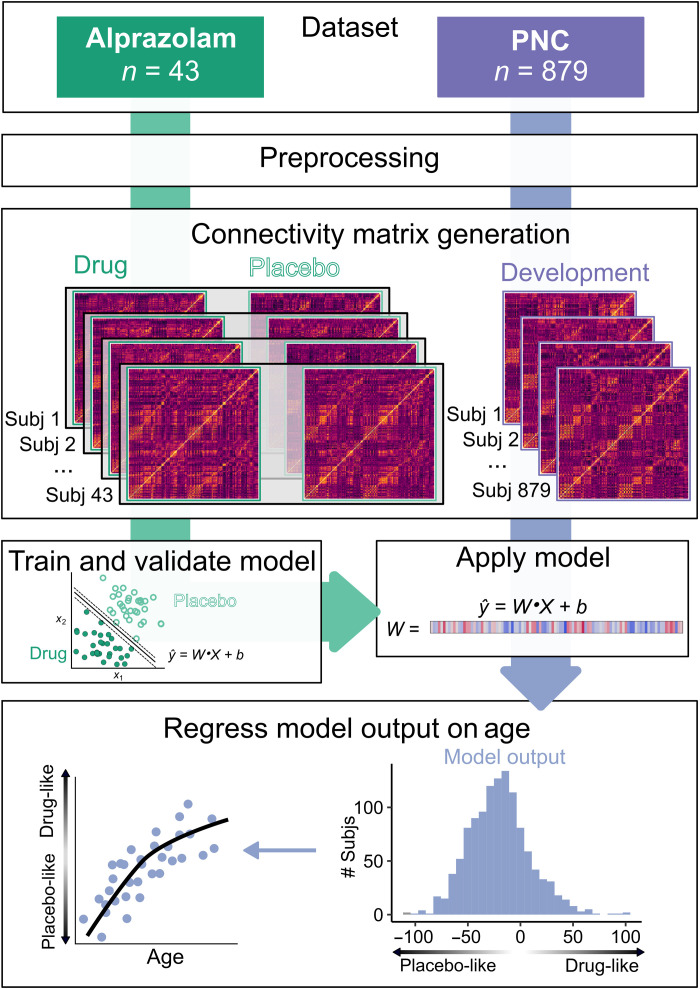
Fig. 1.
Fig. 1.. Analysis workflow.
Dataset: Two datasets were collected on the same scanner using highly similar acquisition parameters: a phMRI dataset using the benzodiazepine alprazolam (green) and a developmental fMRI sample from the Philadelphia Neurodevelopmental Cohort (PNC) (purple). Preprocessing: Datasets were preprocessed using identical pipelines, which included removal of nuisance signal with aCompCor, global signal regression, and task regression. Connectivity matrix generation: Connectivity matrices were generated from standard atlases for placebo and drug sessions from the alprazolam dataset (n = 43; 86 sessions total) and for the PNC dataset (n = 879). Train and validate model: The alprazolam dataset was used to train a linear SVM classifier to distinguish drug and placebo sessions using 10-fold cross-validation. Apply model: The validated alprazolam model was applied to the PNC dataset, generating a distance metric that reflected each participant’s position on a continuum from “drug-like” (lower E:I) to “placebo-like” (higher E:I). Regress model output on age: This metric was then regressed on age using a generalized additive model with penalized splines that included covariates for sex, head motion, and attentiveness.
Fig. 2.
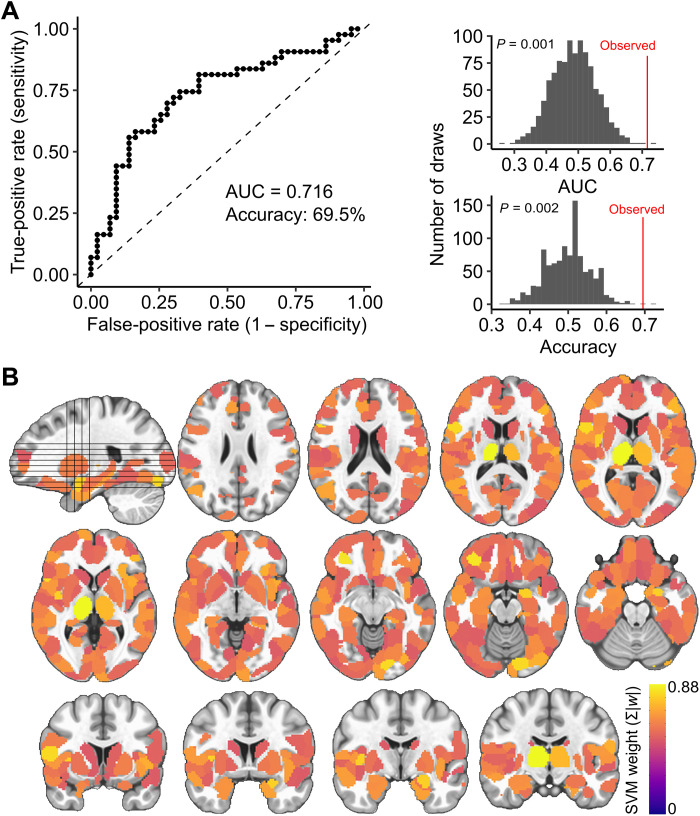
Fig. 2.. A multivariate model distinguishes alprazolam and placebo sessions, capturing E:I ratio.
(A) Classifier performance. The binary SVM classifier identified drug and placebo sessions in 10-fold cross-validation with an AUC of 0.716 and an accuracy of 69.5% (top). The observed AUC and accuracy were significantly greater than a permuted null distribution (bottom). (B) Mean absolute feature weights for all nodes from the validated SVM model.
Fig. 3.
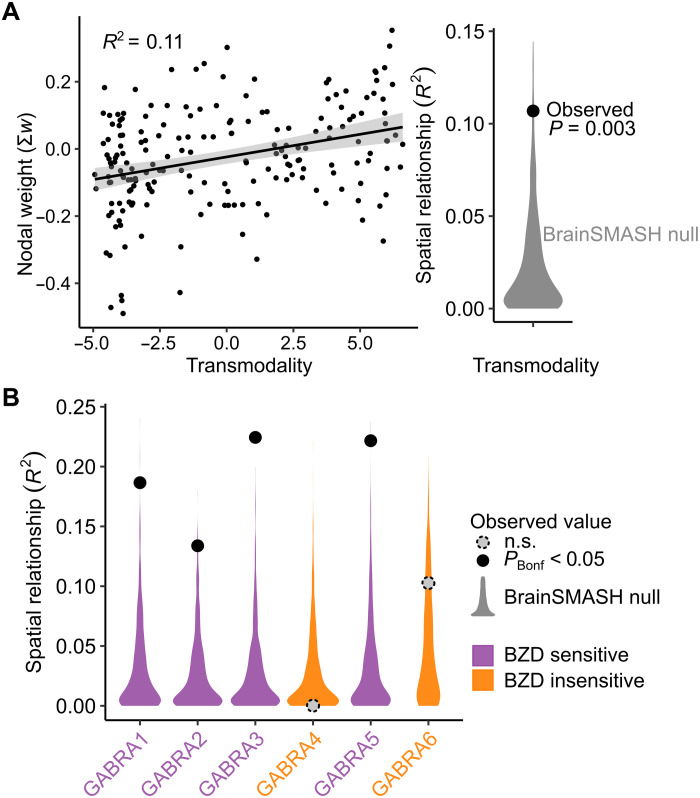
Fig. 3.. Model features align with cortical organization and benzodiazepine pharmacology.
(A) The cortical pattern of nodal SVM weights from the multivariate E:I ratio model was significantly associated with transmodality using an established measure of macroscale cortical organization (35). (B) Nodal weights were also specifically correlated with the spatial patterns of benzodiazepine (BZD)–sensitive GABAA receptor subunit expression. Spatial relationships were tested for significance against a spatial autocorrelation–preserving null distribution [BrainSMASH (36)] and corrected for multiple comparisons using the Bonferroni correction (PBonf). n.s., not significant.
Fig. 4.
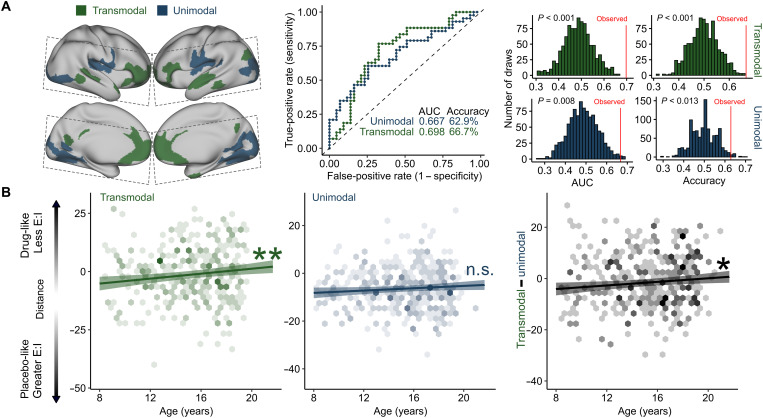
Fig. 4.. Transmodal areas undergo E:I ratio development during adolescence.
(A) Model performance for unimodal and transmodal classifiers. SVM classifiers were trained and validated for connections to the most transmodal (green) and most unimodal (blue) areas only. Dashed lines indicate acquisition field of view for the phMRI dataset. Both models performed significantly better than a permuted null distribution (middle: receiver operating characteristic curves for each model; right: null distributions from 1000 null permutations). (B) Models trained on transmodal and unimodal data were applied to the developmental dataset, generating a distance metric for each participant where greater values represent patterns of functional connectivity consistent with a lower E:I ratio. Individuals had a lower estimated E:I ratio with age in transmodal cortex (left) but not in unimodal cortex (middle). This pattern was confirmed by a significant effect of age on within-subject change in transmodal versus unimodal distance scores (right). *P < 0.05 and **P < 0.01.

References

    1. Cui Z., Li H., Xia C. H., Larsen B., Adebimpe A., Baum G. L., Cieslak M., Gur R. E., Gur R. C., Moore T. M., Oathes D. J., Alexander-Bloch A. F., Raznahan A., Roalf D. R., Shinohara R. T., Wolf D. H., Davatzikos C., Bassett D. S., Fair D. A., Fan Y., Satterthwaite T. D., Individual variation in functional topography of association networks in youth. Neuron 106, 340–353.e8 (2020). - PMC - PubMed
    1. Marek S., Hwang K., Foran W., Hallquist M. N., Luna B., The contribution of network organization and integration to the development of cognitive control. PLOS Biol. 13, e1002328 (2015). - PMC - PubMed
    1. Gennatas E. D., Avants B. B., Wolf D. H., Satterthwaite T. D., Ruparel K., Ciric R., Hakonarson H., Gur R. E., Gur R. C., Age-related effects and sex differences in gray matter density, volume, mass, and cortical thickness from childhood to young adulthood. J. Neurosci. 37, 5065–5073 (2017). - PMC - PubMed
    1. Gogtay N., Thompson P. M., Mapping gray matter development: Implications for typical development and vulnerability to psychopathology. Brain Cogn. 72, 6–15 (2010). - PMC - PubMed
    1. Sydnor V. J., Larsen B., Bassett D. S., Alexander-Bloch A., Fair D. A., Liston C., Mackey A. P., Milham M. P., Pines A., Roalf D. R., Seidlitz J., Xu T., Raznahan A., Satterthwaite T. D., Neurodevelopment of the association cortices: Patterns, mechanisms, and implications for psychopathology. Neuron 109, 2820–2846 (2021). - PMC - PubMed

Publication types