


Limbic-Predominant Age-Related TDP-43 Encephalopathy: Medical and Pathologic Factors Associated With Comorbid Hippocampal Sclerosis
- PMID: 35121671
- PMCID: PMC8992604
- DOI: 10.1212/WNL.0000000000200001
Limbic-Predominant Age-Related TDP-43 Encephalopathy: Medical and Pathologic Factors Associated With Comorbid Hippocampal Sclerosis
Abstract
Background and objectives: Limbic-predominant age-related Tar DNA binding protein 43 (TDP-43) encephalopathy neuropathologic change (LATE-NC) is present in ≈25% of older persons' brains and is strongly associated with cognitive impairment. Hippocampal sclerosis (HS) pathology is often comorbid with LATE-NC, but the clinical and pathologic correlates of HS in LATE-NC are not well understood.
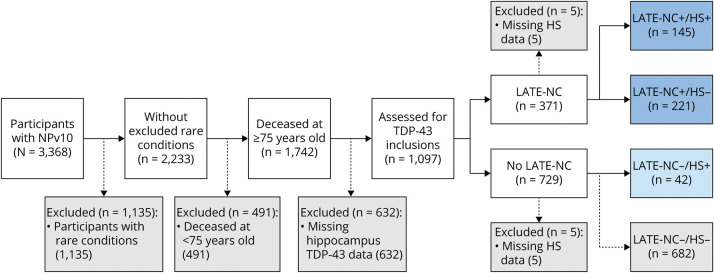
Methods: This retrospective autopsy cohort study used data derived from the National Alzheimer's Coordinating Center Neuropathology Data Set, which included neurologic status, medical histories, and neuropathologic results. All autopsies were performed in 2014 or later. Among participants with LATE-NC, those who also had HS pathology were compared with those without HS with regard to candidate risk factors or common underlying diseases. Statistical significance was set at nominal p < 0.05 in this exploratory study.
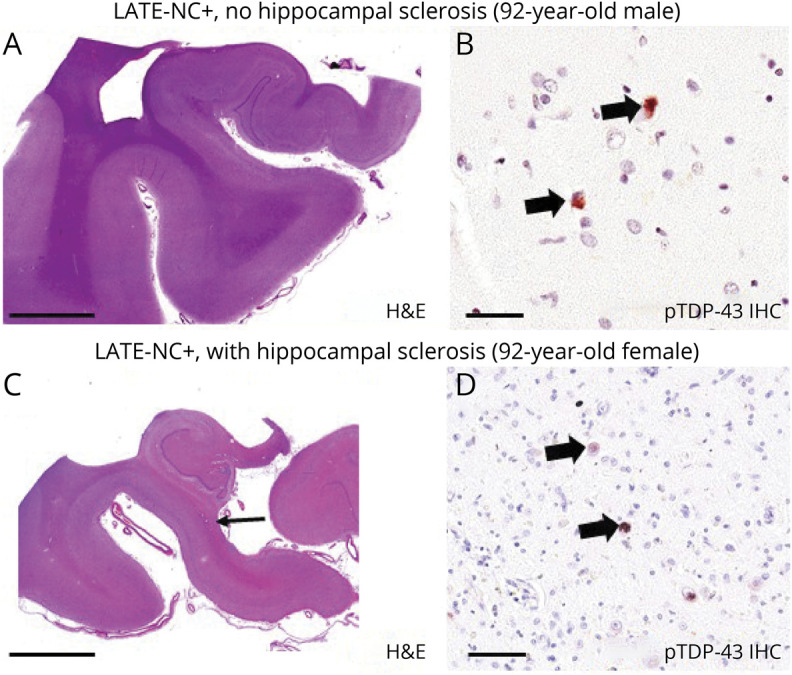
Results: A total of 408 participants were included (n = 221 were LATE-NC+/HS-, n = 145 were LATE-NC+/HS+, and n = 42 were LATE-NC-/HS+). Most of the included LATE-NC+ participants were severely impaired cognitively (83.3% with dementia). Compared to HS- participants, LATE-NC+ participants with HS trended toward having worse cognitive status and scored lower on the Personal Care and Orientation domains (both p = 0.03). Among LATE-NC+ participants with Braak neurofibrillary tangle (NFT) stages 0 to IV (n = 88), HS+ participants were more impaired in the Memory and Orientation domains (both p = 0.02). There were no differences (HS+ compared with HS-) in the proportion with clinical histories of seizures, stroke, cardiac bypass procedures, diabetes, or hypertension. The HS+ group lacking TDP-43 proteinopathy (n = 42) was relatively likely to have had strokes (p = 0.03). When LATE-NC+ participants with or without HS were compared, there were no differences in Alzheimer disease neuropathologies (Thal β-amyloid phases or Braak NFT stages) or Lewy body pathologies. However, the HS+ group was less likely to have amygdala-restricted TDP-43 proteinopathy (LATE-NC stage 1) and more likely to have neocortical TDP-43 proteinopathy (LATE-NC stage 3) (p < 0.001). LATE-NC+ brains with HS also tended to have more severe circle of Willis atherosclerosis and arteriolosclerosis pathologies.
Discussion: In this cohort skewed toward participants with severe dementia, LATE-NC+ HS pathology was not associated with seizures or with Alzheimer-type pathologies. Rather, the presence of comorbid HS pathology was associated with more widespread TDP-43 proteinopathy and with more severe non-β-amyloid vessel wall pathologies.
© 2022 American Academy of Neurology.
Figures
References
-
- Neumann M, Sampathu DM, Kwong LK, et al. Ubiquitinated TDP-43 in frontotemporal lobar degeneration and amyotrophic lateral sclerosis. Science. 2006;314(5796):130-133. - PubMed
-
- Dickson DW, Davies P, Bevona C, et al. Hippocampal sclerosis: a common pathological feature of dementia in very old (> or = 80 years of age) humans. Acta Neuropathol. 1994;88(3):212-221. - PubMed
Publication types
MeSH terms
Substances
Grants and funding
- P30 AG049638/AG/NIA NIH HHS/United States
- P50 AG016573/AG/NIA NIH HHS/United States
- P50 AG005146/AG/NIA NIH HHS/United States
- P50 AG047266/AG/NIA NIH HHS/United States
- P30 AG019610/AG/NIA NIH HHS/United States
- P30 AG010161/AG/NIA NIH HHS/United States
- P30 AG062715/AG/NIA NIH HHS/United States
- P30 AG035982/AG/NIA NIH HHS/United States
- P50 AG005134/AG/NIA NIH HHS/United States
- R01 AG057187/AG/NIA NIH HHS/United States
- P30 AG013854/AG/NIA NIH HHS/United States
- P30 AG053760/AG/NIA NIH HHS/United States
- P50 AG016574/AG/NIA NIH HHS/United States
- R56 AG057191/AG/NIA NIH HHS/United States
- P30 AG010129/AG/NIA NIH HHS/United States
- P30 AG072946/AG/NIA NIH HHS/United States
- U24 AG072122/AG/NIA NIH HHS/United States
- P50 AG005133/AG/NIA NIH HHS/United States
- P30 AG010124/AG/NIA NIH HHS/United States
- P50 AG033514/AG/NIA NIH HHS/United States
- R01 AG061111/AG/NIA NIH HHS/United States
- P30 AG010133/AG/NIA NIH HHS/United States
- RF1 NS118584/NS/NINDS NIH HHS/United States
- R01 AG054060/AG/NIA NIH HHS/United States
- U01 AG016976/AG/NIA NIH HHS/United States
- P50 AG005136/AG/NIA NIH HHS/United States
- P30 AG062422/AG/NIA NIH HHS/United States
- P30 AG012300/AG/NIA NIH HHS/United States
- P30 AG008051/AG/NIA NIH HHS/United States
- P50 AG023501/AG/NIA NIH HHS/United States
- P50 AG005681/AG/NIA NIH HHS/United States
- P30 AG028383/AG/NIA NIH HHS/United States
- P30 AG066509/AG/NIA NIH HHS/United States
- P50 AG008702/AG/NIA NIH HHS/United States
- P50 AG047270/AG/NIA NIH HHS/United States
- P50 AG005138/AG/NIA NIH HHS/United States
- P50 AG005131/AG/NIA NIH HHS/United States
- P50 AG005142/AG/NIA NIH HHS/United States
- P30 AG008017/AG/NIA NIH HHS/United States
- P30 AG072947/AG/NIA NIH HHS/United States
- P50 AG047366/AG/NIA NIH HHS/United States
- P50 AG025688/AG/NIA NIH HHS/United States
- P30 AG013846/AG/NIA NIH HHS/United States
LinkOut - more resources
Full Text Sources
Medical
