. 2022 May;234(3):827-836.
doi: 10.1111/nph.18019. Epub 2022 Mar 3.

The SINGLE FLOWER (SFL) gene encodes a MYB transcription factor that regulates the number of flowers produced by the inflorescence of chickpea

Affiliations

The SINGLE FLOWER (SFL) gene encodes a MYB transcription factor that regulates the number of flowers produced by the inflorescence of chickpea

Cristina Caballo et al. New Phytol. 2022 May.

Abstract

Legumes usually have compound inflorescences, where flowers/pods develop from secondary inflorescences (I2), formed laterally at the primary inflorescence (I1). Number of flowers per I2, characteristic of each legume species, has important ecological and evolutionary relevance as it determines diversity in inflorescence architecture; moreover, it is also agronomically important for its potential impact on yield. Nevertheless, the genetic network controlling the number of flowers per I2 is virtually unknown. Chickpea (Cicer arietinum) typically produces one flower per I2 but single flower (sfl) mutants produce two (double-pod phenotype). We isolated the SFL gene by mapping the sfl-d mutation and identifying and characterising a second mutant allele. We analysed the effect of sfl on chickpea inflorescence ontogeny with scanning electron microscopy and studied the expression of SFL and meristem identity genes by RNA in situ hybridisation. We show that SFL corresponds to CaRAX1/2a, which codes a MYB transcription factor specifically expressed in the I2 meristem. Our findings reveal SFL as a central factor controlling chickpea inflorescence architecture, acting in the I2 meristem to regulate the length of the period for which it remains active, and therefore determining the number of floral meristems that it can produce.

Keywords: R2R3-MYB genes; RAX genes; chickpea breeding; chickpea double-pod mutants; compound inflorescence; inflorescence architecture; meristem activity; seed yield.


Figures

Fig. 1
Fig. 1
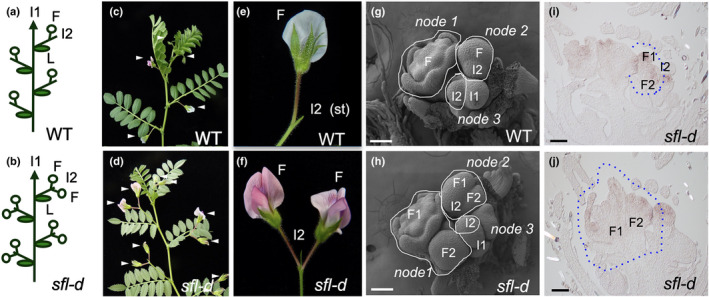
Double‐pod phenotype in chickpea (Cicer arietinum) caused by the mutation in the SINGLE FLOWER (SFL) gene and ontogeny of the inflorescence of the sfl‐d mutant. (a, b) Diagrams of wild‐type (WT) and sfl‐d chickpea plants. Flowers (F) develop at secondary inflorescences (I2) that are formed in the axil of the leaves (L) of the primary inflorescence (I1) stem. Wild‐type I2s (a) produce one flower, whereas sfl‐d I2s (b) produce two flowers. (c, d) Wild‐type and sfl‐d chickpea plants. Arrowheads mark individual flowers formed at the I2s of the wild‐type (c) and two flowers in the sfl‐d (d) I2s. (e) Close‐up of a wild‐type I2, in which the stub (st) is marked. (f) Close‐up of a sfl‐d I2. (g) Scanning electron micrograph (SEM) of the inflorescence apex of a wild‐type plant. In each I2 node one flower is found. (h) Scanning electron micrograph of the inflorescence apex of a sfl‐d plant. In the I2 nodes two flowers (at different developmental stages) are found. (i, j) In situ hybridisation of CaPIM mRNA in inflorescence apices of the sfl‐d mutant, in which each I2 node bears two flowers at different developmental stages. (g–j) Bar, 100 µm.
Fig. 2
Fig. 2
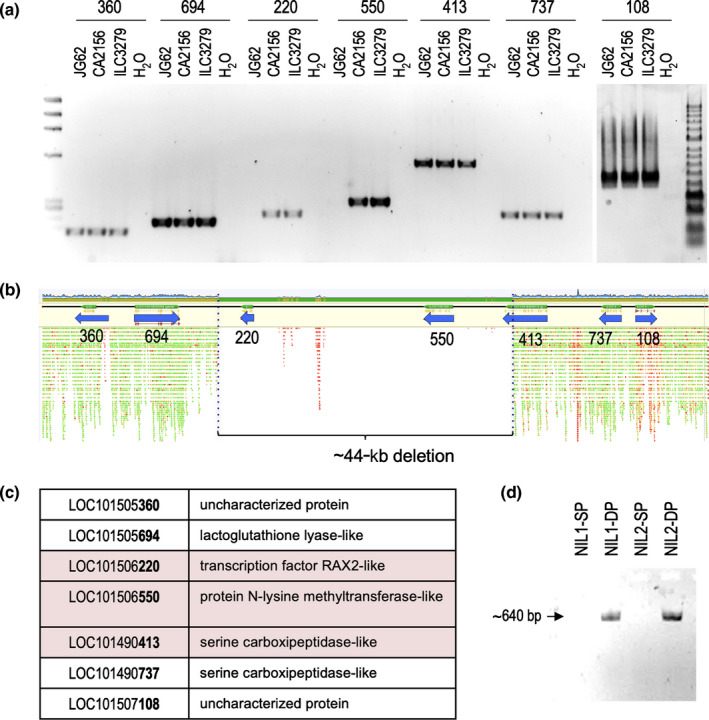
Deletion in the 92.6‐kb SFL mapping interval. (a) PCR amplification with primers for the seven genes in the 92.6‐kb SFL mapping in DNA from the chickpea (Cicer arietinum) double‐pod line JG62 and the single‐pod lines CA2156 and ILC3279. (b) Mapping of sequencing reads of the JG62 re‐sequencing against the genome of the reference single‐pod line CDC‐Frontier in the 92.6‐kb SFL mapping interval, showing a deletion affecting three genes. (c) List of the genes contained in the 92.6‐kb SFL mapping interval. Genes affected by the deletion are highlighted in pink. (d) PCR amplification with primers at the limits of the deletion in two pairs of single‐pod (SP) or double‐pod (DP) nearly isogenic lines (NIL1, NIL2).
Fig. 3
Fig. 3
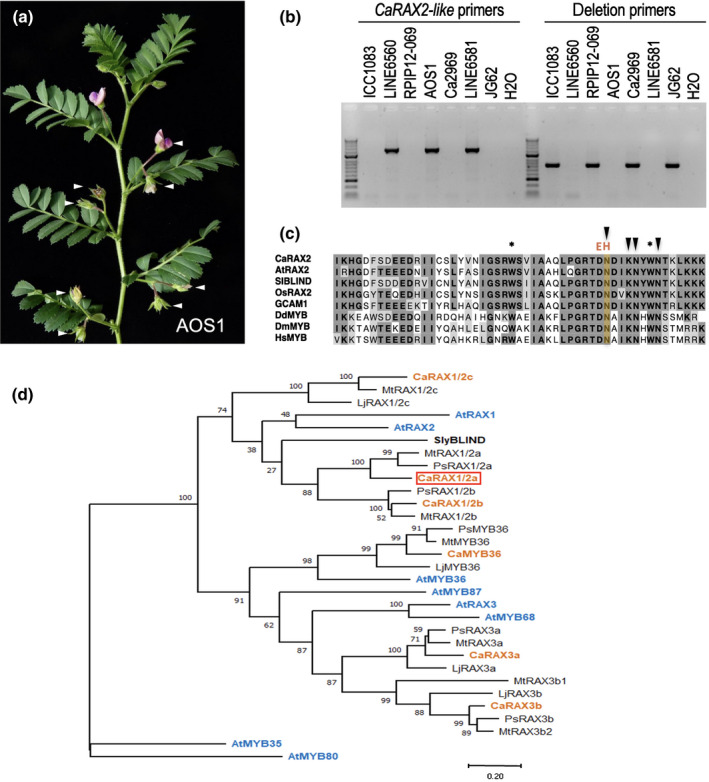
CaRAX2‐like is mutated in a new mutant allele of SFL and a phylogenetic tree of legume RAX proteins. (a) Double‐pod phenotype of a chickpea (Cicer arietinum) AOS1 plant. Arrowheads mark the flowers. (b) PCR amplification in the USDA double‐pod lines with primer pairs at CaRAX2‐like or at the limits of the deletion. (c) clustalw alignment of the R3 repeat of representative R2R3‐MYB proteins from plants, microorganisms and animals. At, Arabidopsis thaliana; Ca, Cicer arietinum; Dd, Dictyostelium discoideum; Dm, Drosophila melanogaster; GCMA1, Marchantia polymorpha; Hs, Homo sapiens; Os, Oriza sativa; Sl, Solanum lycopersicum. Asterisks mark conserved tryptophan residues. Arrowheads mark base‐contacting residues of the mouse homologue of HsMYB. (d) Phylogenetic tree of subgroup 14 MYB proteins from Arabidopsis and legumes. Legume proteins have been named after their Arabidopsis homologues. CaRAX2‐like/CaRAX1/2a is framed in red. At, Arabidopsis thaliana; Ca, Cicer arietinum (chickpea); Lj, Lotus japonicus; Mt, Medicago truncatula; Ps, Pisum sativum (pea); Sl, Solanum lycopersicum. Accession numbers of the genes in the phylogenetic tree can be found in Supporting Information Table S2.
Fig. 4
Fig. 4
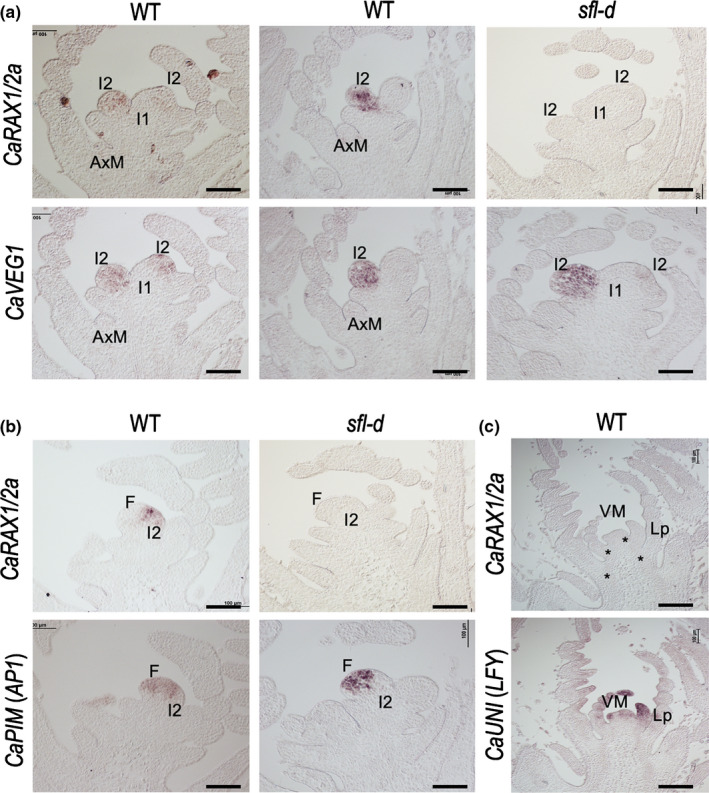
Expression pattern of the CaRAX1/2a/SFL gene in shoot apices of chickpea (Cicer arietinum). (a) In situ hybridisation of CaRAX1/2a mRNA (upper row) and of the secondary inflorescence meristem (I2) marker CaVEG1 mRNA (lower row) in contiguous sections of inflorescence shoot apices of wild‐type (WT) or sfl‐d plants. AxM, vegetative axillary meristem; I1, primary inflorescence meristem; I2, secondary inflorescence. (b) In situ hybridisation of CaRAX1/2a mRNA (upper row) and of the floral meristem (F) marker CaPIM mRNA (lower row) in contiguous sections of inflorescence shoot apices of wild‐type or sfl‐d plants. (c) In situ hybridisation of CaRAX1/2a mRNA (upper) and of the leaf (and floral) marker CaUNI mRNA (lower) in contiguous sections of vegetative shoot apices of a wild‐type plant. Asterisks in the top image mark leaf axils. Lp, leaf primordium; VM, vegetative shoot apical meristem. Bar, 100 μm.

References

    1. Ali L, Deokar A, Caballo C, Tar’an B, Gil J, Chen W, Millan T, Rubio J. 2016. Fine mapping for double podding gene in chickpea. Theoretical and Applied Genetics 129: 77–86. - PubMed
    1. Benlloch R, Berbel A, Serrano‐Mislata A, Madueño F. 2007. Floral initiation and inflorescence architecture: a comparative view. Annals of Botany 100: 659–676. - PMC - PubMed
    1. Benlloch R, Berbel A, Ali L, Gohari G, Millán T, Madueño F. 2015. Genetic control of inflorescence architecture in legumes. Frontiers in Plant Science 6: 543. - PMC - PubMed
    1. Benlloch R, d'Erfurth I, Ferrandiz C, Cosson V, Beltrán JP, Cañas LA, Kondorosi A, Madueño F, Ratet P. 2006. Isolation of mtpim proves Tnt1 a useful reverse genetics tool in Medicago truncatula and uncovers new aspects of AP1‐like functions in legumes. Plant Physiology 142: 972–983. - PMC - PubMed
    1. Berbel A, Ferrándiz C, Hecht V, Dalmais M, Lund OS, Sussmilch FC, Taylor SA, Bendahmane A, Ellis THN, Beltrán JP et al. 2012. VEGETATIVE1 is essential for development of the compound inflorescence in pea. Nature Communications 3: 659–714. - PubMed

Publication types

Substances