


An individualized decision between physical therapy or surgery for patients with degenerative meniscal tears cannot be based on continuous treatment selection markers: a marker-by-treatment analysis of the ESCAPE study
- PMID: 35122496
- PMCID: PMC9165275
- DOI: 10.1007/s00167-021-06851-x
An individualized decision between physical therapy or surgery for patients with degenerative meniscal tears cannot be based on continuous treatment selection markers: a marker-by-treatment analysis of the ESCAPE study
Abstract
Purpose: Marker-by-treatment analyses are promising new methods in internal medicine, but have not yet been implemented in orthopaedics. With this analysis, specific cut-off points may be obtained, that can potentially identify whether meniscal surgery or physical therapy is the superior intervention for an individual patient. This study aimed to introduce a novel approach in orthopaedic research to identify relevant treatment selection markers that affect treatment outcome following meniscal surgery or physical therapy in patients with degenerative meniscal tears.
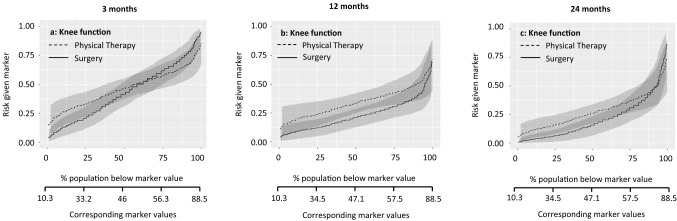
Methods: Data were analysed from the ESCAPE trial, which assessed the treatment of patients over 45 years old with a degenerative meniscal tear. The treatment outcome of interest was a clinically relevant improvement on the International Knee Documentation Committee Subjective Knee Form at 3, 12, and 24 months follow-up. Logistic regression models were developed to predict the outcome using baseline characteristics (markers), the treatment (meniscal surgery or physical therapy), and a marker-by-treatment interaction term. Interactions with p < 0.10 were considered as potential treatment selection markers and used these to develop predictiveness curves which provide thresholds to identify marker-based differences in clinical outcomes between the two treatments.
Results: Potential treatment selection markers included general physical health, pain during activities, knee function, BMI, and age. While some marker-based thresholds could be identified at 3, 12, and 24 months follow-up, none of the baseline characteristics were consistent markers at all three follow-up times.
Conclusion: This novel in-depth analysis did not result in clear clinical subgroups of patients who are substantially more likely to benefit from either surgery or physical therapy. However, this study may serve as an exemplar for other orthopaedic trials to investigate the heterogeneity in treatment effect. It will help clinicians to quantify the additional benefit of one treatment over another at an individual level, based on the patient's baseline characteristics.
Level of evidence: II.
Keywords: Exercise; Healthcare; Individualized; Knee; Meniscus; Orthopedics; Prediction; Rehabilitation.
© 2022. The Author(s).
Conflict of interest statement
All authors completed the Unified Competing Interest form (available on request from the corresponding author) and declare: VG, NW, JN, and RP received financial support from The Netherlands Organization for Health Research and Development (in Dutch: ZonMw) for the submitted work; the Achmea Healthcare Foundation (in Dutch Stichting Achmea Gezondheidszorg fonds), Dutch Arthritis Society (in Dutch: ReumaNederland and the foundation of medical research at OLVG, Amsterdam, the Netherlands; no financial relationships with any organization that might have an interest in the submitted work in the previous three years; no other relationships or activities that could appear to have influenced the submitted work.
Figures



References
Publication types
MeSH terms
Grants and funding
LinkOut - more resources
Full Text Sources
Medical
