


Efficacy and safety of endoscopic sleeve gastroplasty and laparoscopic sleeve gastrectomy with 12+ months of adjuvant multidisciplinary support
- PMID: 35123409
- PMCID: PMC8817771
- DOI: 10.1186/s12875-022-01629-7
Efficacy and safety of endoscopic sleeve gastroplasty and laparoscopic sleeve gastrectomy with 12+ months of adjuvant multidisciplinary support
Abstract
Background: The laparoscopic sleeve gastrectomy (LSG) and the incisionless endoscopic sleeve gastroplasty (ESG) weight loss procedures require further investigation of their efficacy, safety and patient-centered outcomes in the Australian setting.
Methods: The aim was to examine the 6- and 12-month weight loss efficacy, safety, and weight-related quality of life (QoL) of adults with obesity who received the ESG or LSG bariatric procedure with 12+ months of adjuvant multidisciplinary pre- and postprocedural support. Data were from a two-arm prospective cohort study that followed patients from baseline to 12-months postprocedure from a medical center in Queensland. Percent excess weight loss (%EWL) was the primary outcome. Secondary outcomes were body composition (fat mass, fat-free mass, android:gynoid ratio, bone mineral content) via dual energy X-ray absorptiometry, weight-related QoL, lipid, glycemic, and hepatic biochemistry, and adverse events.
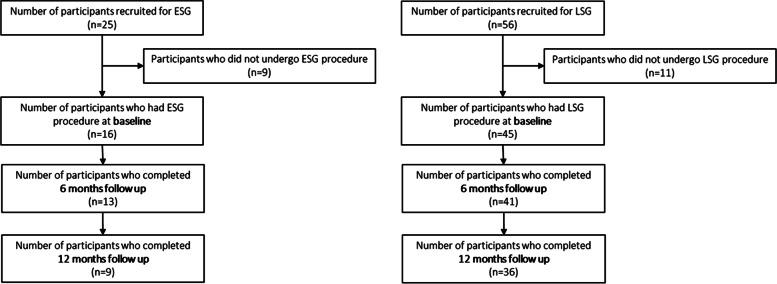
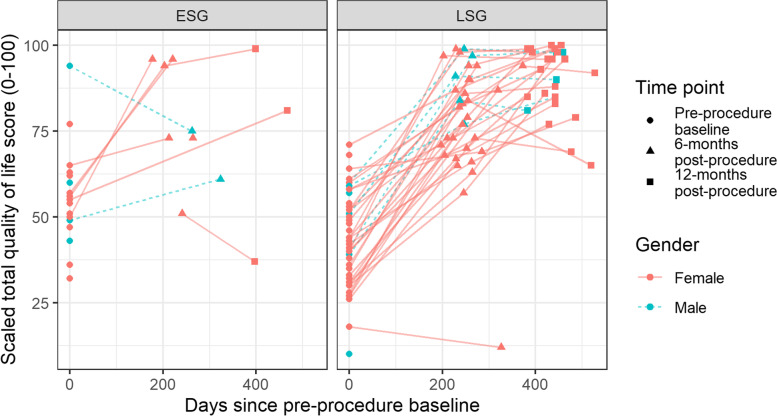
Results: 16 ESG (19% attrition; 81.2% female; aged:41.4 (SD: 10.4) years; BMI: 35.5 (SD: 5.2) kg/m2) and 45 LSG (9% attrition; 84.4% female; aged:40.4 (SD: 9.0) years; BMI: 40.7 (SD: 5.6) kg/m2) participants were recruited. At 12-months postprocedure, ESG %EWL was 57% (SD: 32%; p < 0.01) and LSG %EWL was 79% (SD: 24%; p < 0.001). ESG and LSG cohorts improved QoL (19.8% in ESG [p > 0.05]; 48.1% in LSG [p < 0.05]), liver function (AST: - 4.4 U/L in ESG [p < 0.05]; - 2.7 U/L in LSG [p < 0.05]), HbA1c (- 0.5% in ESG [p < 0.05]; - 0.1% in LSG [p < 0.05]) and triglycerides (- 0.6 mmol/L in ESG [p > 0.05]; - 0.4 mmol/L in LSG [P < 0.05]) at 12-months. Both cohorts reduced fat mass (p < 0.05). The ESG maintained but LSG decreased fat-free mass at 6-months (p < 0.05); and both cohorts lost fat-free mass at 12-months (p < 0.05). There were no adverse events directly related to the procedure. The ESG reported 25% mild-moderate adverse events possibly related to the procedure, and the LSG reported 27% mild-severe adverse events possibly related to the procedure.
Conclusions: In this setting, the ESG and LSG were safe and effective weight loss treatments for obese adults alongside multidisciplinary support. Patients who elected the ESG maintained fat-free mass at 6-months but both cohorts lost fat-free mass at 12-months postprocedure. Patients who elected the LSG had large and significant improvements to weight-related quality of life. Further well-powered studies are required to confirm these findings.
Trial registration: This study was registered prospectively at the Australia New Zealand Clinical Trials Registry on 06/03/2018, Registration Number ACTRN12618000337279 .
Keywords: Bariatric surgery; Endoscopy; Gastroplasty; Laparoscopy; Obesity.
© 2022. The Author(s).
Conflict of interest statement
GR (ESG proceduralist) was an ad hoc consultant for Apollo Endosurgery and was financially compensated for training specialists to perform the endoscopic sleeve gastroplasty procedure. There was no financial compensation provided by Apollo Endosurgery for this trial. As such, there is no conflict of interest.
FC was the CEO of the study site. FC received no salary or direct financial benefit for contributing to this study. FC was not involved with the implementation of the study beyond providing access for the researchers to the study site and medical records, did not have access to the dataset, and was not involved in the data analysis.
All other authors declare no potential or existing conflict of interest.
Figures
References
-
- Cameron AJ, Magliano DJ, Dunstan DW, et al. A bi-directional relationship between obesity and health-related quality of life: evidence from the longitudinal AusDiab study. Int J Obes. 2012;36(2):295–303. - PubMed
-
- National Health and Medical Research Council . Clinical practice guidelines for the management of overweight and obesity in adults, adolescents and children: draft clinical practice guidelines for primary healthcare professionals. Canberra: NHMRC; 2013.
-
- Dixon JB, Straznicky NE, Lambert EA, Schlaich MP, Lambert GW. Surgical approaches to the treatment of obesity. Nat Rev Gastroenterol Hepatol. 2011;8(8):429–437. - PubMed
-
- National Health Survey: first results, 2017–18. . Canberra: ABS; 2018.
Publication types
MeSH terms
Substances
LinkOut - more resources
Full Text Sources
Medical