


Estimating the effect of vaccination on antimicrobial-resistant typhoid fever in 73 countries supported by Gavi: a mathematical modelling study
- PMID: 35123673
- PMCID: PMC9021026
- DOI: 10.1016/S1473-3099(21)00627-7
Estimating the effect of vaccination on antimicrobial-resistant typhoid fever in 73 countries supported by Gavi: a mathematical modelling study
Abstract
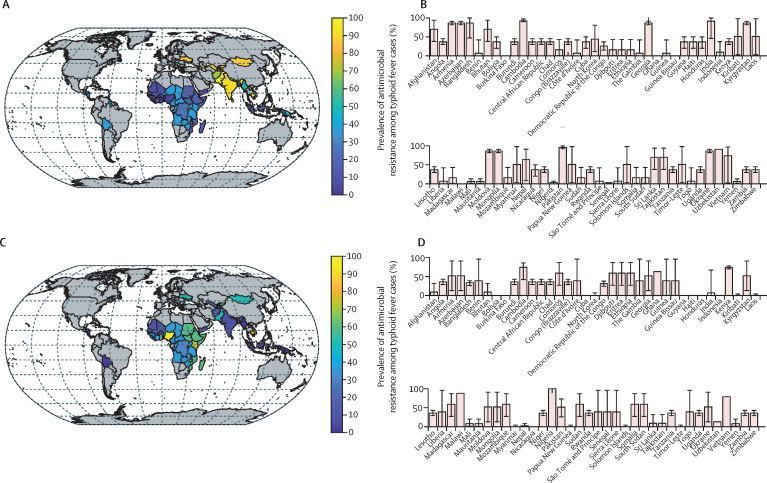
Background: Multidrug resistance and fluoroquinolone non-susceptibility (FQNS) are major concerns for the epidemiology and treatment of typhoid fever. The 2018 prequalification of the first typhoid conjugate vaccine (TCV) by WHO provides an opportunity to limit the transmission and burden of antimicrobial-resistant typhoid fever.
Methods: We combined output from mathematical models of typhoid transmission with estimates of antimicrobial resistance from meta-analyses to predict the burden of antimicrobial-resistant typhoid fever across 73 lower-income countries eligible for support from Gavi, the Vaccine Alliance. We considered FQNS and multidrug resistance separately. The effect of vaccination was predicted on the basis of forecasts of vaccine coverage. We explored how the potential effect of vaccination on the prevalence of antimicrobial resistance varied depending on key model parameters.
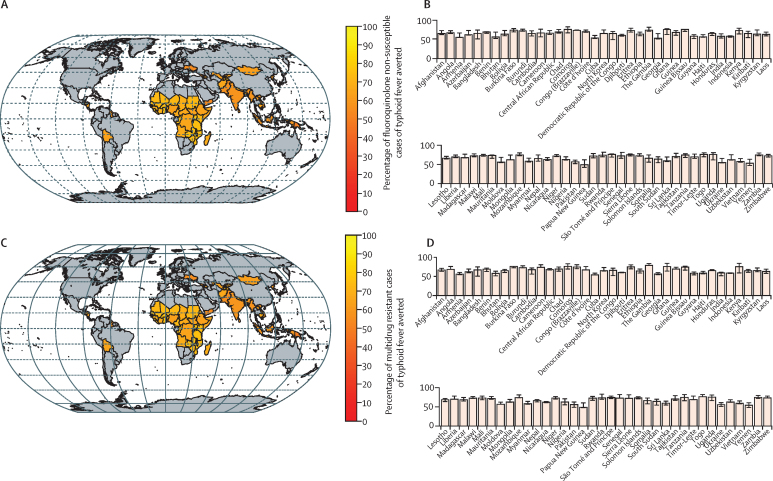
Findings: The introduction of routine immunisation with TCV at age 9 months with a catch-up campaign up to age 15 years was predicted to avert 46-74% of all typhoid fever cases in 73 countries eligible for Gavi support. Vaccination was predicted to reduce the relative prevalence of antimicrobial-resistant typhoid fever by 16% (95% prediction interval [PI] 0-49). TCV introduction with a catch-up campaign was predicted to avert 42·5 million (95% PI 24·8-62·8 million) cases and 506 000 (95% PI 187 000-1·9 million) deaths caused by FQNS typhoid fever, and 21·2 million (95% PI 16·4-26·5 million) cases and 342 000 (95% PI 135 000-1·5 million) deaths from multidrug-resistant typhoid fever over 10 years following introduction.
Interpretation: Our results indicate the benefits of prioritising TCV introduction for countries with a high avertable burden of antimicrobial-resistant typhoid fever.
Funding: The Bill & Melinda Gates Foundation.
Copyright © 2022 The Author(s). Published by Elsevier Ltd. This is an Open Access article under the CC BY 4.0 license. Published by Elsevier Ltd.. All rights reserved.
Conflict of interest statement
Declaration of interests RB is now employed by Merck Sharp & Dohme. AJP has received grants from National Institute for Health Research, the Bill & Melinda Gates Foundation, Wellcome Trust, and Astra Zeneca outside of the submitted work; chairs the UK Department of Health's Joint Committee on Vaccination and Immunisation; and is a member of WHO's Strategic Advisory Group of Experts. VEP has received reimbursement from Merck and Pfizer for travel expenses to Scientific Input Engagements unrelated to the subject of this Article; and is a member of the WHO's Immunization and Vaccine-related Implementation Research Advisory Committee. The views expressed in this manuscript are those of the authors and do not necessarily reflect the views of the Joint Committee on Vaccination and Immunisation, Department of Health, or WHO. All other authors declare no competing interests.
Figures
Comment in
-
Modelling vaccination to mitigate typhoid fever burden.Lancet Infect Dis. 2022 May;22(5):571-573. doi: 10.1016/S1473-3099(21)00678-2. Epub 2022 Feb 3. Lancet Infect Dis. 2022. PMID: 35123674 No abstract available.
References
-
- Cooke FJ, Wain J. The emergence of antibiotic resistance in typhoid fever. Travel Med Infect Dis. 2004;2:67–74. - PubMed
Publication types
MeSH terms
Substances
LinkOut - more resources
Full Text Sources
Research Materials
Miscellaneous
