


Anxiety and Depression Assessments in a Mouse Model of Congenital Blindness
- PMID: 35126047
- PMCID: PMC8816321
- DOI: 10.3389/fnins.2021.807434
Anxiety and Depression Assessments in a Mouse Model of Congenital Blindness
Abstract
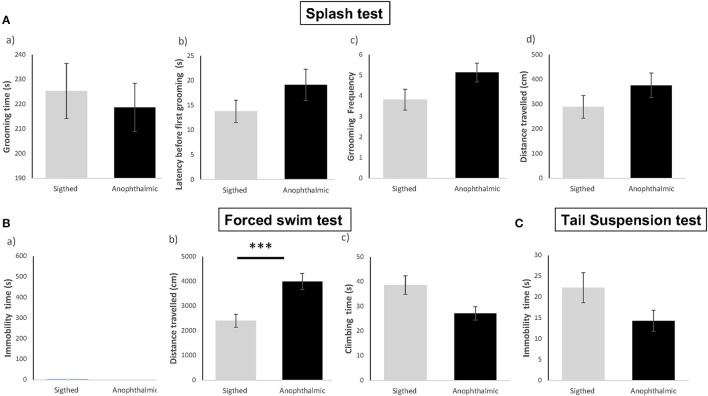
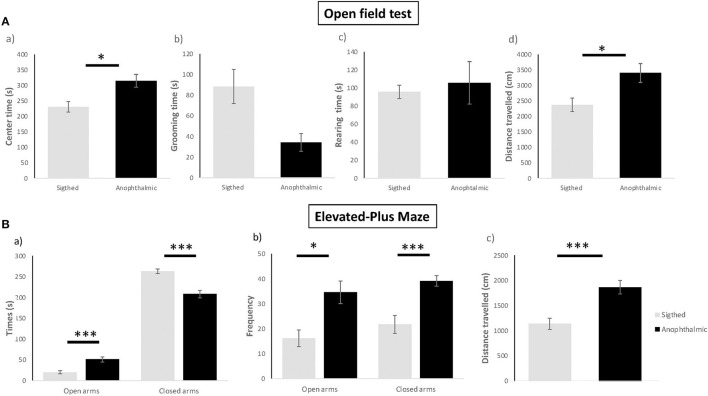
Previous studies have reported that visual impairment can affect the quality of life leading to mental health disorders. This study aimed to investigate associations between vision impairment, depression and anxiety using a mouse model of congenital blindness. We phenotyped 15 anophthalmic and 17 sighted adult mice in a battery of tests for anxiety and depression-like behaviors: open field test, elevated plus maze, coated test, splash test, and forced swim test. We found that: (1) Anxiety levels of the anophthalmic mice were significantly lower when compared with sighted mice, (2) Anophthalmic mice displayed more exploratory behaviors in a new environment than the sighted one, and (3) Depression levels between those groups were similar. In conclusion, this behavioral study showed that early visual deprivation lowers anxiety levels, associated with heightened exploratory activity, but does not induce depressive symptoms in a mouse model of congenital blindness, underlying several behavioral adaptations.
Keywords: anxiety; congenital blindness; depression; exploration; mice.
Copyright © 2022 Bouguiyoud, Roullet, Bronchti, Frasnelli and Al Aïn.
Conflict of interest statement
The authors declare that the research was conducted in the absence of any commercial or financial relationships that could be construed as a potential conflict of interest.
Figures
References
-
- Bolat N., Dogangün B., Yavuz M., Demir T., Kayaalp L. (2011). Depression and anxiety levels and self-concept characteristics of adolescents with congenital complete visual impairment. Turk. J. Psychiatry 22, 77–82. - PubMed
LinkOut - more resources
Full Text Sources
