


Deep Learning for Autism Diagnosis and Facial Analysis in Children
- PMID: 35126078
- PMCID: PMC8811190
- DOI: 10.3389/fncom.2021.789998
Deep Learning for Autism Diagnosis and Facial Analysis in Children
Retraction in
-
Retraction: Deep learning for autism diagnosis and facial analysis in children.Front Comput Neurosci. 2023 May 16;17:1215827. doi: 10.3389/fncom.2023.1215827. eCollection 2023. Front Comput Neurosci. 2023. PMID: 37261070 Free PMC article.
Abstract
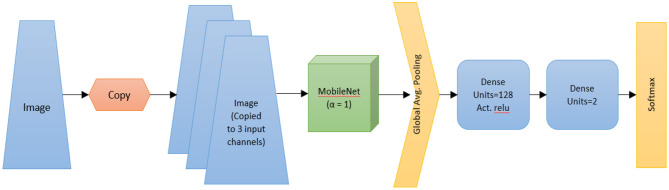
In this paper, we introduce a deep learning model to classify children as either healthy or potentially having autism with 94.6% accuracy using Deep Learning. Patients with autism struggle with social skills, repetitive behaviors, and communication, both verbal and non-verbal. Although the disease is considered to be genetic, the highest rates of accurate diagnosis occur when the child is tested on behavioral characteristics and facial features. Patients have a common pattern of distinct facial deformities, allowing researchers to analyze only an image of the child to determine if the child has the disease. While there are other techniques and models used for facial analysis and autism classification on their own, our proposal bridges these two ideas allowing classification in a cheaper, more efficient method. Our deep learning model uses MobileNet and two dense layers to perform feature extraction and image classification. The model is trained and tested using 3,014 images, evenly split between children with autism and children without it; 90% of the data is used for training and 10% is used for testing. Based on our accuracy, we propose that the diagnosis of autism can be done effectively using only a picture. Additionally, there may be other diseases that are similarly diagnosable.
Keywords: autism; children; deep learning; diagnosis; facial image analysis.
Copyright © 2022 Hosseini, Beary, Hadsell, Messersmith and Soltanian-Zadeh.
Conflict of interest statement
The authors declare that the research was conducted in the absence of any commercial or financial relationships that could be construed as a potential conflict of interest.
Figures
References
-
- Austimspeaks (2019). What Is Autism? Austimspeaks. Available online at: https://www.autismspeaks.org/what-autism (accessed March 11, 2020).
-
- CBS News (2017). Is it Autism? Facial Features That Show Disorder. CBS News. Available online at: https://www.cbsnews.com/pictures/is-it-autism-facial-features-that-show-... (accessed March 12, 2020).
-
- El-Baz A., Casanova M. F., Gimel'farb G., Mott M., Switwala A. E. (2007). A new image analysis approach for automatic classification of autistic brains, in 2007 4th IEEE International Symposium on Biomedical Imaging: From Nano to Macro (Arlington, VA: IEEE; ), 352–355. 10.1109/ISBI.2007.356861 - DOI
Publication types
LinkOut - more resources
Full Text Sources
