


Outcomes and Disease Spectrum of LBW Neonates in a Secondary Health Facility
- PMID: 35126962
- PMCID: PMC8813240
- DOI: 10.1155/2022/9974636
Outcomes and Disease Spectrum of LBW Neonates in a Secondary Health Facility
Abstract
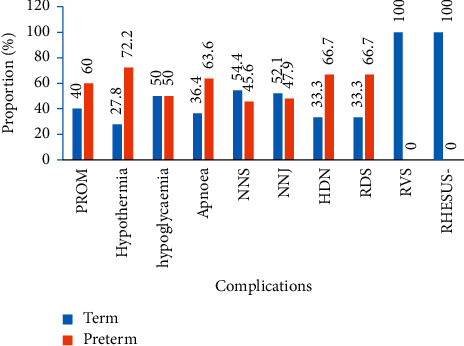
Globally, 30 million low birth weight (LBW) babies are born every year and 95% of them are from developing countries. LBW neonates are at a high risk of mortality, morbidity, and long-term disability. The objective of this study is to investigate outcomes and disease spectrum among low birth weight neonates. This is a prospective, observational study conducted on 540 neonates admitted in the Mother and Child Hospital, Akure, Ondo State, Nigeria, from 2017 to 2018. Questionnaire, interview, clinical, and diagnostic procedures were used as research tools. There were 137 low birth weight (LBW) neonates, with the mean mothers' age of 31.92 ± 6.60. Of the 540 neonates, 69 (50.4%) and 68 (49.6%) were term and preterm, respectively. There were 64 female neonates (46.7%) and 73 male neonates (53.3%). The mean weight of the neonates was 1.82 ± 0.44 kg, and mean number of days on admission was 6.42 ± 6.75 days. Neonatal sepsis (NNS) was the highest morbidity 51 (37.2%) among the LBW neonates, followed by prematurity 47 (34.4%) and neonatal jaundice (NNJ) 18 (13.1%). Sex ( χ 2 = 3.584, p=0.310), mode of delivery ( χ 2 = 4.669, p=0.198), and gestational age ( χ 2 = 3.904, p=0.272) were not a significant determinant of outcome among LBW neonates. Men were 2.36 times more likely to be preterm (OR = 2.36, 95% CL = 1.01-5.54, p=0.048) among LBW neonates. Outcomes of LBW neonates who were delivered by SVD were not significant compared to preterm delivered by CS (OR = 0.46, 95% CL = 0.13-1.65, p=0.096). Sixty percent (60%) of the mothers had Prolonged Rupture of Membranes (PROM). Morbidities such as hypothermia (72.2%), apnoea (63.6%), haemorrhagic disease of the newborn (HDN) (66.7%), and respiratory distress syndrome (RDS) (66.7%) were more observed with preterm LBW neonates. Importance of qualitative antenatal care (ANC) should be emphasized; anticipation and prevention of LBW births can help mitigate some of the problems they are prone to.
Copyright © 2022 Rosena Olubanke Oluwafemi et al.
Conflict of interest statement
The authors declare that they have no conflicts of interest.
Figures
References
-
- Oluwafemi R., Njokanma O., Disu E., Ogunlesi T. Maternal factors in the aetiology of small-for-gestational age among term Nigerian babies. Nigerian Journal of Paediatrics . 2013;40(2):119–124. doi: 10.4314/njp.v40i2.3. - DOI
Publication types
MeSH terms
LinkOut - more resources
Full Text Sources
Medical
