


Barker Hypothesis and Hypertension
- PMID: 35127619
- PMCID: PMC8814110
- DOI: 10.3389/fpubh.2021.767545
Barker Hypothesis and Hypertension
Abstract
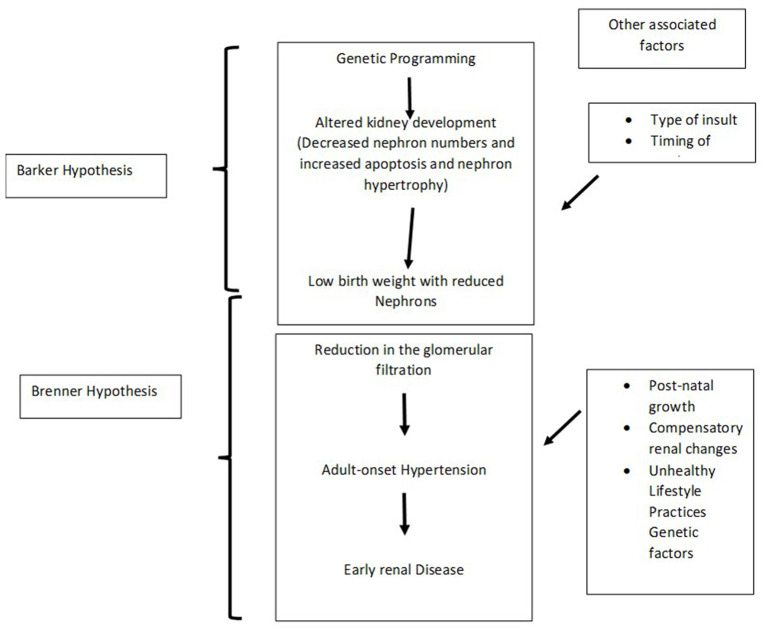
Early onset hypertension is one of many major medical disorders that have evolved over the current millennium across both the developing as well as the developed world. Though various mechanisms have been postulated for the evolution of hypertension in these individuals, one of the most relevant ones is that of low birth weight and its association with hypertension. Barker from historical evidence has postulated the foetal onset adult disease (FOAD) or Thrifty phenotype on Low Birth Weight (LBW) associated hypertension. Later, Brenner highlighted the importance of low nephron mass and future implications. In this review we elaborate the mechanisms that were postulated for LBW-related hypertension as well the potential antihypertensive therapy that may be used in these individuals.
Keywords: Barker hypothesis; Brenner hypothesis; hypertension; low birth weight; low nephron number.
Copyright © 2022 Jebasingh and Thomas.
Conflict of interest statement
The authors declare that the research was conducted in the absence of any commercial or financial relationships that could be construed as a potential conflict of interest.
Figures

References
-
- International Institute for Population Sciences - IIPS/India, ICF . India National Family Health Survey NFHS-4 2015-16. Mumbai, India: IIPS ICF (2017) Available online at: http://dhsprogram.com/pubs/pdf/FR339/FR339.pdf (accessed August 27, 2021).
Publication types
MeSH terms
LinkOut - more resources
Full Text Sources
Medical
