


Gut Microbiota Is a Potential Biomarker in Inflammatory Bowel Disease
- PMID: 35127797
- PMCID: PMC8814525
- DOI: 10.3389/fnut.2021.818902
Gut Microbiota Is a Potential Biomarker in Inflammatory Bowel Disease
Abstract
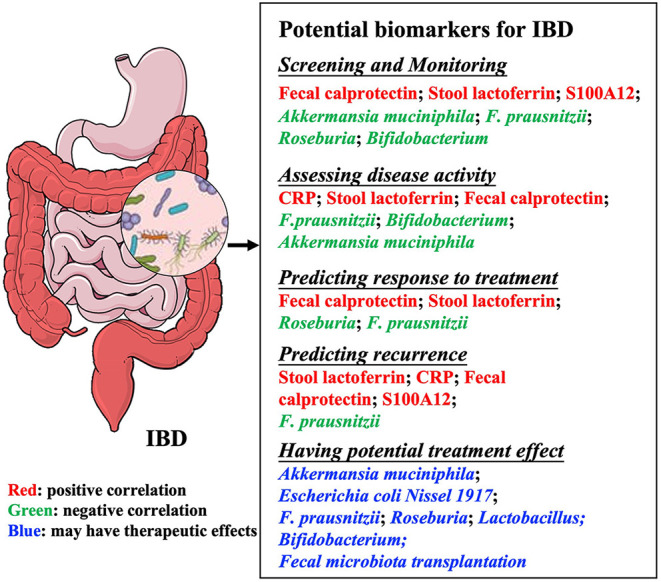
Inflammatory bowel disease (IBD), which includes ulcerative colitis (UC) and Crohn's disease (CD), is characterized by relapse and remission alternately. It remains a great challenge to diagnose and assess disease activity during IBD due to the lack of specific markers. While traditional biomarkers from plasma and stool, such as C-reactive protein (CRP), fecal calprotectin (FC), and S100A12, can be used to measure inflammation, they are not specific to IBD and difficult to determine an effective cut-off value. There is consensus that gut microbiota is crucial for intestinal dysbiosis is closely associated with IBD etiopathology and pathogenesis. Multiple studies have documented differences in the composition of gut microbiota between patients with IBD and healthy individuals, particularly regarding microbial diversity and relative abundance of specific bacteria. Patients with IBD have higher levels of Proteobacteria and lower amounts of Bacteroides, Eubacterium, and Faecalibacterium than healthy individuals. This review summarizes the pros and cons of using traditional and microbiota biomarkers to assess disease severity and treatment outcomes and addresses the possibility of using microbiota-focused interventions during IBD treatment. Understanding the role of microbial biomarkers in the assessment of disease activity and treatment outcomes has the potential to change clinical practice and lead to the development of more personalized therapies.
Keywords: Crohn's disease; biomarkers; fecal microbiota transplantation; gut microbiome; inflammatory bowel disease; ulcerative colitis.
Copyright © 2022 Guo, Huang, Xu, Xu, Liu, Zhao, Wang, Huang, Peng, Chen, Nie, Zhou and Zhou.
Conflict of interest statement
The authors declare that the research was conducted in the absence of any commercial or financial relationships that could be construed as a potential conflict of interest.
Figures
References
Publication types
LinkOut - more resources
Full Text Sources
Research Materials
Miscellaneous
