


Prevalence of depression and anxiety and associated factors among geriatric orthopedic trauma inpatients: A cross-sectional study
- PMID: 35127906
- PMCID: PMC8790454
- DOI: 10.12998/wjcc.v10.i3.919
Prevalence of depression and anxiety and associated factors among geriatric orthopedic trauma inpatients: A cross-sectional study
Abstract
Background: Common mental disorders such as anxiety and depression in geriatric orthopedic trauma patients have received little attention in research.
Aim: To investigate the prevalence of emotional disorders among geriatric orthopedic trauma patients and identify demographic, social and clinical risk factors.
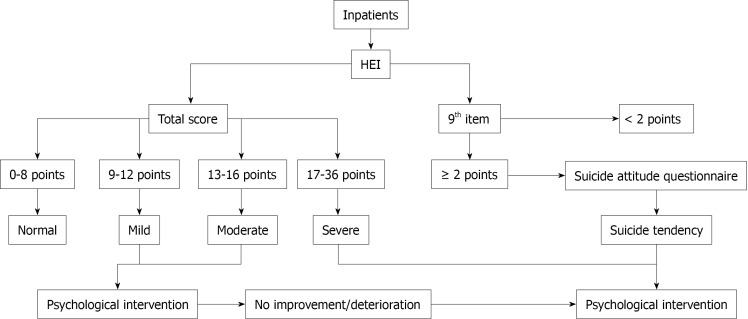
Methods: This cross-sectional study was performed in geriatric patients (aged ≥ 60 years, both sexes) with orthopedic trauma admitted to a level I trauma center between May 2015 and December 2017. Demographic, social, and clinical characteristics were described. Huaxi Emotional-Distress Index (HEI) was used to evaluate the severity of anxiety and depression status. Differences in continuous variables were tested using the t-test, and differences in categorical variables were assessed using the Pearson χ 2 test. Binary logistic regression analyses were used to identify the factors associated with a HEI score > 8.
Results: Among the 966 patients, 487 were male and 479 were female, with a mean age of 70.2 ± 7.1 years. The age ranged from 60 to 90 years. Seventy-five patients had an HEI score > 8, accounting for about 7.8% of all patients. A higher Injury Severity Score (4.17 ± 3.10 vs 7.96 ± 6.68, P < 0.001), higher Visual Analog Score (5.05 ± 1.09 vs 6.89 ±1.23, P < 0.001), number of chronic diseases (P < 0.001), injury type (P = 0.038), and education level (P = 0.001) were significantly associated with HEI score > 8. On logistic regression, a higher education level was a protective factor for emotional disorders (P = 0.047), whereas Injury Severity Score (P = 0.024), Visual Analog Score (P < 0.001), two or more chronic diseases (P < 0.001) were the related independent risk factors.
Conclusion: Emotional disorders are common in geriatric patients with orthopedic trauma. Clinicians should remain vigilant of emotional disorders in geriatric patients and screen for anxiety and depression in higher risk groups.
Keywords: Anxiety; Depression; Geriatric; Orthopedic; Trauma.
©The Author(s) 2022. Published by Baishideng Publishing Group Inc. All rights reserved.
Conflict of interest statement
Conflict-of-interest statement: The authors declare that they have no conflict of interest to disclose.
Figures
References
-
- McQueen M. Psychological Distress and Orthopaedic Trauma: Commentary on an article by Douglas S. Weinberg, MD, et al: "Psychiatric Illness Is Common Among Patients with Orthopaedic Polytrauma and Is Linked with Poor Outcomes". J Bone Joint Surg Am. 2016;98:e19. - PubMed
-
- Weinberg DS, Narayanan AS, Boden KA, Breslin MA, Vallier HA. Psychiatric Illness Is Common Among Patients with Orthopaedic Polytrauma and Is Linked with Poor Outcomes. J Bone Joint Surg Am. 2016;98:341–348. - PubMed
-
- Srahbzu M, Yigizaw N, Fanta T, Assefa D, Tirfeneh E. Prevalence of Depression and Anxiety and Associated Factors among Patients Visiting Orthopedic Outpatient Clinic at Tikur Anbessa Specialized Hospital, Addis Ababa, Ethiopia, 2017. J Psychiatry. 2018;21:450.
-
- Muscatelli S, Spurr H, OʼHara NN, OʼHara LM, Sprague SA, Slobogean GP. Prevalence of Depression and Posttraumatic Stress Disorder After Acute Orthopaedic Trauma: A Systematic Review and Meta-Analysis. J Orthop Trauma. 2017;31:47–55. - PubMed
-
- Jain R, Rishi R, Sharma B, Kiyawat V. Role of depression and its associating factors in indoor orthopaedic patients. Asian J Med Sci. 2015;6:70–76.
LinkOut - more resources
Full Text Sources
