


Germline variant testing in serrated polyposis syndrome
- PMID: 35128723
- PMCID: PMC9305167
- DOI: 10.1111/jgh.15791
Germline variant testing in serrated polyposis syndrome
Abstract
Background and aim: Serrated polyposis syndrome (SPS) is now known to be the commonest polyposis syndrome. Previous analyses for germline variants have shown no consistent positive findings. To exclude other polyposis syndromes, 2019 British Society of Gastroenterology (BSG) guidelines advise gene panel testing if the patient is under 50 years, there are multiple affected individuals within a family, or there is dysplasia within any of the polyps.
Methods: A database of SPS patients was established at the Oxford University Hospitals NHS Foundation Trust. Patients were referred for genetic assessment based on personal and family history and patient preference. The majority were tested for a hereditary colorectal cancer panel including MUTYH, APC, PTEN, SMAD4, BMPR1A, STK11, NTLH1, POLD1, POLE, GREM1 (40-kb duplication), PMS2, and Lynch syndrome mismatch repair genes.
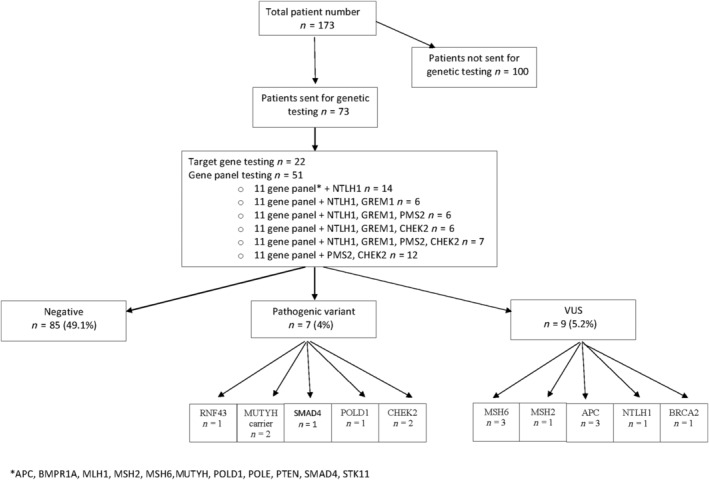
Results: One hundred and seventy-three patients were diagnosed with SPS based on World Health Organization 2019 criteria between February 2010 and December 2020. The mean age of diagnosis was 54.2 ± 16.8 years. Seventy-three patients underwent genetic testing and 15/73 (20.5%) were found to have germline variants, of which 7/73 (9.6%) had a pathogenic variant (MUTYH n = 2, SMAD4 n = 1, CHEK2 n = 2, POLD1 n = 1, and RNF43 n = 1). Only 60% (9/15) of these patients would have been recommended for gene panel testing according to current BSG guidelines.
Conclusions: A total of 20.5% of SPS patients tested were affected by heterozygous germline variants, including previously unreported associations with CHEK2 and POLD1. This led to a change in management in seven patients (9.6%). Current recommendations may miss SPS associated with germline variants, which is more common than previously anticipated.
Keywords: colon; genetics; polyposis.
© 2022 The Authors. Journal of Gastroenterology and Hepatology published by Journal of Gastroenterology and Hepatology Foundation and John Wiley & Sons Australia, Ltd.
Figures
References
-
- Leggett B, Whitehall V. Role of the serrated pathway in colorectal cancer pathogenesis. Gastroenterology 2010; 138: 2088–2100. - PubMed
-
- East JE, Saunders BP, Jass JR. Sporadic and syndromic hyperplastic polyps and serrated adenomas of the colon: classification, molecular genetics, natural history, and clinical management. Gastroenterol. Clin. North Am. 2008; 37: 25–46, v. - PubMed
-
- Snover DC. Update on the serrated pathway to colorectal carcinoma. Hum. Pathol. 2011; 42: 1–10. - PubMed
MeSH terms
Grants and funding
LinkOut - more resources
Full Text Sources
Medical
Research Materials
Miscellaneous
