


A specific microbiota signature is associated to various degrees of ulcerative colitis as assessed by a machine learning approach
- PMID: 35129058
- PMCID: PMC8820804
- DOI: 10.1080/19490976.2022.2028366
A specific microbiota signature is associated to various degrees of ulcerative colitis as assessed by a machine learning approach
Abstract
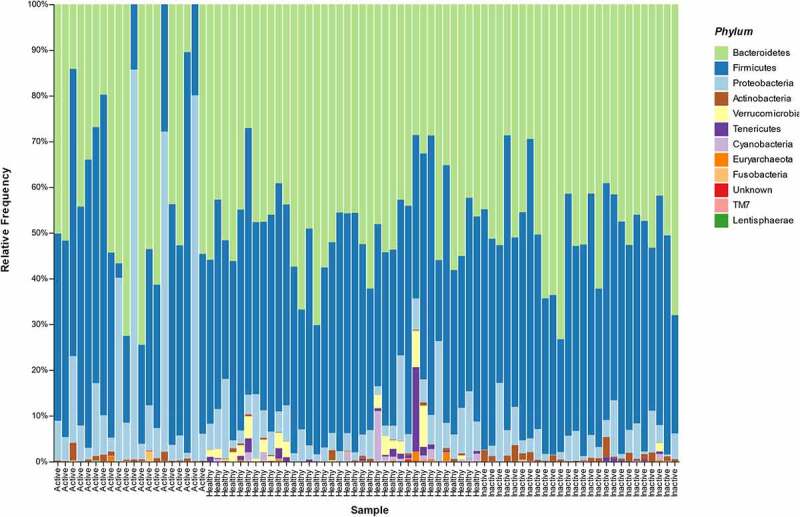
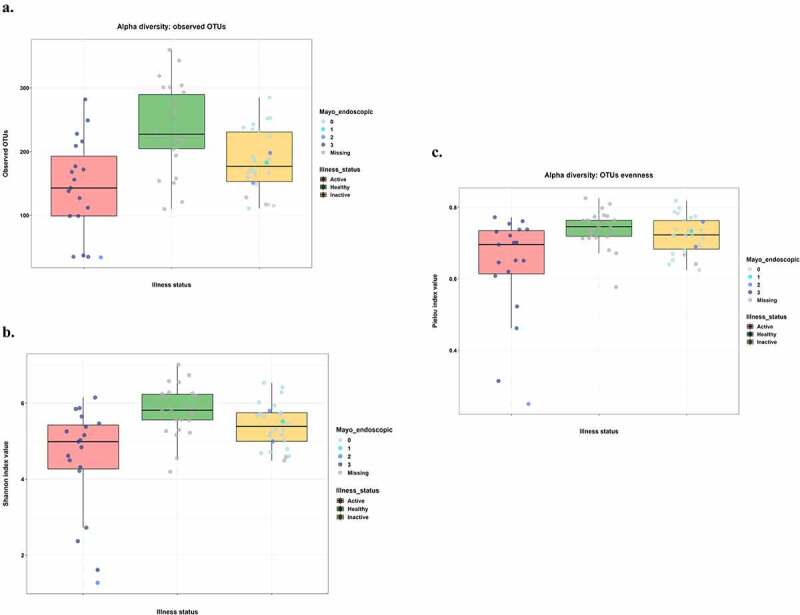
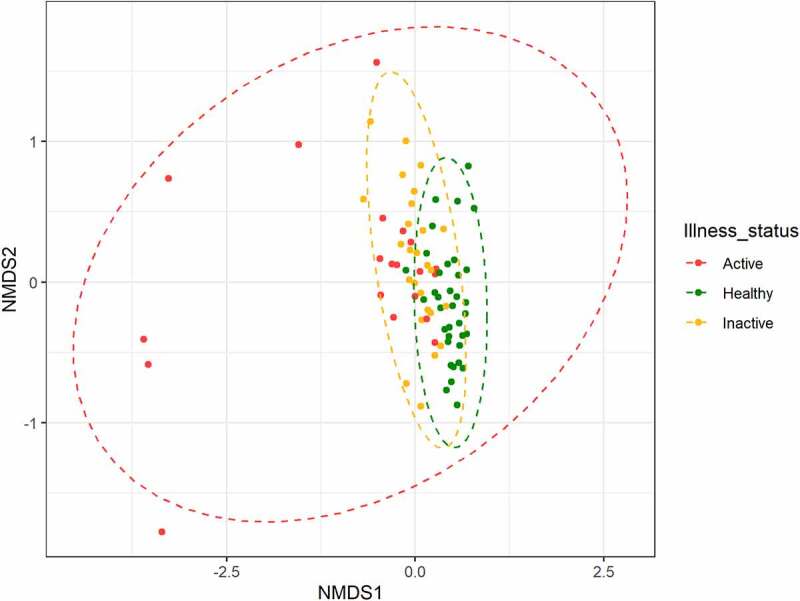
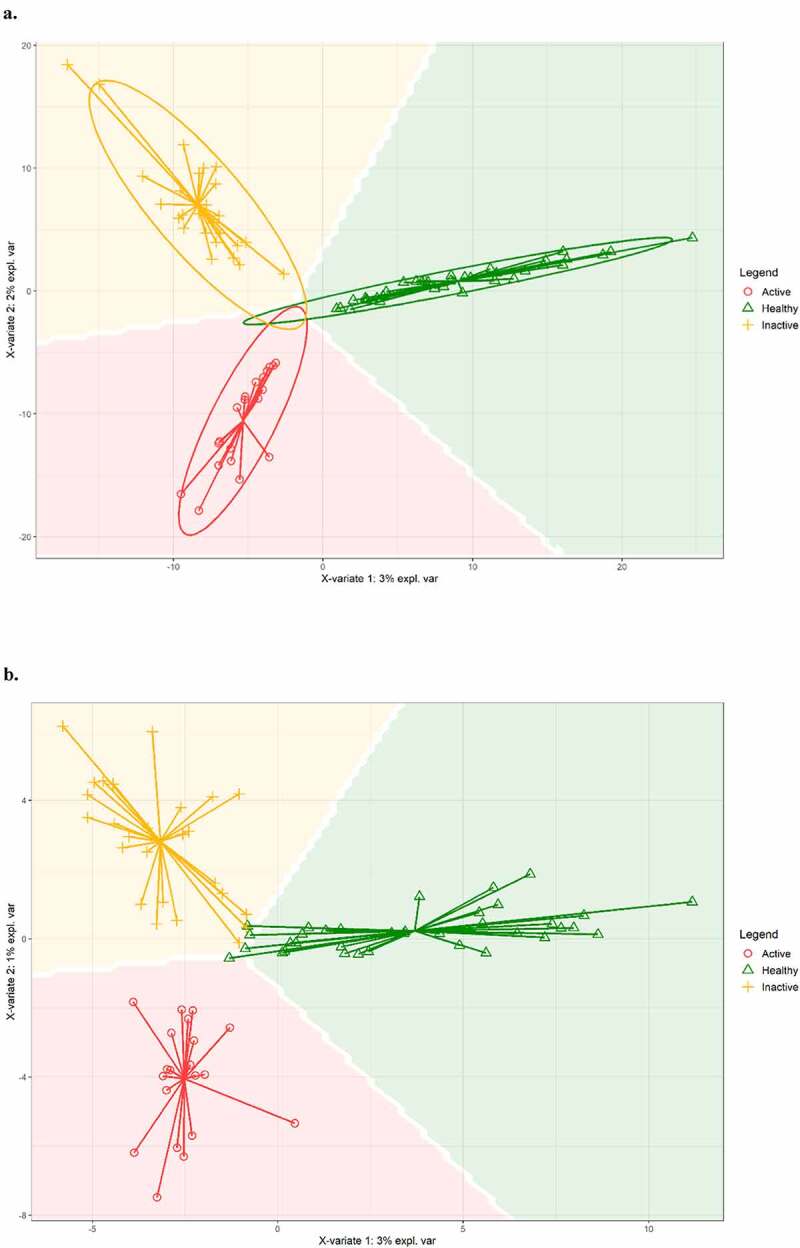
Ulcerative colitis (UC) is a complex immune-mediated disease in which the gut microbiota plays a central role, and may determine prognosis and disease progression. We aimed to assess whether a specific microbiota profile, as measured by a machine learning approach, can be associated with disease severity in patients with UC. In this prospective pilot study, consecutive patients with active or inactive UC and healthy controls (HCs) were enrolled. Stool samples were collected for fecal microbiota assessment analysis by 16S rRNA gene sequencing approach. A machine learning approach was used to predict the groups' separation. Thirty-six HCs and forty-six patients with UC (20 active and 26 inactive) were enrolled. Alpha diversity was significantly different between the three groups (Shannon index: p-values: active UC vs HCs = 0.0005; active UC vs inactive UC = 0.0273; HCs vs inactive UC = 0.0260). In particular, patients with active UC showed the lowest values, followed by patients with inactive UC, and HCs. At species level, we found high levels of Bifidobacterium adolescentis and Haemophilus parainfluenzae in inactive UC and active UC, respectively. A specific microbiota profile was found for each group and was confirmed with sparse partial least squares discriminant analysis, a machine learning-supervised approach. The latter allowed us to observe a perfect class prediction and group separation using the complete information (full Operational Taxonomic Unit table), with a minimal loss in performance when using only 5% of features. A machine learning approach to 16S rRNA data identifies a bacterial signature characterizing different degrees of disease activity in UC. Follow-up studies will clarify whether such microbiota profiling are useful for diagnosis and management.
Keywords: Inflammatory bowel disease; machine learning; microbiota; ulcerative colitis.
Conflict of interest statement
Brigida Barberio has received lecture or consultancy fees from Janssen, Sofar, Alfasigma, Procise, Doxapharma.
Ilaria Patuzzi: none; Alexander Ford: none; Davide Massimi: none; Giorgio Valle: none; Eleonora Sattin: none; Barbara Simionati: none; Elena Bertazzo: none; Fabiana Zingone: none.
Sonia Facchin has received lecture or consultancy fees from Grifols and Unifarco.
Edoardo Savarino has received lecture or consultancy fees from Abbvie, Amgen, Bristol-Myers Squibb, Fresenius Kabi, Grifols, Janssen, Johnson&Johnson, Innovamedica, Merck & Co, Novartis, Sandoz, Shire, SILA, Sofar, Takeda, Unifarco.
Figures
References
-
- Marinelli C, Savarino E, Inferrera M, Lorenzon G, Rigo A, Ghisa M, Facchin S, D’Incà R, Zingone F.. Factors influencing disability and quality of life during treatment: a cross-sectional study on IBD patients. Gastroenterol Res Pract. 2019;2019:5354320. doi: 10.1155/2019/5354320. - DOI - PMC - PubMed
-
- Barberio B, Zamani M, Black CJ, Savarino, EV, Ford , AC. Prevalence of anxiety and depression in inflammatory bowel disease: systematic review and meta-analysis. The Lancet Gastroenterology & Hepatology. 2021;6(5):359-370. - PubMed
MeSH terms
Substances
LinkOut - more resources
Full Text Sources
Medical
