. 2022 Sep;71(9):2255-2266.
doi: 10.1007/s00262-022-03162-z. Epub 2022 Feb 7.

Murine myeloid derived suppressor cells possess a range of suppressive mechanisms-Granzyme B is not among them

Affiliations

Murine myeloid derived suppressor cells possess a range of suppressive mechanisms-Granzyme B is not among them

Ellis Tibbs et al. Cancer Immunol Immunother. 2022 Sep.

Abstract

This paper addresses the controversy of Granzyme B (GzmB) expression by murine Myeloid Derived Suppressor Cells (MDSCs). MDSCs are a heterogenous immature myeloid population that are generated in chronic inflammatory pathologies for the purpose to suppress inflammatory responses. MDSCs express a multitude of factors to induce suppressive function such as PD-L1, reactive oxygen species (ROS), nitric oxide synthase (iNOS), and Arginase-1. Recently, Dufait et al. sought to demonstrate GzmB as an additional mechanism for suppression by MDSCs. They reported that murine MDSCs not only significantly express GzmB as well as Perforin (Prf1), but this expression is functionally important for tumor growth in vivo as well as tumor migration in vitro. We conducted experiments to address the same question but made confounding observations: MDSCs under stringent developmental process do not express GzmB. Our results show that not only GzmB protein is not produced at functional level, but the mRNA transcript is not detectable either. In fact, the GzmB protein found in the media of MDSC culture was due to T cells or natural killer cells contained in bone marrow and cultured alongside MDSCs. We strengthen this finding by genetically deleting GzmB from the myeloid lineage and measuring tumor burden compared to WT counterpart. Our results show no significant difference in tumor burden, suggesting that even if there is minor expression of GzmB, it is not produced at a functional amount to affect tumor growth. Therefore, this paper proposes alternative theories that align with the known understanding of GzmB expression and secretion.

Keywords: Granzyme B; Immune suppression; Myeloid derived suppressor cells.


Conflict of interest statement

The authors declare that they have no conflict of interest.

Figures
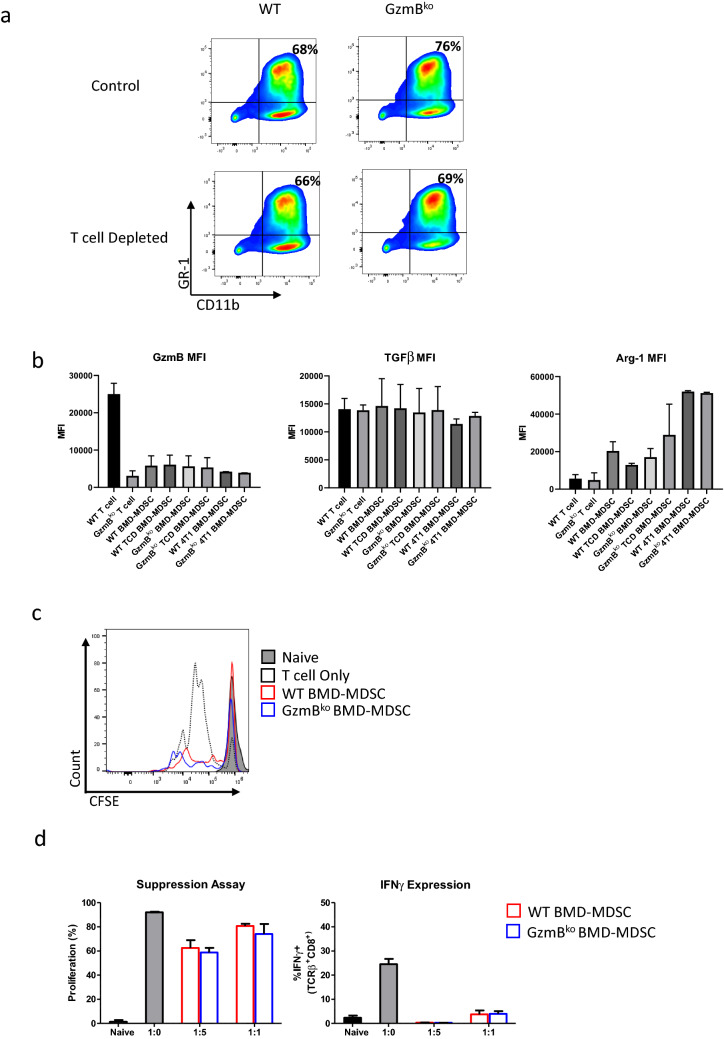
Fig. 1
Fig. 1
Murine BMD-MDSCs suppress T cells in vitro in a GzmB-independent fashion. a Representative plots showing important surface markers for cell subset selection. BMD-MDSCs were generated by bone marrow cells in B16-GMCSF conditioned media for 6 days. T cells and NK cells were depleted and labeled TCD. Depleting T cells and NK cells from BMD-MDSC culture does not significantly alter MDSC phenotype. b Representative graphs showing the Mean Fluorescence Intensity of labeled Flow Cytometry markers. c Representative plot showing suppression of T cell proliferation. d Representative graphs showing suppression of T cell proliferation or activation gated on CD8 T cells. T cells were labeled with CFSE, activated using αCD3-CD28, and cultured with or without indicated BMD-MDSCs
Fig. 2
Fig. 2
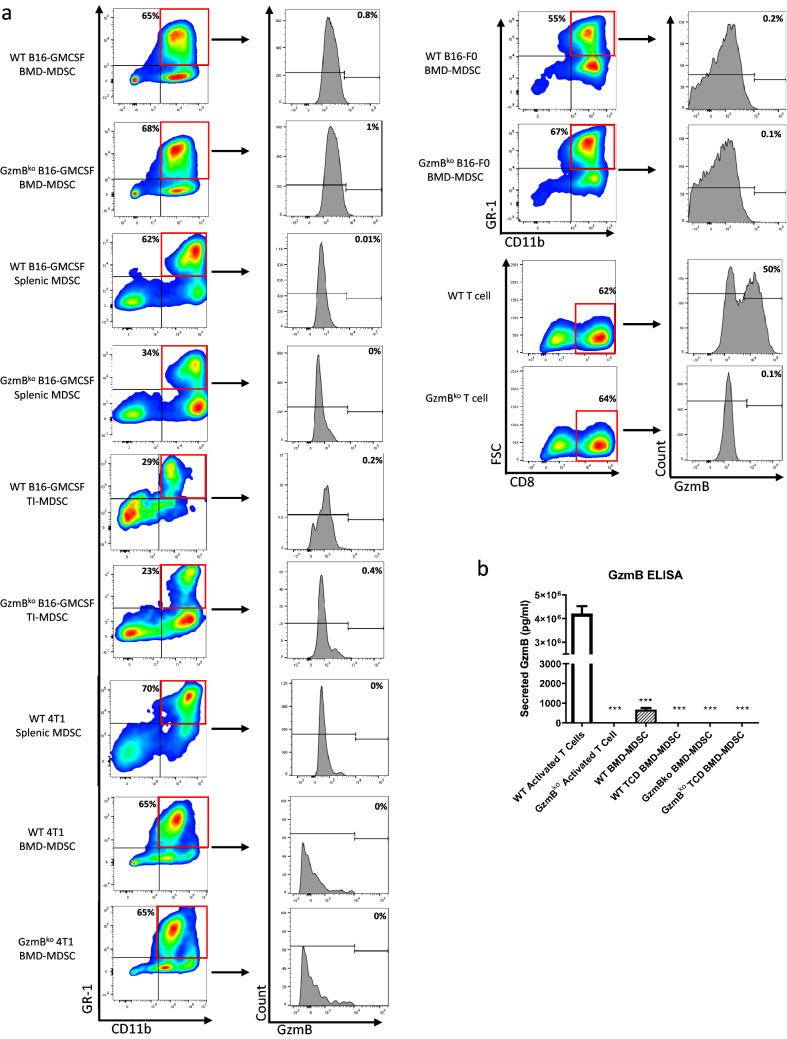
GzmB protein is not expressed in murine MDSCs in vivo or in vitro. a Representative plots showing important surface markers for cell subset selection. Representative histogram plot of GzmB expression. b Representative plot showing the concentration of secreted GzmB in the supernatant of indicated culture system. The graph shows the mean ± SEM of at least three data points. Experiments were performed twice. A student’s t-test was used to calculate the statistics. BMD-MDSCs were generated by bone marrow cells cultured in B16-GMCSF, B16-F0 supplemented with murine GMCSF, or 4T1 conditioned media for 6 days. Splenic and Tumor Infiltrating (TI) MDSCs were generated by euthanizing representative B16-GMCSF or 4T1 tumor bearing mice that have reached endpoint. TI-MDSCs were collected by percoll gradient selection followed by CD11b + sorting. T cells were generated by sorting for Pan-T cells from naïve mice and activating via αCD3-CD28 stimulation for 6 days
Fig. 3
Fig. 3
BMD-MDSC and Ex-vivo MDSCs do not express GzmB mRNA transcript. Summarizing graph showing fold change, as measured by quantitative PCR of GzmB, Arg-1, and iNOS of cultured cells and ex-vivo MDSCs from WT or GzmBko mice. The fold change for GzmB is normalized to activated GzmBko T cells. The fold change for Arg-1 and iNOS were normalized to activated WT T cells. The graph shows the mean ± SEM of at least three data points. Experiments were performed twice. A student’s t-test was used to calculate the statistics. BMD-MDSCs were generated by culturing bone marrow cells in B16-GMCSF conditioned media for 6 days. TCD indicates T cell and NK cell depleted bone marrow that was then cultured in tumor conditioned media. T cells were generated by sorting for Pan-T cells from naïve mice and activating via αCD3-CD28 stimulation for 6 days
Fig. 4
Fig. 4
Generation of Lyz2-Cre X GzmBflox mice and confirmation of specificity of Cre-LoxP system. a Schematic of mouse lines used to characterize the expression pattern. Lyz2-Cre driver line was crossed with GzmBflox/flox. In the presence of Cre recombinase, GzmB will be deleted. b A Lyz2 PCR yields a 700-bp for the cre recombinase allele (top). A 307-bp for the GzmB LoxP allele and 194-bp for WT lacking LoxP allele (middle). When the constitutive LoxP allele has been deleted PCR will yield a 338-bp allele. (bottom). c Representative flow cytometry plots showing GzmB expression is not altered in T cells following GzmB deletion from the myeloid lineage. Mice were injected intraperitoneally with IL-2 complex for 3 consecutive days. 5 days following first injection, mice spleens were harvested and stained for flow cytometry. Plots shown were gated on live single cells. d Representative flow cytometry plots showing no difference in GzmB expression in CD11b + GR-1 + cells in WT and Lyz2creGzmBfl/fl mice. Cells were collected following B16-GMCSF experimental endpoint
Fig. 5
Fig. 5
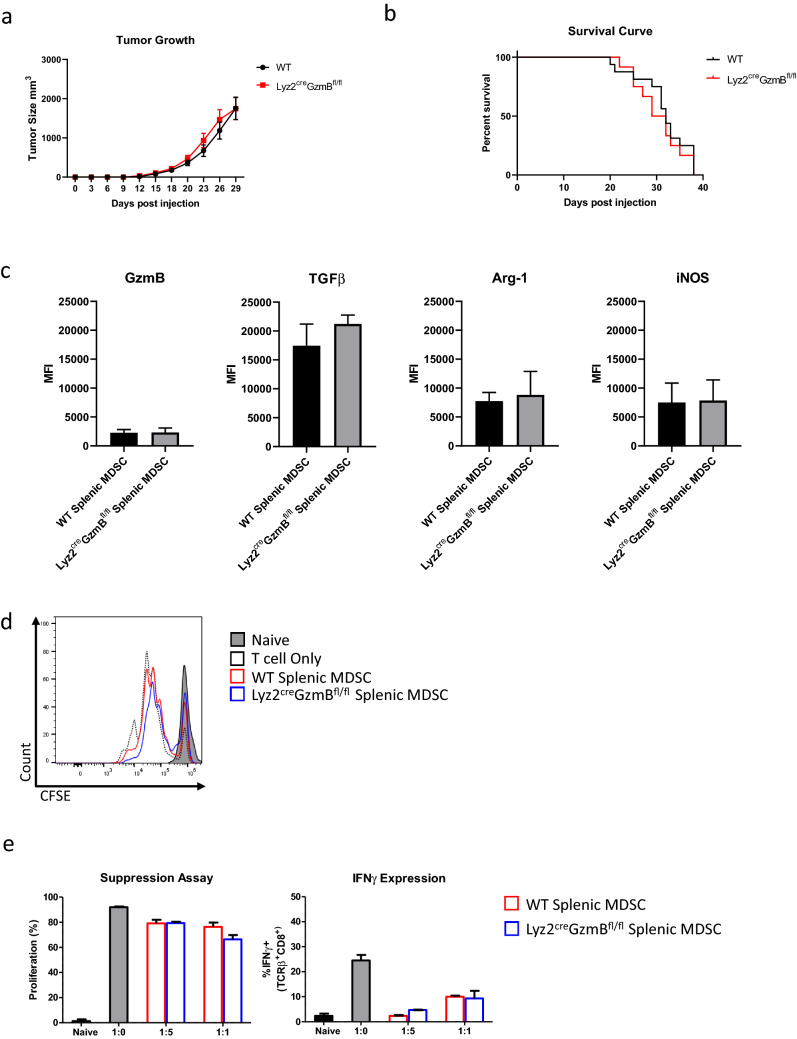
Myeloid cell-specific deletion of GzmB does not affect tumor growth in vivo. a Representative tumor growth curve of mice inoculated with B16-GMCSF as measured by caliper. The graph was shown until day 29. The mean ± SEM of at least 10 data points is shown. All experiments were repeated at least once. b Representative survival curve of mice inoculated with B16-GMCSF. Mice were either found succumb to tumor or sacrificed upon tumor size endpoint as established through IACUC protocol. n = 12–16 mice for each group pooled from 2 independent experiments. c Representative graphs showing the Mean Fluorescence Intensity (MFI) of labeled Flow Cytometry markers. d Representative plot showing suppression of T cell proliferation. e Representative graphs showing suppression of T cell proliferation or activation gated on CD8 T cells. Splenic MDSCs were harvested from sacrificed mice upon tumor size endpoint. T cells were labeled with CFSE, activated using αCD3-CD28, and cultured with or without indicated splenic MDSCs

References

    1. Bronte V et al (2016) Recommendations for myeloid-derived suppressor cell nomenclature and characterization standards. Nat Commun 7(1), Art. 1. 10.1038/ncomms12150 - PMC - PubMed
    1. Chalmin F, et al. Membrane-associated Hsp72 from tumor-derived exosomes mediates STAT3-dependent immunosuppressive function of mouse and human myeloid-derived suppressor cells. J Clin Invest. 2010;120(2):457–471. doi: 10.1172/JCI40483. - DOI - PMC - PubMed
    1. Lechner MG, Liebertz DJ, Epstein AL. Characterization of cytokine-induced myeloid-derived suppressor cells from normal human peripheral blood mononuclear cells. J Immunol. 2010;185(4):2273–2284. doi: 10.4049/jimmunol.1000901. - DOI - PMC - PubMed
    1. Xiang X, et al. TLR2-mediated expansion of MDSCs is dependent on the source of tumor exosomes. Am J Pathol. 2010;177(4):1606–1610. doi: 10.2353/ajpath.2010.100245. - DOI - PMC - PubMed
    1. Zhou Z, et al. Development and function of myeloid-derived suppressor cells generated from mouse embryonic and hematopoietic stem cells. Stem Cells. 2010;28(3):620–632. doi: 10.1002/stem.301. - DOI - PMC - PubMed

LinkOut - more resources