


Utility of Surgical Risk Calculators in Spine Surgery in Patients Aged Over 80 Years: Analysis of SpineSage and ACS NSQIP
- PMID: 35130102
- PMCID: PMC10538327
- DOI: 10.1177/21925682221074659
Utility of Surgical Risk Calculators in Spine Surgery in Patients Aged Over 80 Years: Analysis of SpineSage and ACS NSQIP
Abstract
Study design: Retrospective cohort study.
Objective: To validate the predictive accuracy of both the SpineSage and ACS-NSQIP surgical risk calculators in patients over the age of 80 years, undergoing spine surgery for any reason.
Methods: We included 210 consecutive patients treated with single-stage spine surgery at our institution between 2009 and 2019. The demographic details and preoperative characteristics of each patient were collected and reviewed for entry into both the SpineSage and ACS risk calculators. The estimated risk supplied by these calculators was compared to the observed rate of complications post-surgery. The main method of comparison was using receiver operating characteristic (ROC) curve analysis.
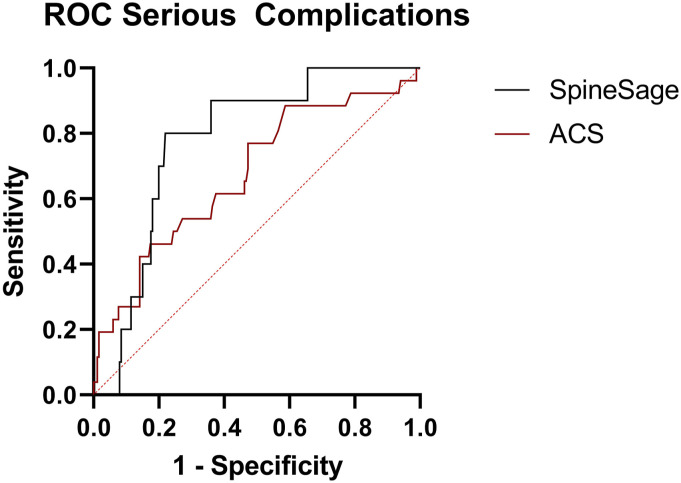
Results: Complications were identified in 51 patients (24%). Most patients underwent surgery for a degenerative cause (71%), with the majority of procedures performed on the lumbosacral spine (66%). Receiver operating characteristic (ROC) curves were calculated to compare the outcomes of each tool. Area under the curve (AUC) analysis showed similar predictive accuracy between SpineSage and ACS when predicting overall complications (0.688; P < .001 vs 0.634; P = .021). AUC analysis demonstrated that SpineSage had better predictive accuracy when estimating risk of major complications (0.778; P = .037 vs 0.675; P = .001).
Conclusion: For the prediction of risks associated with spine surgery in those aged >80 years, SpineSage appears to be preferable to the ACS-NSQIP surgical risk calculator in this single centre cohort, SpineSage was more accurate in predicting the risk of serious medical complications. The accuracy of both of these tools could still be improved upon.
Keywords: ACS; complications; elderly; invasiveness index; prediction; risk calculator; spine surgery; spinesage.
Conflict of interest statement
The author(s) declared no potential conflicts of interest with respect to the research, authorship, and/or publication of this article.
Figures
References
-
- O’Lynnger TM, Zuckerman SL, Morone PJ, et al. Trends for spine surgery for the elderly: Implications for access to healthcare in North America. Neurosurgery . 2015;77:S136–S141. - PubMed
-
- Li G, Patil CG, Lad SP, et al. Effects of age and comorbidities on complication rates and adverse outcomes after lumbar laminectomy in elderly patients. Spine . 2008;33:1250–1255. - PubMed
LinkOut - more resources
Full Text Sources
