A Review of Recurrent Neural Network-Based Methods in Computational Physiology
- PMID: 35130174
- PMCID: PMC10589904
- DOI: 10.1109/TNNLS.2022.3145365
A Review of Recurrent Neural Network-Based Methods in Computational Physiology
Abstract
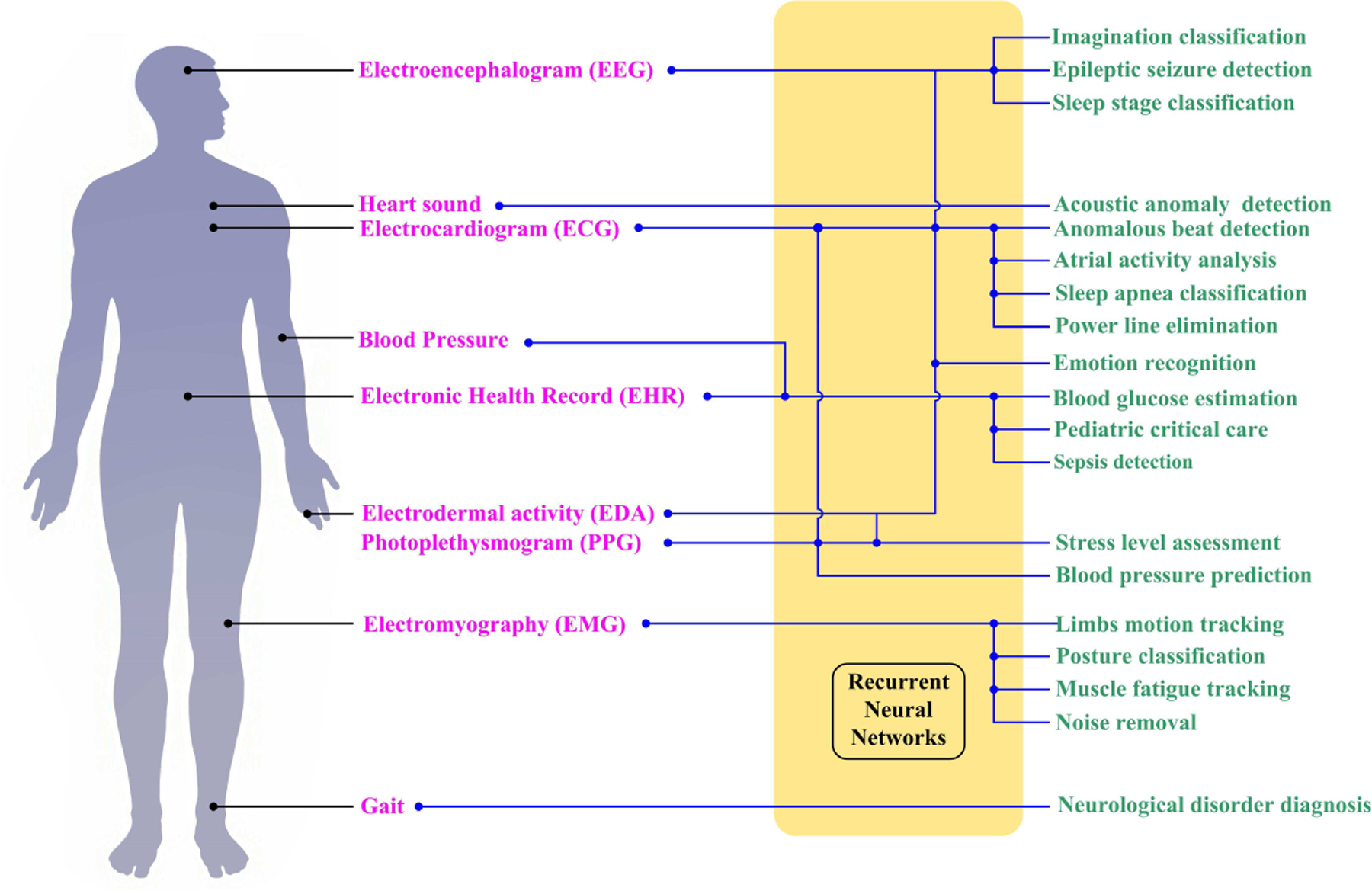
Artificial intelligence and machine learning techniques have progressed dramatically and become powerful tools required to solve complicated tasks, such as computer vision, speech recognition, and natural language processing. Since these techniques have provided promising and evident results in these fields, they emerged as valuable methods for applications in human physiology and healthcare. General physiological recordings are time-related expressions of bodily processes associated with health or morbidity. Sequence classification, anomaly detection, decision making, and future status prediction drive the learning algorithms to focus on the temporal pattern and model the nonstationary dynamics of the human body. These practical requirements give birth to the use of recurrent neural networks (RNNs), which offer a tractable solution in dealing with physiological time series and provide a way to understand complex time variations and dependencies. The primary objective of this article is to provide an overview of current applications of RNNs in the area of human physiology for automated prediction and diagnosis within different fields. Finally, we highlight some pathways of future RNN developments for human physiology.
Figures
References
-
- “Openai five benchmark: Results,” https://blog.openai.com/openai-five-benchmark-results/, 2018-August-06.
-
- Lipton ZC, Berkowitz J, and Elkan C, “A critical review of recurrent neural networks for sequence learning,” arXiv preprint arXiv:1506.00019, 2015.
-
- Khalifa Y, Mandic D, and Sejdić E, “A review of hidden markov models and recurrent neural networks for event detection and localization in biomedical signals,” Information Fusion, vol. 69, pp. 52–72, 2021.
-
- Chung J, Gulcehre C, Cho K, and Bengio Y, “Empirical evaluation of gated recurrent neural networks on sequence modeling,” arXiv preprint arXiv:1412.3555, 2014.
Publication types
MeSH terms
Grants and funding
LinkOut - more resources
Full Text Sources