Frailty Status Is a More Robust Predictor Than Age of Spinal Tumor Surgery Outcomes: A NSQIP Analysis of 4,662 Patients
- PMID: 35130424
- PMCID: PMC8987561
- DOI: 10.14245/ns.2142770.385
Frailty Status Is a More Robust Predictor Than Age of Spinal Tumor Surgery Outcomes: A NSQIP Analysis of 4,662 Patients
Abstract
Objective: The present study aimed to evaluate the effect of baseline frailty status (as measured by modified frailty index-5 [mFI-5]) versus age on postoperative outcomes of patients undergoing surgery for spinal tumors using data from a large national registry.
Methods: The National Surgical Quality Improvement Program database was used to collect spinal tumor resection patients' data from 2015 to 2019 (n = 4,662). Univariate and multivariate analyses for age and mFI-5 were performed for the following outcomes: 30-day mortality, major complications, unplanned reoperation, unplanned readmission, hospital length of stay (LOS), and discharge to a nonhome destination. Receiver operating characteristic (ROC) curve analysis was used to evaluate the discriminative performance of age versus mFI-5.
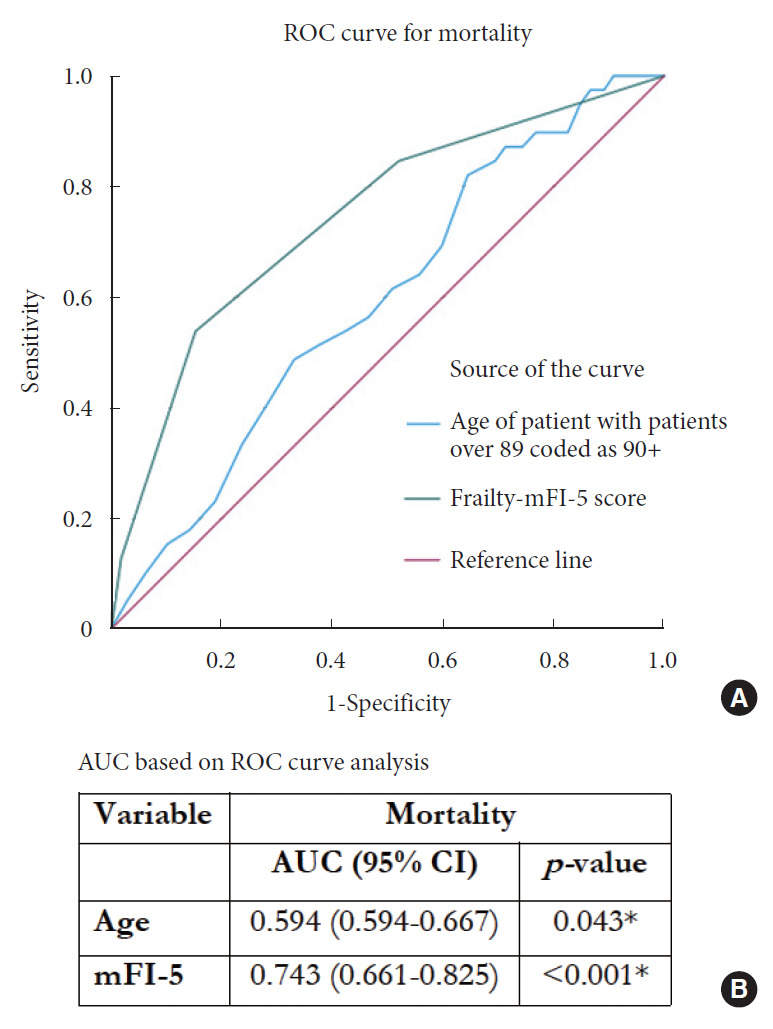
Results: Both univariate and multivariate analyses demonstrated that mFI-5 was a more robust predictor of worse postoperative outcomes as compared to age. Furthermore, based on categorical analysis of frailty tiers, increasing frailty was significantly associated with increased risk of adverse outcomes. 'Severely frail' patients were found to have the highest risk, with odds ratio 16.4 (95% confidence interval [CI],11.21-35.44) for 30-day mortality, 3.02 (95% CI, 1.97-4.56) for major complications, and 2.94 (95% CI, 2.32-4.21) for LOS. In ROC curve analysis, mFI-5 score (area under the curve [AUC] = 0.743) achieved superior discrimination compared to age (AUC = 0.594) for mortality.
Conclusion: Increasing frailty, as measured by mFI-5, is a more robust predictor as compared to age, for poor postoperative outcomes in spinal tumor surgery patients. The mFI-5 may be clinically used for preoperative risk stratification of spinal tumor patients.
Keywords: Age; Frailty; Modified frailty index-5; National Surgical Quality Improvement Project; Spinal tumors; Surgical outcomes.
Conflict of interest statement
The authors have nothing to disclose.
Figures

Comment in
-
Commentary on "Frailty Status Is a More Robust Predictor Than Age of Spinal Tumor Surgery Outcomes: A NSQIP Analysis of 4,662 Patients".Neurospine. 2022 Mar;19(1):63-64. doi: 10.14245/ns.2244110.055. Epub 2022 Mar 31. Neurospine. 2022. PMID: 35378582 Free PMC article. No abstract available.
References
-
- Mechtler LL, Nandigam K. Spinal cord tumors: new views and future directions. Neurol Clin. 2013;31:241–68. - PubMed
-
- Sharma M, Sonig A, Ambekar S, et al. Discharge dispositions, complications, and costs of hospitalization in spinal cord tumor surgery: analysis of data from the United States Nationwide Inpatient Sample, 2003-2010. Journal of neurosurgery. Spine. 2014;20:125–41. - PubMed
-
- Tihan T, Chi JH, McCormick PC, et al. Pathologic and epidemiologic findings of intramedullary spinal cord tumors. Neurosurg Clin N Am. 2006;17:7–11. - PubMed
-
- Kaloostian PE, Zadnik PL, Etame AB, et al. Surgical management of primary and metastatic spinal tumors. Cancer Control. 2014;21:133–9. - PubMed
LinkOut - more resources
Full Text Sources